

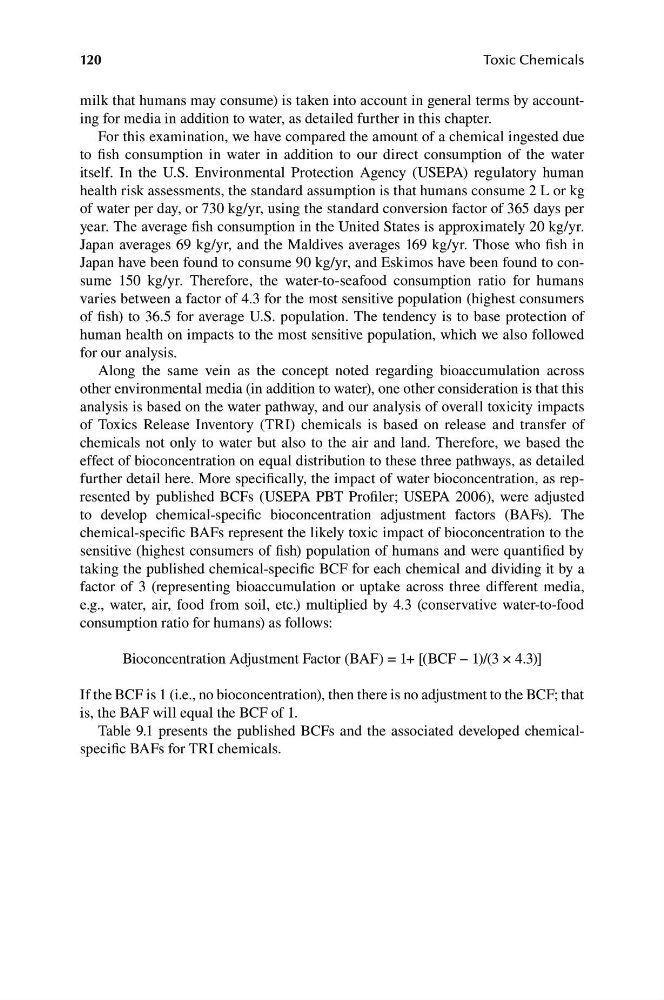
Bioconcentration Adjustment Factor (BAF) = 1+ [(BCF − 1)/(3 × 4.3)]
120
Toxic Chemicals
milk that humans may consume) is taken into account in general terms by accounting for media in addition to water, as detailed further in this chapter.
For this examination, we have compared the amount of a chemical ingested due
to fish consumption in water in addition to our direct consumption of the water
itself. In the U.S. Environmental Protection Agency (USEPA) regulatory human
health risk assessments, the standard assumption is that humans consume 2 L or kg
of water per day, or 730 kg/yr, using the standard conversion factor of 365 days per
year. The average fish consumption in the United States is approximately 20 kg/yr.
Japan averages 69 kg/yr, and the Maldives averages 169 kg/yr. Those who fish in
Japan have been found to consume 90 kg/yr, and Eskimos have been found to consume 150 kg/yr. Therefore, the water-to-seafood consumption ratio for humans
varies between a factor of 4.3 for the most sensitive population (highest consumers
of fish) to 36.5 for average U.S. population. The tendency is to base protection of
human health on impacts to the most sensitive population, which we also followed
for our analysis.
Along the same vein as the concept noted regarding bioaccumulation across
other environmental media (in addition to water), one other consideration is that this
analysis is based on the water pathway, and our analysis of overall toxicity impacts
of Toxics Release Inventory (TRI) chemicals is based on release and transfer of
chemicals not only to water but also to the air and land. Therefore, we based the
effect of bioconcentration on equal distribution to these three pathways, as detailed
further detail here. More specifically, the impact of water bioconcentration, as represented by published BCFs (USEPA PBT Profiler; USEPA 2006), were adjusted
to develop chemical-specific bioconcentration adjustment factors (BAFs). The
chemical-specific BAFs represent the likely toxic impact of bioconcentration to the
sensitive (highest consumers of fish) population of humans and were quantified by
taking the published chemical-specific BCF for each chemical and dividing it by a
factor of 3 (representing bioaccumulation or uptake across three different media,
e.g., water, air, food from soil, etc.) multiplied by 4.3 (conservative water-to-food
consumption ratio for humans) as follows:
If the BCF is 1 (i.e., no bioconcentration), then there is no adjustment to the BCF; that
is, the BAF will equal the BCF of 1.
Table 9.1 presents the published BCFs and the associated developed chemicalspecific BAFs for TRI chemicals.