

3.3
Screening Methodologies for Heat Tolerance
Identification and efficient screening procedure of traits associated with HS in
germplasm are preliminary actions taken before starting breeding for heat tolerance.
Challenges are faced throughout the field during screening for heat tolerance due to
the interaction of traits with other environmental factors. Even though there are few
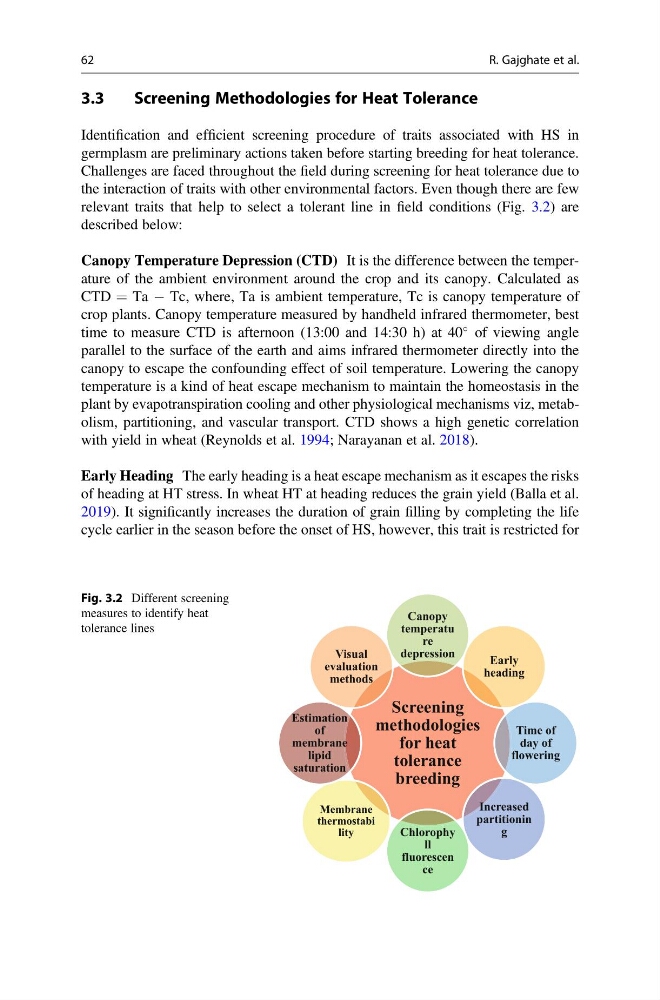
relevant traits that help to select a tolerant line in field conditions (Fig. 3.2) are
described below:
Canopy Temperature Depression (CTD) It is the difference between the temperature of the ambient environment around the crop and its canopy. Calculated as
CTD ¼ Ta À Tc, where, Ta is ambient temperature, Tc is canopy temperature of
crop plants. Canopy temperature measured by handheld infrared thermometer, best
time to measure CTD is afternoon (13:00 and 14:30 h) at 40
of viewing angle
parallel to the surface of the earth and aims infrared thermometer directly into the
canopy to escape the confounding effect of soil temperature. Lowering the canopy
temperature is a kind of heat escape mechanism to maintain the homeostasis in the
plant by evapotranspiration cooling and other physiological mechanisms viz, metabolism, partitioning, and vascular transport. CTD shows a high genetic correlation
with yield in wheat (Reynolds et al. 1994; Narayanan et al. 2018).
Early Heading The early heading is a heat escape mechanism as it escapes the risks
of heading at HT stress. In wheat HT at heading reduces the grain yield (Balla et al.
2019). It significantly increases the duration of grain filling by completing the life
cycle earlier in the season before the onset of HS, however, this trait is restricted for
Screening
methodologies
for heat
tolerance
breeding
Canopy
temperatu
re
depression
Early
heading
Time of
day of
flowering
Increased
partitionin
g
Chlorophy
ll
fluorescen
ce
Membrane
thermostabi
lity
Estimation
of
membrane
lipid
saturation
Visual
evaluation
methods
Fig. 3.2 Different screening
measures to identify heat
tolerance lines
62
R. Gajghate et al.
Screening Methodologies for Heat Tolerance
Identification and efficient screening procedure of traits associated with HS in
germplasm are preliminary actions taken before starting breeding for heat tolerance.
Challenges are faced throughout the field during screening for heat tolerance due to
the interaction of traits with other environmental factors. Even though there are few
relevant traits that help to select a tolerant line in field conditions (Fig. 3.2) are
described below:
Canopy Temperature Depression (CTD) It is the difference between the temperature of the ambient environment around the crop and its canopy. Calculated as
CTD ¼ Ta À Tc, where, Ta is ambient temperature, Tc is canopy temperature of
crop plants. Canopy temperature measured by handheld infrared thermometer, best
time to measure CTD is afternoon (13:00 and 14:30 h) at 40
of viewing angle
parallel to the surface of the earth and aims infrared thermometer directly into the
canopy to escape the confounding effect of soil temperature. Lowering the canopy
temperature is a kind of heat escape mechanism to maintain the homeostasis in the
plant by evapotranspiration cooling and other physiological mechanisms viz, metabolism, partitioning, and vascular transport. CTD shows a high genetic correlation
with yield in wheat (Reynolds et al. 1994; Narayanan et al. 2018).
Early Heading The early heading is a heat escape mechanism as it escapes the risks
of heading at HT stress. In wheat HT at heading reduces the grain yield (Balla et al.
2019). It significantly increases the duration of grain filling by completing the life
cycle earlier in the season before the onset of HS, however, this trait is restricted for
Screening
methodologies
for heat
tolerance
breeding
Canopy
temperatu
re
depression
Early
heading
Time of
day of
flowering
Increased
partitionin
g
Chlorophy
ll
fluorescen
ce
Membrane
thermostabi
lity
Estimation
of
membrane
lipid
saturation
Visual
evaluation
methods
Fig. 3.2 Different screening
measures to identify heat
tolerance lines
62
R. Gajghate et al.