

Singh (2009) and Balla et al. (2019). Some of the key effects of HS on the
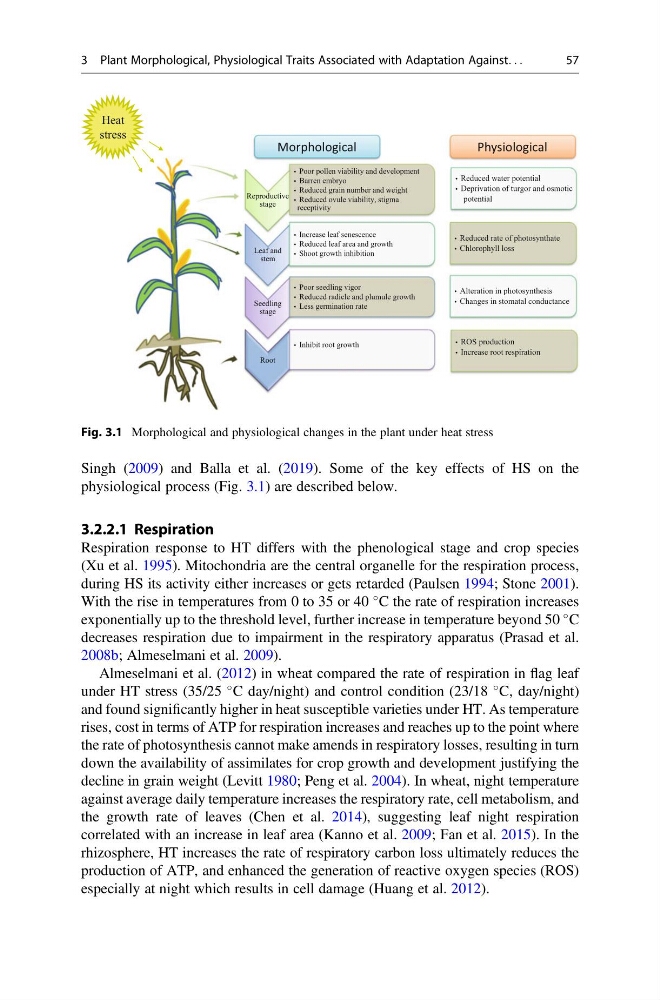
physiological process (Fig. 3.1) are described below.
3.2.2.1 Respiration
Respiration response to HT differs with the phenological stage and crop species
(Xu et al. 1995). Mitochondria are the central organelle for the respiration process,
during HS its activity either increases or gets retarded (Paulsen 1994; Stone 2001).
With the rise in temperatures from 0 to 35 or 40
C the rate of respiration increases
exponentially up to the threshold level, further increase in temperature beyond 50
C
decreases respiration due to impairment in the respiratory apparatus (Prasad et al.
2008b; Almeselmani et al. 2009).
Almeselmani et al. (2012) in wheat compared the rate of respiration in flag leaf
under HT stress (35/25
C day/night) and control condition (23/18
C, day/night)
and found significantly higher in heat susceptible varieties under HT. As temperature
rises, cost in terms of ATP for respiration increases and reaches up to the point where
the rate of photosynthesis cannot make amends in respiratory losses, resulting in turn
down the availability of assimilates for crop growth and development justifying the
decline in grain weight (Levitt 1980; Peng et al. 2004). In wheat, night temperature
against average daily temperature increases the respiratory rate, cell metabolism, and
the growth rate of leaves (Chen et al. 2014), suggesting leaf night respiration
correlated with an increase in leaf area (Kanno et al. 2009; Fan et al. 2015). In the
rhizosphere, HT increases the rate of respiratory carbon loss ultimately reduces the
production of ATP, and enhanced the generation of reactive oxygen species (ROS)
especially at night which results in cell damage (Huang et al. 2012).
Reproductive
stage
• Poor pollen viability and development
• Barren embryo
• Reduced grain number and weight
• Reduced ovule viability, stigma
receptivity
Leaf and
stem
• Increase leaf senescence
• Reduced leaf area and growth
• Shoot growth inhibition
Seedling
stage
• Poor seedling vigor
• Reduced radicle and plumule growth
• Less germination rate
Root
• Inhibit root growth
Morphological
Physiological
• Reduced rate of photosynthate
• Chlorophyll loss
• Reduced water potential
• Deprivation of turgor and osmotic
potential
• ROS production
• Increase root respiration
• Alteration in photosynthesis
• Changes in stomatal conductance
Heat
stress
Fig. 3.1 Morphological and physiological changes in the plant under heat stress
3 Plant Morphological, Physiological Traits Associated with Adaptation Against. . .
57
physiological process (Fig. 3.1) are described below.
3.2.2.1 Respiration
Respiration response to HT differs with the phenological stage and crop species
(Xu et al. 1995). Mitochondria are the central organelle for the respiration process,
during HS its activity either increases or gets retarded (Paulsen 1994; Stone 2001).
With the rise in temperatures from 0 to 35 or 40
C the rate of respiration increases
exponentially up to the threshold level, further increase in temperature beyond 50
C
decreases respiration due to impairment in the respiratory apparatus (Prasad et al.
2008b; Almeselmani et al. 2009).
Almeselmani et al. (2012) in wheat compared the rate of respiration in flag leaf
under HT stress (35/25
C day/night) and control condition (23/18
C, day/night)
and found significantly higher in heat susceptible varieties under HT. As temperature
rises, cost in terms of ATP for respiration increases and reaches up to the point where
the rate of photosynthesis cannot make amends in respiratory losses, resulting in turn
down the availability of assimilates for crop growth and development justifying the
decline in grain weight (Levitt 1980; Peng et al. 2004). In wheat, night temperature
against average daily temperature increases the respiratory rate, cell metabolism, and
the growth rate of leaves (Chen et al. 2014), suggesting leaf night respiration
correlated with an increase in leaf area (Kanno et al. 2009; Fan et al. 2015). In the
rhizosphere, HT increases the rate of respiratory carbon loss ultimately reduces the
production of ATP, and enhanced the generation of reactive oxygen species (ROS)
especially at night which results in cell damage (Huang et al. 2012).
Reproductive
stage
• Poor pollen viability and development
• Barren embryo
• Reduced grain number and weight
• Reduced ovule viability, stigma
receptivity
Leaf and
stem
• Increase leaf senescence
• Reduced leaf area and growth
• Shoot growth inhibition
Seedling
stage
• Poor seedling vigor
• Reduced radicle and plumule growth
• Less germination rate
Root
• Inhibit root growth
Morphological
Physiological
• Reduced rate of photosynthate
• Chlorophyll loss
• Reduced water potential
• Deprivation of turgor and osmotic
potential
• ROS production
• Increase root respiration
• Alteration in photosynthesis
• Changes in stomatal conductance
Heat
stress
Fig. 3.1 Morphological and physiological changes in the plant under heat stress
3 Plant Morphological, Physiological Traits Associated with Adaptation Against. . .
57