

element of animal feed and raw material for the manufacture of many industrial
products (Klopfenstein et al. 2013).
Wheat (Triticum aestivum L. em Thell) and maize (Zea mays L.) crops are very
sensitive to HT (Gupta et al. 2013; Tao et al. 2016). Zhao et al. (2017) observed with
no addition of fertilization, adaptive methods, and genetic improvement each degree
rise in above threshold temperature leads to decrease in average global yields by 6%
and 7.4% in wheat and maize, respectively. HS induces flower abortion, fertilization
failure, and shrink seed size in maize (Dupuis and Dumas 1990; Begcy et al. 2019).
End-of-season or “terminal” HS resulted in lower yields due to the direct effect on
grain number and dry weight (Macas et al. 2000; Guedira et al. 2002; Wollenweber
et al. 2003) in most severe case lead to complete kernel abortion and sterility in
maize (Shah et al. 2011).
The HS effects on the root zone of wheat, temperatures above 30
C inhibit plant
growth by reducing chlorophyll content, nutrient uptake (Huang et al. 2012),
obstruct plant water relations, decreases stomatal conductance (Behboudian et al.
1994), and altering chemical signaling (Wang et al. 2014). In maize root temperature
strongly affect the root tip growth (Nagel et al. 2009). Moreover, in various studies
showed the effect of HS on different growth stages of wheat and maize and their
response on various stages (Porter and Gawith 1999; Akman 2009). This chapter
focal point is to get an idea about the impact of HT on traits associated with heat
tolerance and to formulate management strategies for yield improvement in wheat
and maize crops under HS to develop HT tolerant varieties.
3.2
Plant Responses to Heat Stress
HS causes myriad, and often adverse, alterations in plant parts and processes leading
to morphophysiological changes, prohibiting the growth and yield in the plant
(McClung and Davis 2010). The requirement of optimum temperature for plants
varied with growth stages, crop season, and environments. Therefore, the response
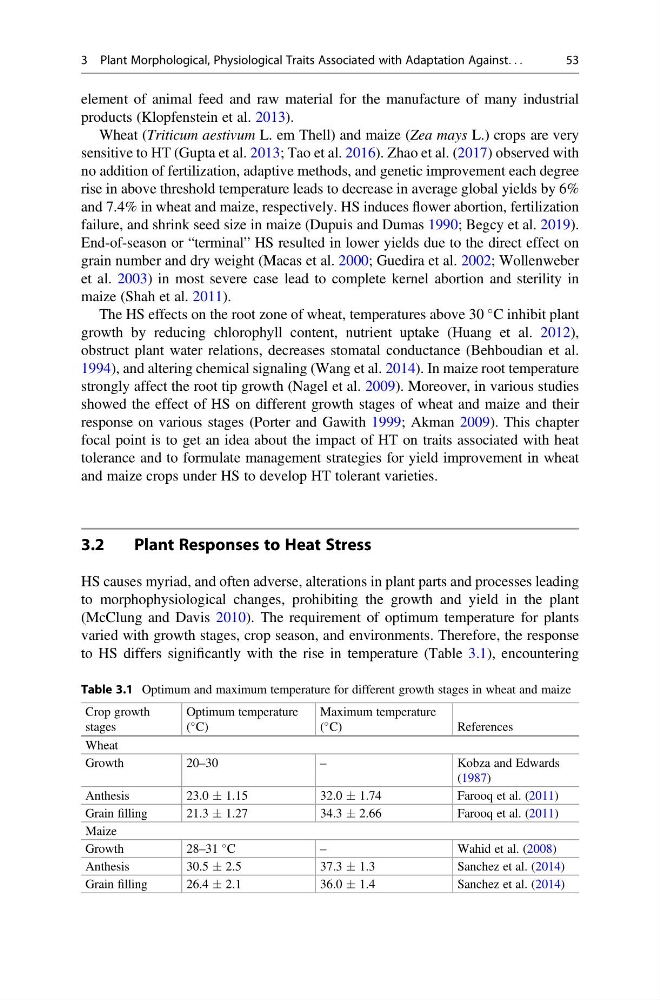
to HS differs significantly with the rise in temperature (Table 3.1), encountering
Table 3.1 Optimum and maximum temperature for different growth stages in wheat and maize
Crop growth
stages
Optimum temperature
(
C)
Maximum temperature
(
C)
References
Wheat
Growth
20–30
–
Kobza and Edwards
(1987)
Anthesis
23.0 Æ 1.15
32.0 Æ 1.74
Farooq et al. (2011)
Grain filling
21.3 Æ 1.27
34.3 Æ 2.66
Farooq et al. (2011)
Maize
Growth
28–31
C
–
Wahid et al. (2008)
Anthesis
30.5 Æ 2.5
37.3 Æ 1.3
Sanchez et al. (2014)
Grain filling
26.4 Æ 2.1
36.0 Æ 1.4
Sanchez et al. (2014)
3 Plant Morphological, Physiological Traits Associated with Adaptation Against. . .
53
products (Klopfenstein et al. 2013).
Wheat (Triticum aestivum L. em Thell) and maize (Zea mays L.) crops are very
sensitive to HT (Gupta et al. 2013; Tao et al. 2016). Zhao et al. (2017) observed with
no addition of fertilization, adaptive methods, and genetic improvement each degree
rise in above threshold temperature leads to decrease in average global yields by 6%
and 7.4% in wheat and maize, respectively. HS induces flower abortion, fertilization
failure, and shrink seed size in maize (Dupuis and Dumas 1990; Begcy et al. 2019).
End-of-season or “terminal” HS resulted in lower yields due to the direct effect on
grain number and dry weight (Macas et al. 2000; Guedira et al. 2002; Wollenweber
et al. 2003) in most severe case lead to complete kernel abortion and sterility in
maize (Shah et al. 2011).
The HS effects on the root zone of wheat, temperatures above 30
C inhibit plant
growth by reducing chlorophyll content, nutrient uptake (Huang et al. 2012),
obstruct plant water relations, decreases stomatal conductance (Behboudian et al.
1994), and altering chemical signaling (Wang et al. 2014). In maize root temperature
strongly affect the root tip growth (Nagel et al. 2009). Moreover, in various studies
showed the effect of HS on different growth stages of wheat and maize and their
response on various stages (Porter and Gawith 1999; Akman 2009). This chapter
focal point is to get an idea about the impact of HT on traits associated with heat
tolerance and to formulate management strategies for yield improvement in wheat
and maize crops under HS to develop HT tolerant varieties.
3.2
Plant Responses to Heat Stress
HS causes myriad, and often adverse, alterations in plant parts and processes leading
to morphophysiological changes, prohibiting the growth and yield in the plant
(McClung and Davis 2010). The requirement of optimum temperature for plants
varied with growth stages, crop season, and environments. Therefore, the response
to HS differs significantly with the rise in temperature (Table 3.1), encountering
Table 3.1 Optimum and maximum temperature for different growth stages in wheat and maize
Crop growth
stages
Optimum temperature
(
C)
Maximum temperature
(
C)
References
Wheat
Growth
20–30
–
Kobza and Edwards
(1987)
Anthesis
23.0 Æ 1.15
32.0 Æ 1.74
Farooq et al. (2011)
Grain filling
21.3 Æ 1.27
34.3 Æ 2.66
Farooq et al. (2011)
Maize
Growth
28–31
C
–
Wahid et al. (2008)
Anthesis
30.5 Æ 2.5
37.3 Æ 1.3
Sanchez et al. (2014)
Grain filling
26.4 Æ 2.1
36.0 Æ 1.4
Sanchez et al. (2014)
3 Plant Morphological, Physiological Traits Associated with Adaptation Against. . .
53