

has significantly improved interception efficiency and harvest index but not light
energy conversion competence, which depends on the effectiveness of photosynthesis and respiratory losses by the crop (Long et al. 2015). Moreover, the application of
recent plant biology approaches on the road to recover carbon fixation by photosynthesis can provide solutions for the sequestration of anthropogenic CO 2 (Jez et al.
2016).
Different approaches for optimizing and re-designing photosynthetic efficiency
include engineering Rubisco for higher specificity and activity, modulating Calvin–
Benson–Bassham cycle (CBBC) enzymes to getaway kinetic blockage, introducing
carbon-concentrating mechanisms (CCMs), and rewiring photorespiration (PR) into
energetically competent routes or routes that do not discharge CO 2 . Using de novo
synthetic pathways including tailored-engineered enzymes offer a platform for
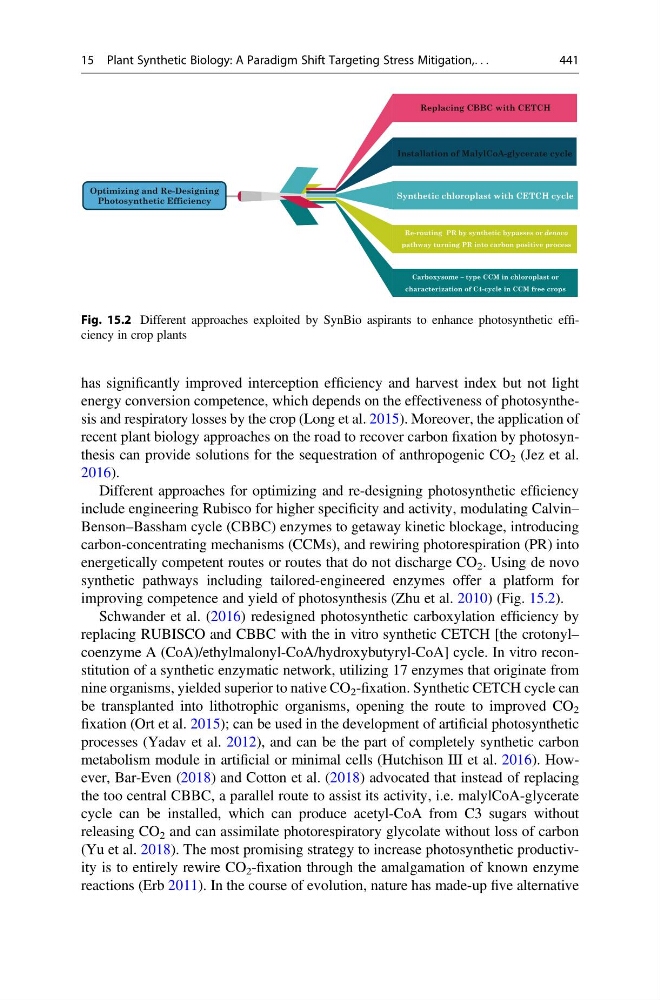
improving competence and yield of photosynthesis (Zhu et al. 2010) (Fig. 15.2).
Schwander et al. (2016) redesigned photosynthetic carboxylation efficiency by
replacing RUBISCO and CBBC with the in vitro synthetic CETCH [the crotonyl–
coenzyme A (CoA)/ethylmalonyl-CoA/hydroxybutyryl-CoA] cycle. In vitro reconstitution of a synthetic enzymatic network, utilizing 17 enzymes that originate from
nine organisms, yielded superior to native CO 2 -fixation. Synthetic CETCH cycle can
be transplanted into lithotrophic organisms, opening the route to improved CO 2
fixation (Ort et al. 2015); can be used in the development of artificial photosynthetic
processes (Yadav et al. 2012), and can be the part of completely synthetic carbon
metabolism module in artificial or minimal cells (Hutchison III et al. 2016). However, Bar-Even (2018) and Cotton et al. (2018) advocated that instead of replacing
the too central CBBC, a parallel route to assist its activity, i.e. malylCoA-glycerate
cycle can be installed, which can produce acetyl-CoA from C3 sugars without
releasing CO 2 and can assimilate photorespiratory glycolate without loss of carbon
(Yu et al. 2018). The most promising strategy to increase photosynthetic productivity is to entirely rewire CO 2 -fixation through the amalgamation of known enzyme
reactions (Erb 2011). In the course of evolution, nature has made-up five alternative
Replacing CBBC with CETCH
Installation of MalylCoA-glycerate cycle
Synthetic chloroplast with CETCH cycle
Re-routing PR by synthetic bypasses or denovo
pathway turning PR into carbon positive process
Carboxysome – type CCM in chloroplast or
characterization of C4-cycle in CCM free crops
Optimizing and Re-Designing
Photosynthetic Efficiency
Fig. 15.2 Different approaches exploited by SynBio aspirants to enhance photosynthetic efficiency in crop plants
15 Plant Synthetic Biology: A Paradigm Shift Targeting Stress Mitigation,. . .
441
energy conversion competence, which depends on the effectiveness of photosynthesis and respiratory losses by the crop (Long et al. 2015). Moreover, the application of
recent plant biology approaches on the road to recover carbon fixation by photosynthesis can provide solutions for the sequestration of anthropogenic CO 2 (Jez et al.
2016).
Different approaches for optimizing and re-designing photosynthetic efficiency
include engineering Rubisco for higher specificity and activity, modulating Calvin–
Benson–Bassham cycle (CBBC) enzymes to getaway kinetic blockage, introducing
carbon-concentrating mechanisms (CCMs), and rewiring photorespiration (PR) into
energetically competent routes or routes that do not discharge CO 2 . Using de novo
synthetic pathways including tailored-engineered enzymes offer a platform for
improving competence and yield of photosynthesis (Zhu et al. 2010) (Fig. 15.2).
Schwander et al. (2016) redesigned photosynthetic carboxylation efficiency by
replacing RUBISCO and CBBC with the in vitro synthetic CETCH [the crotonyl–
coenzyme A (CoA)/ethylmalonyl-CoA/hydroxybutyryl-CoA] cycle. In vitro reconstitution of a synthetic enzymatic network, utilizing 17 enzymes that originate from
nine organisms, yielded superior to native CO 2 -fixation. Synthetic CETCH cycle can
be transplanted into lithotrophic organisms, opening the route to improved CO 2
fixation (Ort et al. 2015); can be used in the development of artificial photosynthetic
processes (Yadav et al. 2012), and can be the part of completely synthetic carbon
metabolism module in artificial or minimal cells (Hutchison III et al. 2016). However, Bar-Even (2018) and Cotton et al. (2018) advocated that instead of replacing
the too central CBBC, a parallel route to assist its activity, i.e. malylCoA-glycerate
cycle can be installed, which can produce acetyl-CoA from C3 sugars without
releasing CO 2 and can assimilate photorespiratory glycolate without loss of carbon
(Yu et al. 2018). The most promising strategy to increase photosynthetic productivity is to entirely rewire CO 2 -fixation through the amalgamation of known enzyme
reactions (Erb 2011). In the course of evolution, nature has made-up five alternative
Replacing CBBC with CETCH
Installation of MalylCoA-glycerate cycle
Synthetic chloroplast with CETCH cycle
Re-routing PR by synthetic bypasses or denovo
pathway turning PR into carbon positive process
Carboxysome – type CCM in chloroplast or
characterization of C4-cycle in CCM free crops
Optimizing and Re-Designing
Photosynthetic Efficiency
Fig. 15.2 Different approaches exploited by SynBio aspirants to enhance photosynthetic efficiency in crop plants
15 Plant Synthetic Biology: A Paradigm Shift Targeting Stress Mitigation,. . .
441