

• A normal shape which gives them the appearance of an ordinary tree with the
main stem when they develop in ordinary environments, such as Tamarix
articulata (aphylla);
• A second form is characterized by an abundant branching when the feet are in an
environment subjected to stress conditions or in the case of accumulation of
alluvial sediments: This is the case of Tamarix gallica.
14.2.1 Tamarix Species Distribution in Algerian Areas
The Tamarix genus is native to Middle Asian deserts, where it evolved in riparian
areas with saline soils to Mongolia through China into India, across the Middle East
towards the eastern Mediterranean and southern Europe (such Spain), across northern Africa (Morocco, Senegal, and southern Algeria) and through eastern and
southern Africa (Baum 1978; Marlin et al. 2017). This genus has been described
for the first time by Willdenow in 1816 when he considered only 16 species
(Willdenow 1816). In 1978, Baum, conducted an extensive revision of the genus,
adding the Pakistani species and increasing the total to 55 species (Baum 1978). The
genus is characterized by considerable morphological and ecological similarity
among species, making it one of the most taxonomically challenging genera in the
angiosperms (Baum 1978; Marlin et al. 2017). In addition, Tamarix can grow in
varied climatic and edaphic conditions, and each species exhibits considerable
phenotypic variation under different circumstances (Thomson and Liu 1967; Marlin
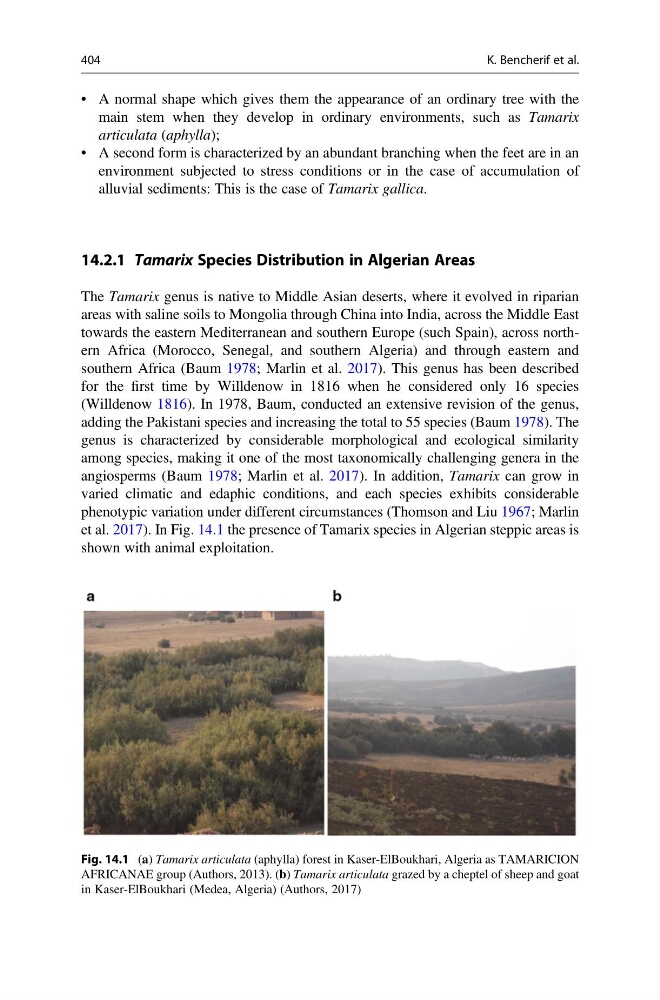
et al. 2017). In Fig. 14.1 the presence of Tamarix species in Algerian steppic areas is
shown with animal exploitation.
Fig. 14.1 (a) Tamarix articulata (aphylla) forest in Kaser-ElBoukhari, Algeria as TAMARICION
AFRICANAE group (Authors, 2013). (b) Tamarix articulata grazed by a cheptel of sheep and goat
in Kaser-ElBoukhari (Medea, Algeria) (Authors, 2017)
404
K. Bencherif et al.
main stem when they develop in ordinary environments, such as Tamarix
articulata (aphylla);
• A second form is characterized by an abundant branching when the feet are in an
environment subjected to stress conditions or in the case of accumulation of
alluvial sediments: This is the case of Tamarix gallica.
14.2.1 Tamarix Species Distribution in Algerian Areas
The Tamarix genus is native to Middle Asian deserts, where it evolved in riparian
areas with saline soils to Mongolia through China into India, across the Middle East
towards the eastern Mediterranean and southern Europe (such Spain), across northern Africa (Morocco, Senegal, and southern Algeria) and through eastern and
southern Africa (Baum 1978; Marlin et al. 2017). This genus has been described
for the first time by Willdenow in 1816 when he considered only 16 species
(Willdenow 1816). In 1978, Baum, conducted an extensive revision of the genus,
adding the Pakistani species and increasing the total to 55 species (Baum 1978). The
genus is characterized by considerable morphological and ecological similarity
among species, making it one of the most taxonomically challenging genera in the
angiosperms (Baum 1978; Marlin et al. 2017). In addition, Tamarix can grow in
varied climatic and edaphic conditions, and each species exhibits considerable
phenotypic variation under different circumstances (Thomson and Liu 1967; Marlin
et al. 2017). In Fig. 14.1 the presence of Tamarix species in Algerian steppic areas is
shown with animal exploitation.
Fig. 14.1 (a) Tamarix articulata (aphylla) forest in Kaser-ElBoukhari, Algeria as TAMARICION
AFRICANAE group (Authors, 2013). (b) Tamarix articulata grazed by a cheptel of sheep and goat
in Kaser-ElBoukhari (Medea, Algeria) (Authors, 2017)
404
K. Bencherif et al.