

12.2.2 Chitin–LysM Domain Protein-Mediated Immunity
Chitin, a polymer of β-1,4-linked N-acetyl glucosamine, is a constituent of fungal
cell walls that acts as a PAMP in plants including rice. Among the three identified
PAMPs in M. oryzae, chitin is the best characterized one. In rice, at least four PRRs
have been identified that directly or indirectly recognize chitin fragments. These
chitin recognizing PRRs include CEBiP (chitin oligosaccharide elicitor-binding
protein), CERK1 (chitin elicitor receptor kinase 1), LYP4, and LYP6 (LysM
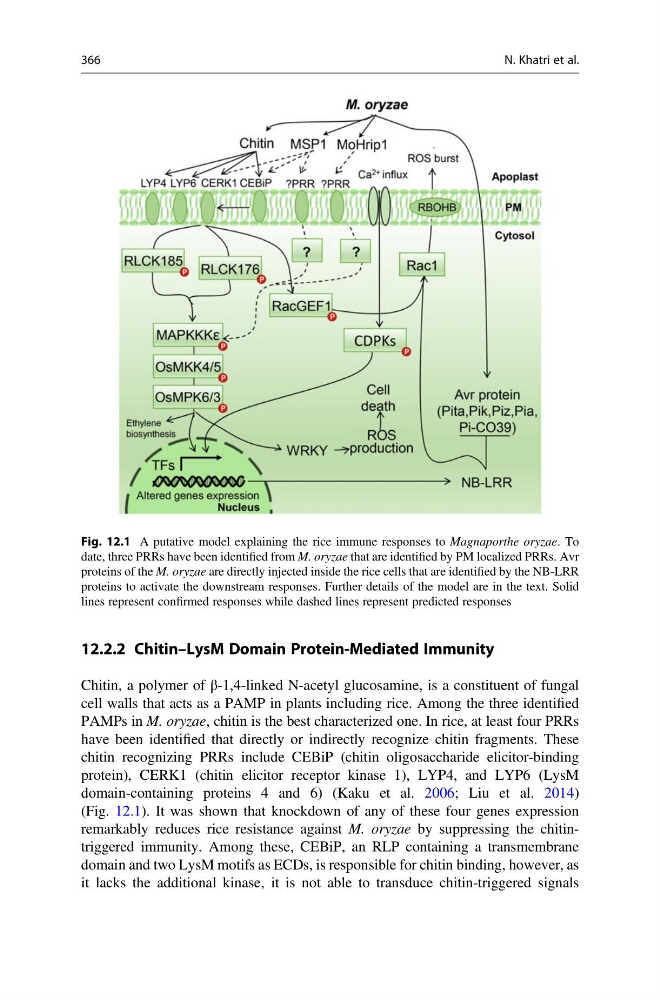
domain-containing proteins 4 and 6) (Kaku et al. 2006; Liu et al. 2014)
(Fig. 12.1). It was shown that knockdown of any of these four genes expression
remarkably reduces rice resistance against M. oryzae by suppressing the chitintriggered immunity. Among these, CEBiP, an RLP containing a transmembrane
domain and two LysM motifs as ECDs, is responsible for chitin binding, however, as
it lacks the additional kinase, it is not able to transduce chitin-triggered signals
Fig. 12.1 A putative model explaining the rice immune responses to Magnaporthe oryzae. To
date, three PRRs have been identified from M. oryzae that are identified by PM localized PRRs. Avr
proteins of the M. oryzae are directly injected inside the rice cells that are identified by the NB-LRR
proteins to activate the downstream responses. Further details of the model are in the text. Solid
lines represent confirmed responses while dashed lines represent predicted responses
366
N. Khatri et al.
Chitin, a polymer of β-1,4-linked N-acetyl glucosamine, is a constituent of fungal
cell walls that acts as a PAMP in plants including rice. Among the three identified
PAMPs in M. oryzae, chitin is the best characterized one. In rice, at least four PRRs
have been identified that directly or indirectly recognize chitin fragments. These
chitin recognizing PRRs include CEBiP (chitin oligosaccharide elicitor-binding
protein), CERK1 (chitin elicitor receptor kinase 1), LYP4, and LYP6 (LysM
domain-containing proteins 4 and 6) (Kaku et al. 2006; Liu et al. 2014)
(Fig. 12.1). It was shown that knockdown of any of these four genes expression
remarkably reduces rice resistance against M. oryzae by suppressing the chitintriggered immunity. Among these, CEBiP, an RLP containing a transmembrane
domain and two LysM motifs as ECDs, is responsible for chitin binding, however, as
it lacks the additional kinase, it is not able to transduce chitin-triggered signals
Fig. 12.1 A putative model explaining the rice immune responses to Magnaporthe oryzae. To
date, three PRRs have been identified from M. oryzae that are identified by PM localized PRRs. Avr
proteins of the M. oryzae are directly injected inside the rice cells that are identified by the NB-LRR
proteins to activate the downstream responses. Further details of the model are in the text. Solid
lines represent confirmed responses while dashed lines represent predicted responses
366
N. Khatri et al.