

deposition within xylem. In this regard, OsLSi6 gene plays role in transferring Si
from the large vascular bundles to the panicles (Yamaji and Ma 2009; Feng et al.
2011; Rao and Susmitha 2017). The knock-out and localization studies revealed that
the OsLsi6 gets localized on the adaxial side of xylem parenchyma cells in the leaf
sheaths as well as leaf blades (Feng et al. 2011; Ma and Yamaji 2015). Therefore, it
is important to keep a note that both apoplastic and symplastic route operates for
silicic acid (Exley et al. 2020). In addition to the rice, homologs of Si-transporters
have also been observed in other plant species. The list includes barley (Mitani et al.
2009a, b; Chiba et al. 2009), maize (Mitani et al. 2009a, b), crookneck pumpkin
(Mitani et al. 2011), wheat (Montpetit et al. 2012), soybean (Deshmukh et al. 2013),
field horsetail (Vivancos et al. 2016), cucumber (Sun et al. 2017, 2018), tobacco
(Zellner et al. 2019), poinsettia (Hu et al. 2020), and tomato (Sun et al. 2020). The
possible reason for the identification of Si-transporters lies in the ability to mine the
well-annotated plant genome sequences available for more than 100 species.
Upon successful transport, the silicon gets deposited under the cuticle and in
intercellular spaces or vascular bundles (Heckman 2013). Beneath the cuticle, the
silicon gets deposited as a cuticle–silicon double layer (silicic acid) (Rao and
Susmitha 2017; Rao et al. 2017). Furthermore, with the age, the concentration of
monosilicic acid increases which results in polymerization to form silica gel (SiO 2 .
nH 2 O) through a non-enzymatic reaction (Mitani and Jian 2005; Zargar et al. 2019).
In addition, amorphous silica particles polymerize in plant cells to form phytoliths
without incurring any energy as soon as its concentration exceeds a critical mark of
2 mM. These phytoliths are found as silica cells in vascular bundles and silica bodies
in bulliform cells, and fusoid cells (Rao and Susmitha 2017; Nawaz et al. 2019).
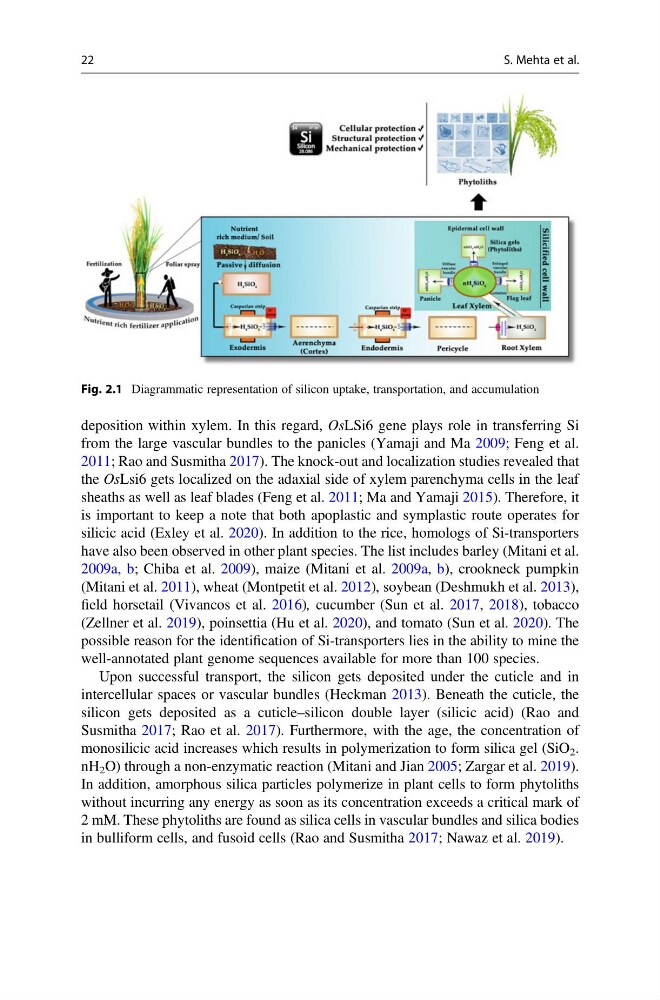
Fig. 2.1 Diagrammatic representation of silicon uptake, transportation, and accumulation
22
S. Mehta et al.
from the large vascular bundles to the panicles (Yamaji and Ma 2009; Feng et al.
2011; Rao and Susmitha 2017). The knock-out and localization studies revealed that
the OsLsi6 gets localized on the adaxial side of xylem parenchyma cells in the leaf
sheaths as well as leaf blades (Feng et al. 2011; Ma and Yamaji 2015). Therefore, it
is important to keep a note that both apoplastic and symplastic route operates for
silicic acid (Exley et al. 2020). In addition to the rice, homologs of Si-transporters
have also been observed in other plant species. The list includes barley (Mitani et al.
2009a, b; Chiba et al. 2009), maize (Mitani et al. 2009a, b), crookneck pumpkin
(Mitani et al. 2011), wheat (Montpetit et al. 2012), soybean (Deshmukh et al. 2013),
field horsetail (Vivancos et al. 2016), cucumber (Sun et al. 2017, 2018), tobacco
(Zellner et al. 2019), poinsettia (Hu et al. 2020), and tomato (Sun et al. 2020). The
possible reason for the identification of Si-transporters lies in the ability to mine the
well-annotated plant genome sequences available for more than 100 species.
Upon successful transport, the silicon gets deposited under the cuticle and in
intercellular spaces or vascular bundles (Heckman 2013). Beneath the cuticle, the
silicon gets deposited as a cuticle–silicon double layer (silicic acid) (Rao and
Susmitha 2017; Rao et al. 2017). Furthermore, with the age, the concentration of
monosilicic acid increases which results in polymerization to form silica gel (SiO 2 .
nH 2 O) through a non-enzymatic reaction (Mitani and Jian 2005; Zargar et al. 2019).
In addition, amorphous silica particles polymerize in plant cells to form phytoliths
without incurring any energy as soon as its concentration exceeds a critical mark of
2 mM. These phytoliths are found as silica cells in vascular bundles and silica bodies
in bulliform cells, and fusoid cells (Rao and Susmitha 2017; Nawaz et al. 2019).
Fig. 2.1 Diagrammatic representation of silicon uptake, transportation, and accumulation
22
S. Mehta et al.