

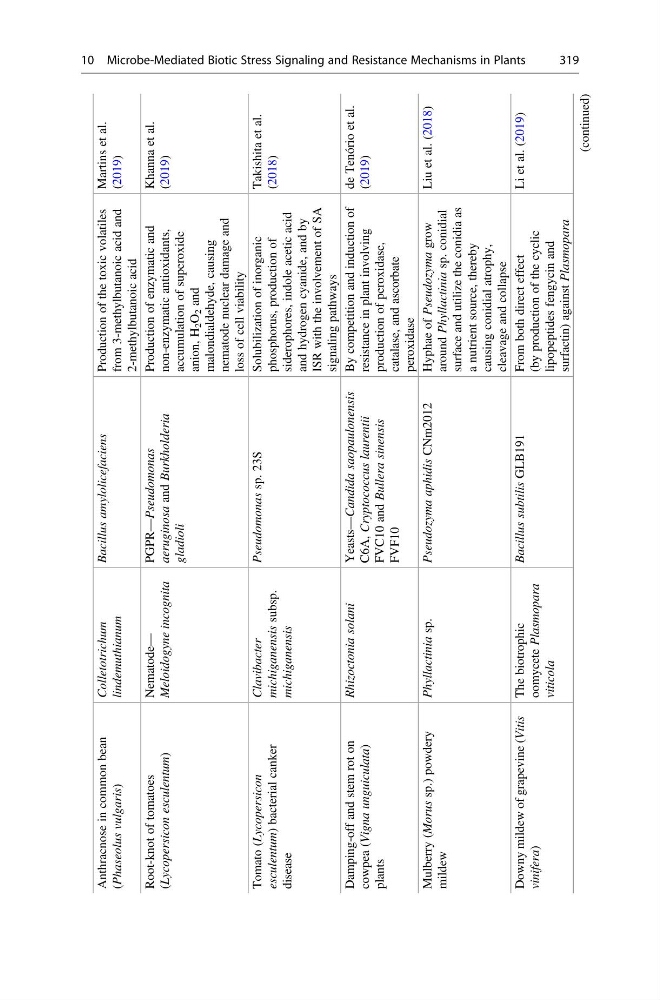
Anthracnose in common bean
(Phaseolus vulgaris)
Colletotrichum
lindemuthianum
Bacillus amylolicefaciens
Production of the toxic volatiles
from 3-methylbutanoic acid and
2-methylbutanoic acid
Martins et al.
(2019)
Root-knot of tomatoes
(Lycopersicon esculentum)
Nematode—
Meloidogyne incognita
PGPR—Pseudomonas
aeruginosa
and Burkholderia
gladioli
Production of enzymatic and
non-enzymatic antioxidants,
accumulation of superoxide
anion, H
2 O
2 and
malondialdehyde, causing
nematode nuclear damage and
loss of cell viability
Khanna et al.
(2019)
Tomato (Lycopersicon
esculentum)
bacterial canker
disease
Clavibacter
michiganensis
subsp.
michiganensis
Pseudomonas
sp. 23S
Solubilization of inorganic
phosphorus, production of
siderophores, indole acetic acid
and hydrogen cyanide, and by
ISR with the involvement of SA
signaling pathways
Takishita et al.
(2018)
Damping-off and stem rot on
cowpea (Vigna unguiculata)
plants
Rhizoctonia solani
Yeasts—Candida saopaulonensis
C6A, Cryptococcus laurentii
FVC10 and Bullera sinensis
FVF10
By competition and induction of
resistance in plant involving
production of peroxidase,
catalase, and ascorbate
peroxidase
de Tenório et al.
(2019)
Mulberry (Morus sp.) powdery
mildew
Phyllactinia
sp.
Pseudozyma aphidis
CNm2012
Hyphae of Pseudozyma
grow
around Phyllactinia
sp. conidial
surface and utilize the conidia as
a nutrient source, thereby
causing conidial atrophy,
cleavage and collapse
Liu et al. (2018)
Downy mildew of grapevine (Vitis
vinifera)
The biotrophic
oomycete Plasmopara
viticola
Bacillus subtilis
GLB191
From both direct effect
(by production of the cyclic
lipopeptides fengycin and
surfactin) against Plasmopara
Li et al. (2019)
(continued)
10 Microbe-Mediated Biotic Stress Signaling and Resistance Mechanisms in Plants
319
(Phaseolus vulgaris)
Colletotrichum
lindemuthianum
Bacillus amylolicefaciens
Production of the toxic volatiles
from 3-methylbutanoic acid and
2-methylbutanoic acid
Martins et al.
(2019)
Root-knot of tomatoes
(Lycopersicon esculentum)
Nematode—
Meloidogyne incognita
PGPR—Pseudomonas
aeruginosa
and Burkholderia
gladioli
Production of enzymatic and
non-enzymatic antioxidants,
accumulation of superoxide
anion, H
2 O
2 and
malondialdehyde, causing
nematode nuclear damage and
loss of cell viability
Khanna et al.
(2019)
Tomato (Lycopersicon
esculentum)
bacterial canker
disease
Clavibacter
michiganensis
subsp.
michiganensis
Pseudomonas
sp. 23S
Solubilization of inorganic
phosphorus, production of
siderophores, indole acetic acid
and hydrogen cyanide, and by
ISR with the involvement of SA
signaling pathways
Takishita et al.
(2018)
Damping-off and stem rot on
cowpea (Vigna unguiculata)
plants
Rhizoctonia solani
Yeasts—Candida saopaulonensis
C6A, Cryptococcus laurentii
FVC10 and Bullera sinensis
FVF10
By competition and induction of
resistance in plant involving
production of peroxidase,
catalase, and ascorbate
peroxidase
de Tenório et al.
(2019)
Mulberry (Morus sp.) powdery
mildew
Phyllactinia
sp.
Pseudozyma aphidis
CNm2012
Hyphae of Pseudozyma
grow
around Phyllactinia
sp. conidial
surface and utilize the conidia as
a nutrient source, thereby
causing conidial atrophy,
cleavage and collapse
Liu et al. (2018)
Downy mildew of grapevine (Vitis
vinifera)
The biotrophic
oomycete Plasmopara
viticola
Bacillus subtilis
GLB191
From both direct effect
(by production of the cyclic
lipopeptides fengycin and
surfactin) against Plasmopara
Li et al. (2019)
(continued)
10 Microbe-Mediated Biotic Stress Signaling and Resistance Mechanisms in Plants
319