

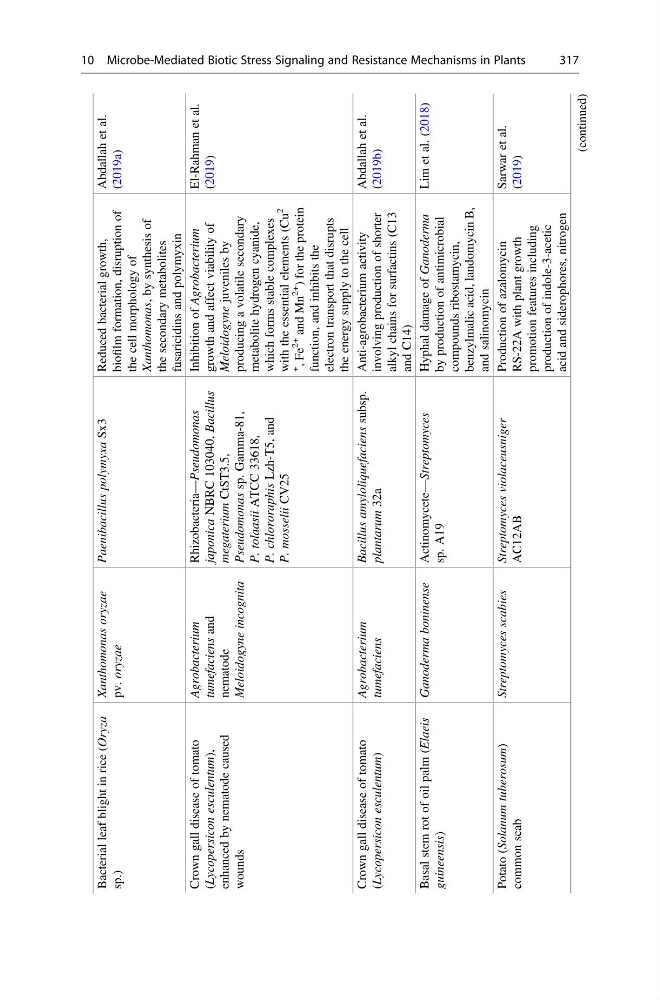
Bacterial leaf blight in rice (Oryza
sp.)
Xanthomonas oryzae
pv. oryzae
Paenibacillus polymyxa
Sx3
Reduced bacterial growth,
biofilm formation, disruption of
the cell morphology of
Xanthomonas,
by synthesis of
the secondary metabolites
fusaricidins and polymyxin
Abdallah et al.
(2019a)
Crown gall disease of tomato
(Lycopersicon esculentum),
enhanced by nematode caused
wounds
Agrobacterium
tumefaciens
and
nematode
Meloidogyne incognita
Rhizobacteria—Pseudomonas
japonica
NBRC 103040, Bacillus
megaterium
CtST3.5,
Pseudomonas
sp. Gamma-81,
P. tolaasii
ATCC 33618,
P. chlororaphis
Lzh-T5, and
P. mosselii
CV25
Inhibition of Agrobacterium
growth and affect viability of
Meloidogyne
juveniles by
producing a volatile secondary
metabolite hydrogen cyanide,
which forms stable complexes
with the essential elements (Cu
2
+
, Fe
2+
and Mn
2+
) for the protein
function, and inhibits the
electron transport that disrupts
the energy supply to the cell
El-Rahman et al.
(2019)
Crown gall disease of tomato
(Lycopersicon esculentum)
Agrobacterium
tumefaciens
Bacillus amyloliquefaciens
subsp.
plantarum
32a
Anti-agrobacterium activity
involving production of shorter
alkyl chains for surfactins (C13
and C14)
Abdallah et al.
(2019b)
Basal stem rot of oil palm (Elaeis
guineensis)
Ganoderma boninense
Actinomycete—Streptomyces
sp. A19
Hyphal damage of Ganoderma
by production of antimicrobial
compounds ribostamycin,
benzylmalic acid, landomycin B,
and salinomycin
Lim et al. (2018)
Potato (Solanum tuberosum)
common scab
Streptomyces scabies
Streptomyces violaceusniger
AC12AB
Production of azalomycin
RS-22A with plant growth
promotion features including
production of indole-3-acetic
acid and siderophores, nitrogen
Sarwar et al.
(2019)
(continued)
10 Microbe-Mediated Biotic Stress Signaling and Resistance Mechanisms in Plants
317
sp.)
Xanthomonas oryzae
pv. oryzae
Paenibacillus polymyxa
Sx3
Reduced bacterial growth,
biofilm formation, disruption of
the cell morphology of
Xanthomonas,
by synthesis of
the secondary metabolites
fusaricidins and polymyxin
Abdallah et al.
(2019a)
Crown gall disease of tomato
(Lycopersicon esculentum),
enhanced by nematode caused
wounds
Agrobacterium
tumefaciens
and
nematode
Meloidogyne incognita
Rhizobacteria—Pseudomonas
japonica
NBRC 103040, Bacillus
megaterium
CtST3.5,
Pseudomonas
sp. Gamma-81,
P. tolaasii
ATCC 33618,
P. chlororaphis
Lzh-T5, and
P. mosselii
CV25
Inhibition of Agrobacterium
growth and affect viability of
Meloidogyne
juveniles by
producing a volatile secondary
metabolite hydrogen cyanide,
which forms stable complexes
with the essential elements (Cu
2
+
, Fe
2+
and Mn
2+
) for the protein
function, and inhibits the
electron transport that disrupts
the energy supply to the cell
El-Rahman et al.
(2019)
Crown gall disease of tomato
(Lycopersicon esculentum)
Agrobacterium
tumefaciens
Bacillus amyloliquefaciens
subsp.
plantarum
32a
Anti-agrobacterium activity
involving production of shorter
alkyl chains for surfactins (C13
and C14)
Abdallah et al.
(2019b)
Basal stem rot of oil palm (Elaeis
guineensis)
Ganoderma boninense
Actinomycete—Streptomyces
sp. A19
Hyphal damage of Ganoderma
by production of antimicrobial
compounds ribostamycin,
benzylmalic acid, landomycin B,
and salinomycin
Lim et al. (2018)
Potato (Solanum tuberosum)
common scab
Streptomyces scabies
Streptomyces violaceusniger
AC12AB
Production of azalomycin
RS-22A with plant growth
promotion features including
production of indole-3-acetic
acid and siderophores, nitrogen
Sarwar et al.
(2019)
(continued)
10 Microbe-Mediated Biotic Stress Signaling and Resistance Mechanisms in Plants
317