

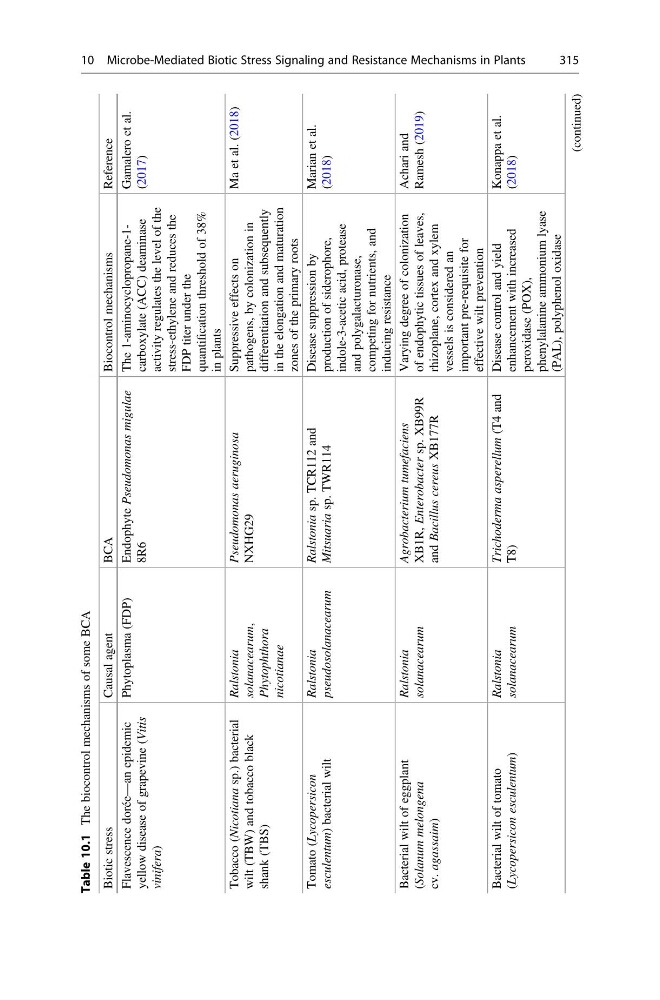
Table 10.1
The biocontrol mechanisms of some BCA
Biotic stress
Causal agent
BCA
Biocontrol mechanisms
Reference
Flavescence dorée—an epidemic
yellow disease of grapevine (Vitis
vinifera)
Phytoplasma (FDP)
Endophyte Pseudomonas migulae
8R6
The 1-aminocyclopropane-1carboxylate (ACC) deaminase
activity regulates the level of the
stress-ethylene and reduces the
FDP titer under the
quantification threshold of 38%
in plants
Gamalero et al.
(2017)
Tobacco (Nicotiana sp.) bacterial
wilt (TBW) and tobacco black
shank (TBS)
Ralstonia
solanacearum,
Phytophthora
nicotianae
Pseudomonas aeruginosa
NXHG29
Suppressive effects on
pathogens, by colonization in
differentiation and subsequently
in the elongation and maturation
zones of the primary roots
Ma et al. (2018)
Tomato (Lycopersicon
esculentum)
bacterial wilt
Ralstonia
pseudosolanacearum
Ralstonia
sp. TCR112 and
Mitsuaria
sp. TWR114
Disease suppression by
production of siderophore,
indole-3-acetic acid, protease
and polygalacturonase,
competing for nutrients, and
inducing resistance
Marian et al.
(2018)
Bacterial wilt of eggplant
(Solanum melongena
cv. agassaim)
Ralstonia
solanacearum
Agrobacterium tumefaciens
XB1R, Enterobacter
sp. XB99R
and Bacillus cereus
XB177R
Varying degree of colonization
of endophytic tissues of leaves,
rhizoplane, cortex and xylem
vessels is considered an
important pre-requisite for
effective wilt prevention
Achari and
Ramesh (2019)
Bacterial wilt of tomato
(Lycopersicon esculentum)
Ralstonia
solanacearum
Trichoderma asperellum
(T4 and
T8)
Disease control and yield
enhancement with increased
peroxidase (POX),
phenylalanine ammonium lyase
(PAL), polyphenol oxidase
Konappa et al.
(2018)
(continued)
10 Microbe-Mediated Biotic Stress Signaling and Resistance Mechanisms in Plants
315
The biocontrol mechanisms of some BCA
Biotic stress
Causal agent
BCA
Biocontrol mechanisms
Reference
Flavescence dorée—an epidemic
yellow disease of grapevine (Vitis
vinifera)
Phytoplasma (FDP)
Endophyte Pseudomonas migulae
8R6
The 1-aminocyclopropane-1carboxylate (ACC) deaminase
activity regulates the level of the
stress-ethylene and reduces the
FDP titer under the
quantification threshold of 38%
in plants
Gamalero et al.
(2017)
Tobacco (Nicotiana sp.) bacterial
wilt (TBW) and tobacco black
shank (TBS)
Ralstonia
solanacearum,
Phytophthora
nicotianae
Pseudomonas aeruginosa
NXHG29
Suppressive effects on
pathogens, by colonization in
differentiation and subsequently
in the elongation and maturation
zones of the primary roots
Ma et al. (2018)
Tomato (Lycopersicon
esculentum)
bacterial wilt
Ralstonia
pseudosolanacearum
Ralstonia
sp. TCR112 and
Mitsuaria
sp. TWR114
Disease suppression by
production of siderophore,
indole-3-acetic acid, protease
and polygalacturonase,
competing for nutrients, and
inducing resistance
Marian et al.
(2018)
Bacterial wilt of eggplant
(Solanum melongena
cv. agassaim)
Ralstonia
solanacearum
Agrobacterium tumefaciens
XB1R, Enterobacter
sp. XB99R
and Bacillus cereus
XB177R
Varying degree of colonization
of endophytic tissues of leaves,
rhizoplane, cortex and xylem
vessels is considered an
important pre-requisite for
effective wilt prevention
Achari and
Ramesh (2019)
Bacterial wilt of tomato
(Lycopersicon esculentum)
Ralstonia
solanacearum
Trichoderma asperellum
(T4 and
T8)
Disease control and yield
enhancement with increased
peroxidase (POX),
phenylalanine ammonium lyase
(PAL), polyphenol oxidase
Konappa et al.
(2018)
(continued)
10 Microbe-Mediated Biotic Stress Signaling and Resistance Mechanisms in Plants
315