

(Dicke and Baldwin 2010). Moreover, plants have evolved R genes, involving
NB-LRRs for ETI against certain suppressive herbivore effectors. For instance in
tomato, wounding caused by insect herbivory elicits a localized and a mediated
distant systemic expression, and accumulation of proteinase inhibitors that affect
digestive enzymes of insect-gut (Green and Ryan 1972), while the Mi gene is
involved in conferring resistance against aphid feeding (Rossi et al. 1998). The
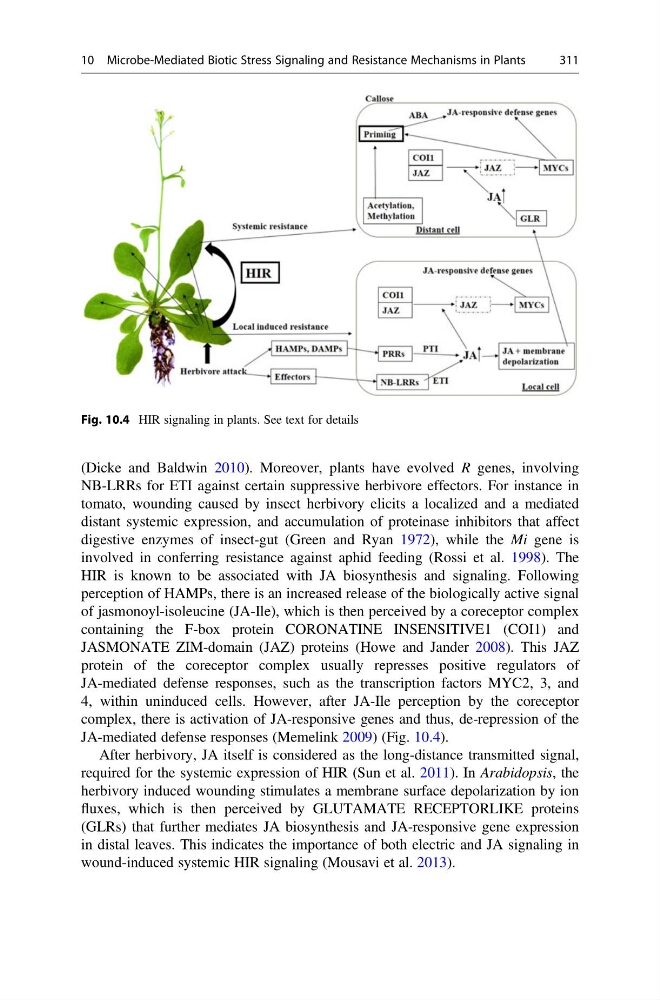
HIR is known to be associated with JA biosynthesis and signaling. Following
perception of HAMPs, there is an increased release of the biologically active signal
of jasmonoyl-isoleucine (JA-Ile), which is then perceived by a coreceptor complex
containing the F-box protein CORONATINE INSENSITIVE1 (COI1) and
JASMONATE ZIM-domain (JAZ) proteins (Howe and Jander 2008). This JAZ
protein of the coreceptor complex usually represses positive regulators of
JA-mediated defense responses, such as the transcription factors MYC2, 3, and
4, within uninduced cells. However, after JA-Ile perception by the coreceptor
complex, there is activation of JA-responsive genes and thus, de-repression of the
JA-mediated defense responses (Memelink 2009) (Fig. 10.4).
After herbivory, JA itself is considered as the long-distance transmitted signal,
required for the systemic expression of HIR (Sun et al. 2011). In Arabidopsis, the
herbivory induced wounding stimulates a membrane surface depolarization by ion
fluxes, which is then perceived by GLUTAMATE RECEPTORLIKE proteins
(GLRs) that further mediates JA biosynthesis and JA-responsive gene expression
in distal leaves. This indicates the importance of both electric and JA signaling in
wound-induced systemic HIR signaling (Mousavi et al. 2013).
Fig. 10.4 HIR signaling in plants. See text for details
10 Microbe-Mediated Biotic Stress Signaling and Resistance Mechanisms in Plants
311
NB-LRRs for ETI against certain suppressive herbivore effectors. For instance in
tomato, wounding caused by insect herbivory elicits a localized and a mediated
distant systemic expression, and accumulation of proteinase inhibitors that affect
digestive enzymes of insect-gut (Green and Ryan 1972), while the Mi gene is
involved in conferring resistance against aphid feeding (Rossi et al. 1998). The
HIR is known to be associated with JA biosynthesis and signaling. Following
perception of HAMPs, there is an increased release of the biologically active signal
of jasmonoyl-isoleucine (JA-Ile), which is then perceived by a coreceptor complex
containing the F-box protein CORONATINE INSENSITIVE1 (COI1) and
JASMONATE ZIM-domain (JAZ) proteins (Howe and Jander 2008). This JAZ
protein of the coreceptor complex usually represses positive regulators of
JA-mediated defense responses, such as the transcription factors MYC2, 3, and
4, within uninduced cells. However, after JA-Ile perception by the coreceptor
complex, there is activation of JA-responsive genes and thus, de-repression of the
JA-mediated defense responses (Memelink 2009) (Fig. 10.4).
After herbivory, JA itself is considered as the long-distance transmitted signal,
required for the systemic expression of HIR (Sun et al. 2011). In Arabidopsis, the
herbivory induced wounding stimulates a membrane surface depolarization by ion
fluxes, which is then perceived by GLUTAMATE RECEPTORLIKE proteins
(GLRs) that further mediates JA biosynthesis and JA-responsive gene expression
in distal leaves. This indicates the importance of both electric and JA signaling in
wound-induced systemic HIR signaling (Mousavi et al. 2013).
Fig. 10.4 HIR signaling in plants. See text for details
10 Microbe-Mediated Biotic Stress Signaling and Resistance Mechanisms in Plants
311