

utilizes the symbiotic effector SP7 (Kloppholz et al. 2011). In Arabidopsis roots, the
JA signaling pathway is activated along with secretion of many immune suppressive
effector proteins by the PGPF Piriformospora indica to suppress both early and late
defense responses (Jacobs et al. 2011; Zuccaro et al. 2011). Similar down–regulation
of root immune responses, which might also involve a type III secretion system, has
also been described for other ISR–inducing PGPM such as Trichoderma, Bacillus
subtilis FB17 and Pseudomonas fluorescens WCS417r (Weller et al. 2012; Brotman
et al. 2013; Lakshmanan et al. 2013).
10.6.4 Regulation of ISR
The ISR is consequential of a long-distance signaling mechanism, which is liable for
regulating the colonization density of the symbionts. PGPM are known to trigger
ISR which is regulated by signaling pathways dissimilar to the pathogen-induced
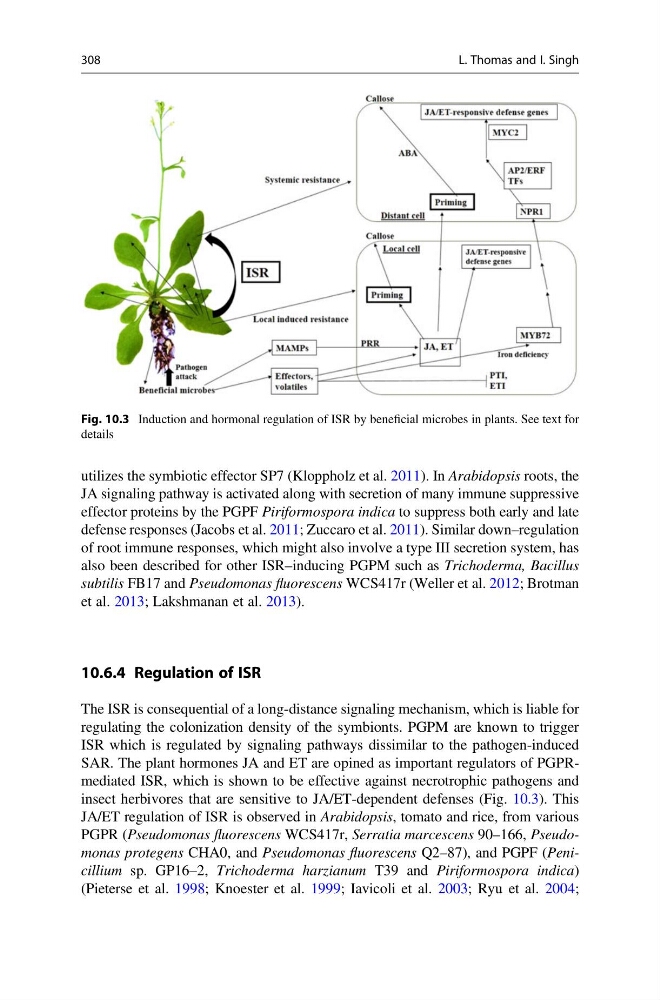
SAR. The plant hormones JA and ET are opined as important regulators of PGPRmediated ISR, which is shown to be effective against necrotrophic pathogens and
insect herbivores that are sensitive to JA/ET-dependent defenses (Fig. 10.3). This
JA/ET regulation of ISR is observed in Arabidopsis, tomato and rice, from various
PGPR (Pseudomonas fluorescens WCS417r, Serratia marcescens 90–166, Pseudomonas protegens CHA0, and Pseudomonas fluorescens Q2–87), and PGPF (Penicillium sp. GP16–2, Trichoderma harzianum T39 and Piriformospora indica)
(Pieterse et al. 1998; Knoester et al. 1999; Iavicoli et al. 2003; Ryu et al. 2004;
Fig. 10.3 Induction and hormonal regulation of ISR by beneficial microbes in plants. See text for
details
308
L. Thomas and I. Singh
JA signaling pathway is activated along with secretion of many immune suppressive
effector proteins by the PGPF Piriformospora indica to suppress both early and late
defense responses (Jacobs et al. 2011; Zuccaro et al. 2011). Similar down–regulation
of root immune responses, which might also involve a type III secretion system, has
also been described for other ISR–inducing PGPM such as Trichoderma, Bacillus
subtilis FB17 and Pseudomonas fluorescens WCS417r (Weller et al. 2012; Brotman
et al. 2013; Lakshmanan et al. 2013).
10.6.4 Regulation of ISR
The ISR is consequential of a long-distance signaling mechanism, which is liable for
regulating the colonization density of the symbionts. PGPM are known to trigger
ISR which is regulated by signaling pathways dissimilar to the pathogen-induced
SAR. The plant hormones JA and ET are opined as important regulators of PGPRmediated ISR, which is shown to be effective against necrotrophic pathogens and
insect herbivores that are sensitive to JA/ET-dependent defenses (Fig. 10.3). This
JA/ET regulation of ISR is observed in Arabidopsis, tomato and rice, from various
PGPR (Pseudomonas fluorescens WCS417r, Serratia marcescens 90–166, Pseudomonas protegens CHA0, and Pseudomonas fluorescens Q2–87), and PGPF (Penicillium sp. GP16–2, Trichoderma harzianum T39 and Piriformospora indica)
(Pieterse et al. 1998; Knoester et al. 1999; Iavicoli et al. 2003; Ryu et al. 2004;
Fig. 10.3 Induction and hormonal regulation of ISR by beneficial microbes in plants. See text for
details
308
L. Thomas and I. Singh