

synthesized by Bacillus subtilis GB03 and a C13 volatile secreted by Paenibacillus
polymyxa can elicit ISR (Ryu et al. 2004; Lee et al. 2012). In Arabidopsis, the
O-antigenic side chain of cell wall LPS, flagella, and the siderophore pyoverdine of
Pseudomonas putida WCS358 can elicit ISR (Meziane et al. 2005). However,
Pseudomonas putida WCS358 mutants that lack these are still capable of triggering
ISR suggesting multiple bacterial elicitors of ISR in this strain. The LPS,
siderophore, and Fe-regulated compounds of Pseudomonas fluorescens WCS
417 are known to elicit ISR in Arabidopsis, carnation, and radish (Van Peer and
Schippers 1992; Leeman et al. 1996). For PGPF, comparative genomics of
Trichoderma spp. and mycorrhizal fungi has indicated the presence of many genes
that encode putative effectors and elicitors (Mukherjee et al. 2013; Tisserant et al.
2013). Several elicitors of ISR identified in PGPF include enzymes (xylanases and
cellulases) and specific proteins and peptides (Sm1 from Trichoderma virens)
(Shoresh et al. 2006; Djonovic et al. 2007).
10.6.2 Root Colonization as an Early Signaling Event in ISR
Initiation of ISR in the plant requires a variety of signals whose generation needs an
efficient root-colonization by the beneficial microbes (Lugtenberg and Kamilova
2009; Shoresh et al. 2010; Zamioudis and Pieterse 2012). PGPM respond to the root
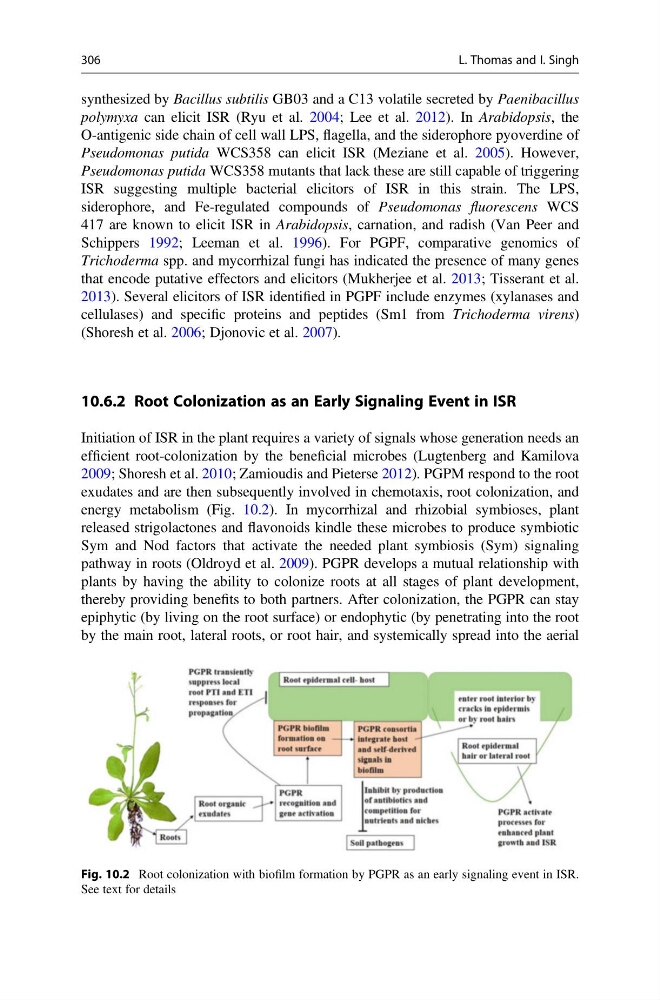
exudates and are then subsequently involved in chemotaxis, root colonization, and
energy metabolism (Fig. 10.2). In mycorrhizal and rhizobial symbioses, plant
released strigolactones and flavonoids kindle these microbes to produce symbiotic
Sym and Nod factors that activate the needed plant symbiosis (Sym) signaling
pathway in roots (Oldroyd et al. 2009). PGPR develops a mutual relationship with
plants by having the ability to colonize roots at all stages of plant development,
thereby providing benefits to both partners. After colonization, the PGPR can stay
epiphytic (by living on the root surface) or endophytic (by penetrating into the root
by the main root, lateral roots, or root hair, and systemically spread into the aerial
Fig. 10.2 Root colonization with biofilm formation by PGPR as an early signaling event in ISR.
See text for details
306
L. Thomas and I. Singh
polymyxa can elicit ISR (Ryu et al. 2004; Lee et al. 2012). In Arabidopsis, the
O-antigenic side chain of cell wall LPS, flagella, and the siderophore pyoverdine of
Pseudomonas putida WCS358 can elicit ISR (Meziane et al. 2005). However,
Pseudomonas putida WCS358 mutants that lack these are still capable of triggering
ISR suggesting multiple bacterial elicitors of ISR in this strain. The LPS,
siderophore, and Fe-regulated compounds of Pseudomonas fluorescens WCS
417 are known to elicit ISR in Arabidopsis, carnation, and radish (Van Peer and
Schippers 1992; Leeman et al. 1996). For PGPF, comparative genomics of
Trichoderma spp. and mycorrhizal fungi has indicated the presence of many genes
that encode putative effectors and elicitors (Mukherjee et al. 2013; Tisserant et al.
2013). Several elicitors of ISR identified in PGPF include enzymes (xylanases and
cellulases) and specific proteins and peptides (Sm1 from Trichoderma virens)
(Shoresh et al. 2006; Djonovic et al. 2007).
10.6.2 Root Colonization as an Early Signaling Event in ISR
Initiation of ISR in the plant requires a variety of signals whose generation needs an
efficient root-colonization by the beneficial microbes (Lugtenberg and Kamilova
2009; Shoresh et al. 2010; Zamioudis and Pieterse 2012). PGPM respond to the root
exudates and are then subsequently involved in chemotaxis, root colonization, and
energy metabolism (Fig. 10.2). In mycorrhizal and rhizobial symbioses, plant
released strigolactones and flavonoids kindle these microbes to produce symbiotic
Sym and Nod factors that activate the needed plant symbiosis (Sym) signaling
pathway in roots (Oldroyd et al. 2009). PGPR develops a mutual relationship with
plants by having the ability to colonize roots at all stages of plant development,
thereby providing benefits to both partners. After colonization, the PGPR can stay
epiphytic (by living on the root surface) or endophytic (by penetrating into the root
by the main root, lateral roots, or root hair, and systemically spread into the aerial
Fig. 10.2 Root colonization with biofilm formation by PGPR as an early signaling event in ISR.
See text for details
306
L. Thomas and I. Singh