

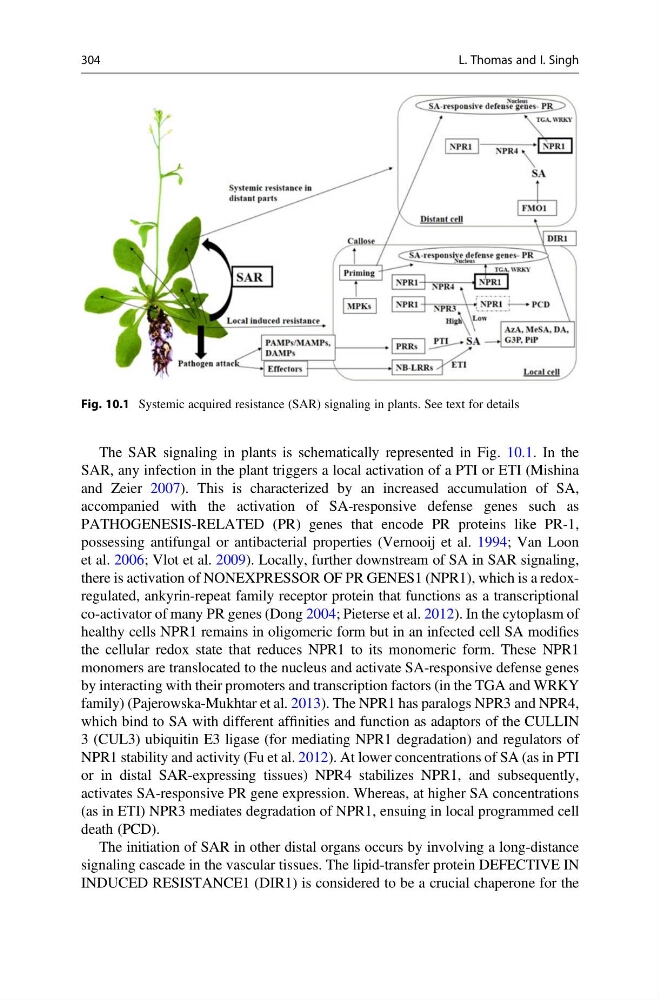
The SAR signaling in plants is schematically represented in Fig. 10.1. In the
SAR, any infection in the plant triggers a local activation of a PTI or ETI (Mishina
and Zeier 2007). This is characterized by an increased accumulation of SA,
accompanied with the activation of SA-responsive defense genes such as
PATHOGENESIS-RELATED (PR) genes that encode PR proteins like PR-1,
possessing antifungal or antibacterial properties (Vernooij et al. 1994; Van Loon
et al. 2006; Vlot et al. 2009). Locally, further downstream of SA in SAR signaling,
there is activation of NONEXPRESSOR OF PR GENES1 (NPR1), which is a redoxregulated, ankyrin-repeat family receptor protein that functions as a transcriptional
co-activator of many PR genes (Dong 2004; Pieterse et al. 2012). In the cytoplasm of
healthy cells NPR1 remains in oligomeric form but in an infected cell SA modifies
the cellular redox state that reduces NPR1 to its monomeric form. These NPR1
monomers are translocated to the nucleus and activate SA-responsive defense genes
by interacting with their promoters and transcription factors (in the TGA and WRKY
family) (Pajerowska-Mukhtar et al. 2013). The NPR1 has paralogs NPR3 and NPR4,
which bind to SA with different affinities and function as adaptors of the CULLIN
3 (CUL3) ubiquitin E3 ligase (for mediating NPR1 degradation) and regulators of
NPR1 stability and activity (Fu et al. 2012). At lower concentrations of SA (as in PTI
or in distal SAR-expressing tissues) NPR4 stabilizes NPR1, and subsequently,
activates SA-responsive PR gene expression. Whereas, at higher SA concentrations
(as in ETI) NPR3 mediates degradation of NPR1, ensuing in local programmed cell
death (PCD).
The initiation of SAR in other distal organs occurs by involving a long-distance
signaling cascade in the vascular tissues. The lipid-transfer protein DEFECTIVE IN
INDUCED RESISTANCE1 (DIR1) is considered to be a crucial chaperone for the
Fig. 10.1 Systemic acquired resistance (SAR) signaling in plants. See text for details
304
L. Thomas and I. Singh
SAR, any infection in the plant triggers a local activation of a PTI or ETI (Mishina
and Zeier 2007). This is characterized by an increased accumulation of SA,
accompanied with the activation of SA-responsive defense genes such as
PATHOGENESIS-RELATED (PR) genes that encode PR proteins like PR-1,
possessing antifungal or antibacterial properties (Vernooij et al. 1994; Van Loon
et al. 2006; Vlot et al. 2009). Locally, further downstream of SA in SAR signaling,
there is activation of NONEXPRESSOR OF PR GENES1 (NPR1), which is a redoxregulated, ankyrin-repeat family receptor protein that functions as a transcriptional
co-activator of many PR genes (Dong 2004; Pieterse et al. 2012). In the cytoplasm of
healthy cells NPR1 remains in oligomeric form but in an infected cell SA modifies
the cellular redox state that reduces NPR1 to its monomeric form. These NPR1
monomers are translocated to the nucleus and activate SA-responsive defense genes
by interacting with their promoters and transcription factors (in the TGA and WRKY
family) (Pajerowska-Mukhtar et al. 2013). The NPR1 has paralogs NPR3 and NPR4,
which bind to SA with different affinities and function as adaptors of the CULLIN
3 (CUL3) ubiquitin E3 ligase (for mediating NPR1 degradation) and regulators of
NPR1 stability and activity (Fu et al. 2012). At lower concentrations of SA (as in PTI
or in distal SAR-expressing tissues) NPR4 stabilizes NPR1, and subsequently,
activates SA-responsive PR gene expression. Whereas, at higher SA concentrations
(as in ETI) NPR3 mediates degradation of NPR1, ensuing in local programmed cell
death (PCD).
The initiation of SAR in other distal organs occurs by involving a long-distance
signaling cascade in the vascular tissues. The lipid-transfer protein DEFECTIVE IN
INDUCED RESISTANCE1 (DIR1) is considered to be a crucial chaperone for the
Fig. 10.1 Systemic acquired resistance (SAR) signaling in plants. See text for details
304
L. Thomas and I. Singh