

negative effect of salinity with a decline in MDA content and increase in photosynthetic pigments and proline content as compared to controls.
Another finding describing amelioration of salinity tolerance by use of Salicylic
acid and jasmonic acid was provided by Golezani and Salar (2018) where they
observed that soybean plants when applied SA + JA treatment displayed much better
tolerance, increased relative water content, etc. than the plants getting individual
phytohormone treatment under salinity.
9.4.2 Transgenic Approach for Generation of Salinity-Tolerant
Plants
Apart from phytohormone exogenous application, another effective strategy for the
generation of salt-tolerant plants is genetic engineering where a gene of interest from
a specific source is inserted in the host plant to develop transgenic plants. This
approach has been applied for the development of many transgenic plants resistant to
salt stress. Transcription factors, signal transduction genes, water channel proteins,
ion transporters, detoxifying genes, molecular chaperones, dehydrins and
osmoprotectants are the most widely used genes for the development of stresstolerant plants by genetic engineering.
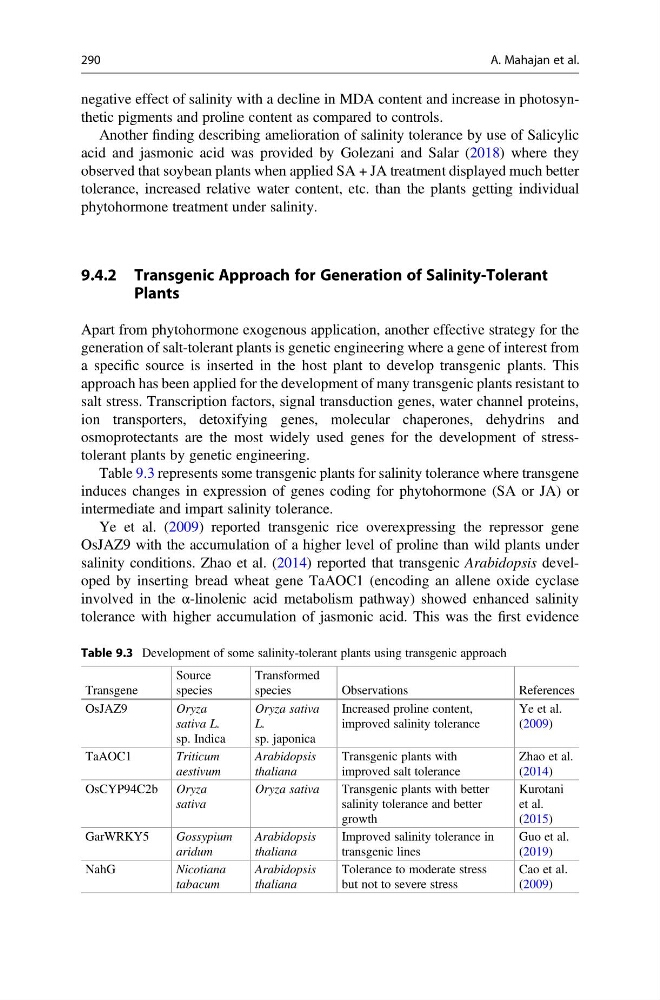
Table 9.3 represents some transgenic plants for salinity tolerance where transgene
induces changes in expression of genes coding for phytohormone (SA or JA) or
intermediate and impart salinity tolerance.
Ye et al. (2009) reported transgenic rice overexpressing the repressor gene
OsJAZ9 with the accumulation of a higher level of proline than wild plants under
salinity conditions. Zhao et al. (2014) reported that transgenic Arabidopsis developed by inserting bread wheat gene TaAOC1 (encoding an allene oxide cyclase
involved in the α-linolenic acid metabolism pathway) showed enhanced salinity
tolerance with higher accumulation of jasmonic acid. This was the first evidence
Table 9.3 Development of some salinity-tolerant plants using transgenic approach
Transgene
Source
species
Transformed
species
Observations
References
OsJAZ9
Oryza
sativa L.
sp. Indica
Oryza sativa
L.
sp. japonica
Increased proline content,
improved salinity tolerance
Ye et al.
(2009)
TaAOC1
Triticum
aestivum
Arabidopsis
thaliana
Transgenic plants with
improved salt tolerance
Zhao et al.
(2014)
OsCYP94C2b Oryza
sativa
Oryza sativa
Transgenic plants with better
salinity tolerance and better
growth
Kurotani
et al.
(2015)
GarWRKY5
Gossypium
aridum
Arabidopsis
thaliana
Improved salinity tolerance in
transgenic lines
Guo et al.
(2019)
NahG
Nicotiana
tabacum
Arabidopsis
thaliana
Tolerance to moderate stress
but not to severe stress
Cao et al.
(2009)
290
A. Mahajan et al.
Another finding describing amelioration of salinity tolerance by use of Salicylic
acid and jasmonic acid was provided by Golezani and Salar (2018) where they
observed that soybean plants when applied SA + JA treatment displayed much better
tolerance, increased relative water content, etc. than the plants getting individual
phytohormone treatment under salinity.
9.4.2 Transgenic Approach for Generation of Salinity-Tolerant
Plants
Apart from phytohormone exogenous application, another effective strategy for the
generation of salt-tolerant plants is genetic engineering where a gene of interest from
a specific source is inserted in the host plant to develop transgenic plants. This
approach has been applied for the development of many transgenic plants resistant to
salt stress. Transcription factors, signal transduction genes, water channel proteins,
ion transporters, detoxifying genes, molecular chaperones, dehydrins and
osmoprotectants are the most widely used genes for the development of stresstolerant plants by genetic engineering.
Table 9.3 represents some transgenic plants for salinity tolerance where transgene
induces changes in expression of genes coding for phytohormone (SA or JA) or
intermediate and impart salinity tolerance.
Ye et al. (2009) reported transgenic rice overexpressing the repressor gene
OsJAZ9 with the accumulation of a higher level of proline than wild plants under
salinity conditions. Zhao et al. (2014) reported that transgenic Arabidopsis developed by inserting bread wheat gene TaAOC1 (encoding an allene oxide cyclase
involved in the α-linolenic acid metabolism pathway) showed enhanced salinity
tolerance with higher accumulation of jasmonic acid. This was the first evidence
Table 9.3 Development of some salinity-tolerant plants using transgenic approach
Transgene
Source
species
Transformed
species
Observations
References
OsJAZ9
Oryza
sativa L.
sp. Indica
Oryza sativa
L.
sp. japonica
Increased proline content,
improved salinity tolerance
Ye et al.
(2009)
TaAOC1
Triticum
aestivum
Arabidopsis
thaliana
Transgenic plants with
improved salt tolerance
Zhao et al.
(2014)
OsCYP94C2b Oryza
sativa
Oryza sativa
Transgenic plants with better
salinity tolerance and better
growth
Kurotani
et al.
(2015)
GarWRKY5
Gossypium
aridum
Arabidopsis
thaliana
Improved salinity tolerance in
transgenic lines
Guo et al.
(2019)
NahG
Nicotiana
tabacum
Arabidopsis
thaliana
Tolerance to moderate stress
but not to severe stress
Cao et al.
(2009)
290
A. Mahajan et al.