

of 4 dS/m (generating an osmotic pressure of approximately 0.2 MPa) or more are
categorised as saline soils (USDA-ARS 2008). Poor drainage, improper irrigation,
irrigation water with high levels of salts, excessive use of fertilisers, etc. are some of
the factors that degrade the land towards salinity (Kijne 2016). Currently saltaffected area in India is about 6.74 million hectare and it is expected to increase to
16.2 million hectares by 2050 (CSSRI 2015). Reduction in biomass production is
one of the major effects of salinity. Salinity hampers the growth and metabolism of
plants by inducing various changes like osmotic stress, ion toxicity, oxidative stress
(ROS), membrane disorganisation (Parihar et al. 2015; Machado and Serralheiro
2017).
9.2.2 Impact of Salinity on Plants
Salinity has a major negative impact on plant growth and poses a major threat to
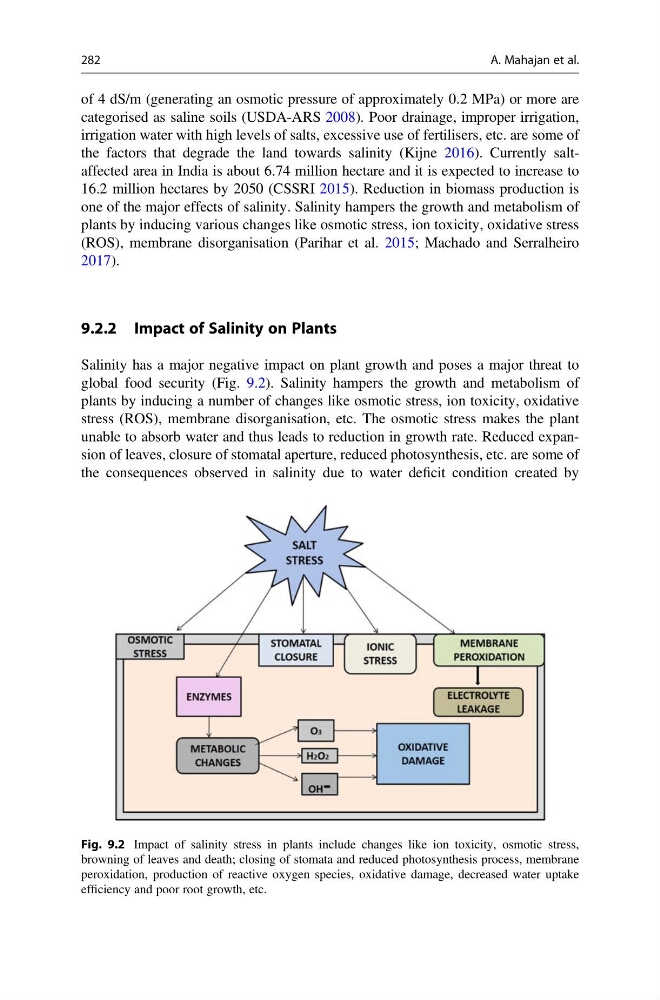
global food security (Fig. 9.2). Salinity hampers the growth and metabolism of
plants by inducing a number of changes like osmotic stress, ion toxicity, oxidative
stress (ROS), membrane disorganisation, etc. The osmotic stress makes the plant
unable to absorb water and thus leads to reduction in growth rate. Reduced expansion of leaves, closure of stomatal aperture, reduced photosynthesis, etc. are some of
the consequences observed in salinity due to water deficit condition created by
Fig. 9.2 Impact of salinity stress in plants include changes like ion toxicity, osmotic stress,
browning of leaves and death; closing of stomata and reduced photosynthesis process, membrane
peroxidation, production of reactive oxygen species, oxidative damage, decreased water uptake
efficiency and poor root growth, etc.
282
A. Mahajan et al.
categorised as saline soils (USDA-ARS 2008). Poor drainage, improper irrigation,
irrigation water with high levels of salts, excessive use of fertilisers, etc. are some of
the factors that degrade the land towards salinity (Kijne 2016). Currently saltaffected area in India is about 6.74 million hectare and it is expected to increase to
16.2 million hectares by 2050 (CSSRI 2015). Reduction in biomass production is
one of the major effects of salinity. Salinity hampers the growth and metabolism of
plants by inducing various changes like osmotic stress, ion toxicity, oxidative stress
(ROS), membrane disorganisation (Parihar et al. 2015; Machado and Serralheiro
2017).
9.2.2 Impact of Salinity on Plants
Salinity has a major negative impact on plant growth and poses a major threat to
global food security (Fig. 9.2). Salinity hampers the growth and metabolism of
plants by inducing a number of changes like osmotic stress, ion toxicity, oxidative
stress (ROS), membrane disorganisation, etc. The osmotic stress makes the plant
unable to absorb water and thus leads to reduction in growth rate. Reduced expansion of leaves, closure of stomatal aperture, reduced photosynthesis, etc. are some of
the consequences observed in salinity due to water deficit condition created by
Fig. 9.2 Impact of salinity stress in plants include changes like ion toxicity, osmotic stress,
browning of leaves and death; closing of stomata and reduced photosynthesis process, membrane
peroxidation, production of reactive oxygen species, oxidative damage, decreased water uptake
efficiency and poor root growth, etc.
282
A. Mahajan et al.