

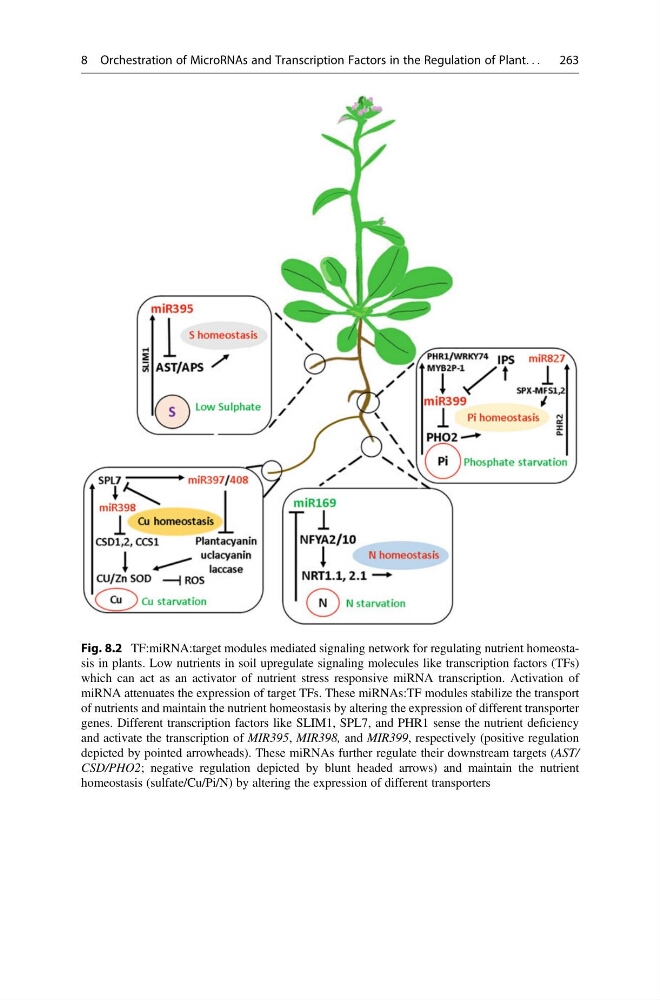
Fig. 8.2 TF:miRNA:target modules mediated signaling network for regulating nutrient homeostasis in plants. Low nutrients in soil upregulate signaling molecules like transcription factors (TFs)
which can act as an activator of nutrient stress responsive miRNA transcription. Activation of
miRNA attenuates the expression of target TFs. These miRNAs:TF modules stabilize the transport
of nutrients and maintain the nutrient homeostasis by altering the expression of different transporter
genes. Different transcription factors like SLIM1, SPL7, and PHR1 sense the nutrient deficiency
and activate the transcription of MIR395, MIR398, and MIR399, respectively (positive regulation
depicted by pointed arrowheads). These miRNAs further regulate their downstream targets (AST/
CSD/PHO2; negative regulation depicted by blunt headed arrows) and maintain the nutrient
homeostasis (sulfate/Cu/Pi/N) by altering the expression of different transporters
8 Orchestration of MicroRNAs and Transcription Factors in the Regulation of Plant. . .
263
which can act as an activator of nutrient stress responsive miRNA transcription. Activation of
miRNA attenuates the expression of target TFs. These miRNAs:TF modules stabilize the transport
of nutrients and maintain the nutrient homeostasis by altering the expression of different transporter
genes. Different transcription factors like SLIM1, SPL7, and PHR1 sense the nutrient deficiency
and activate the transcription of MIR395, MIR398, and MIR399, respectively (positive regulation
depicted by pointed arrowheads). These miRNAs further regulate their downstream targets (AST/
CSD/PHO2; negative regulation depicted by blunt headed arrows) and maintain the nutrient
homeostasis (sulfate/Cu/Pi/N) by altering the expression of different transporters
8 Orchestration of MicroRNAs and Transcription Factors in the Regulation of Plant. . .
263