

precursor required for ethylene, which is generally involved in inducing the plant
response to several abiotic stresses (Dimkpa et al. 2009; Yang et al. 2009).
Along with these the rhizosphere associated microorganisms such as Aeromonas
sp., Serratia sp., and Bacillus sp. are known to produce exopolysaccharides (Ashraf
et al. 2004), volatile compounds, antioxidants, accumulation of osmolytes, regulation of genes associated with drought stress and very importantly alters root morphology to promote more water acquisition from the soil. These alterations help the
plant to develop induced systemic tolerance and even exopolysaccharide produced
by microorganisms is a component of drought stress tolerance (Vurukonda et al.
2016).
The list of microorganisms associated with drought tolerance of plants is listed in
Table 7.2 and it also provides brief information on the mechanisms favored in the
presence of specific microorganisms against drought condition.
7.4
Plastic Pollution
Plastic is a growing monster and its impact on living world is not yet completely
documented and so is the case with agriculture. Especially microplastics distributed
all over the world are a hidden problem need to be evaluated in detail on its health
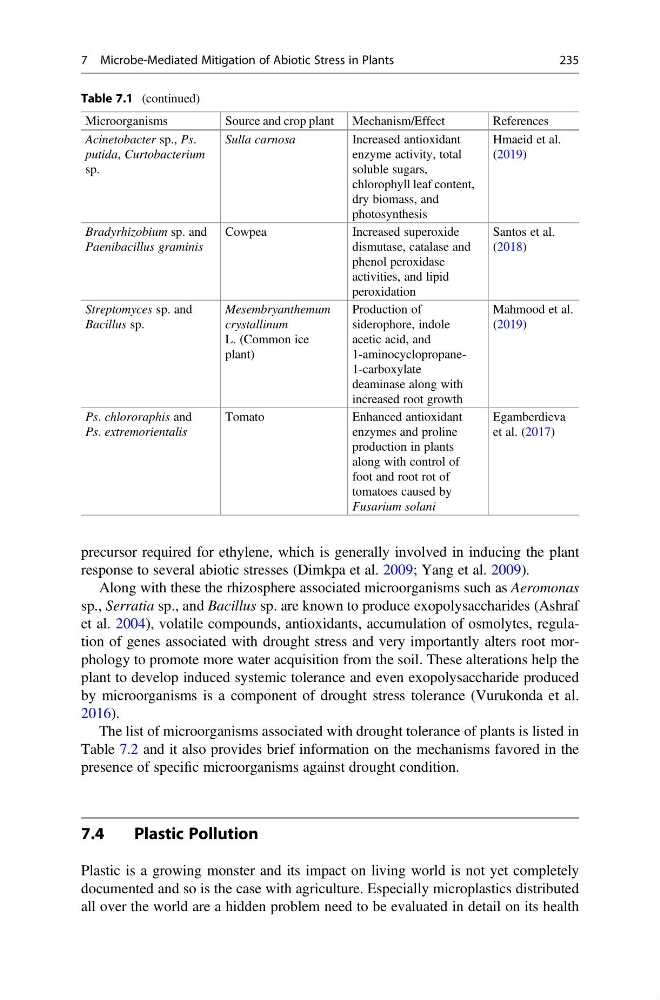
Table 7.1 (continued)
Microorganisms
Source and crop plant Mechanism/Effect
References
Acinetobacter sp., Ps.
putida, Curtobacterium
sp.
Sulla carnosa
Increased antioxidant
enzyme activity, total
soluble sugars,
chlorophyll leaf content,
dry biomass, and
photosynthesis
Hmaeid et al.
(2019)
Bradyrhizobium sp. and
Paenibacillus graminis
Cowpea
Increased superoxide
dismutase, catalase and
phenol peroxidase
activities, and lipid
peroxidation
Santos et al.
(2018)
Streptomyces sp. and
Bacillus sp.
Mesembryanthemum
crystallinum
L. (Common ice
plant)
Production of
siderophore, indole
acetic acid, and
1-aminocyclopropane1-carboxylate
deaminase along with
increased root growth
Mahmood et al.
(2019)
Ps. chlororaphis and
Ps. extremorientalis
Tomato
Enhanced antioxidant
enzymes and proline
production in plants
along with control of
foot and root rot of
tomatoes caused by
Fusarium solani
Egamberdieva
et al. (2017)
7 Microbe-Mediated Mitigation of Abiotic Stress in Plants
235
response to several abiotic stresses (Dimkpa et al. 2009; Yang et al. 2009).
Along with these the rhizosphere associated microorganisms such as Aeromonas
sp., Serratia sp., and Bacillus sp. are known to produce exopolysaccharides (Ashraf
et al. 2004), volatile compounds, antioxidants, accumulation of osmolytes, regulation of genes associated with drought stress and very importantly alters root morphology to promote more water acquisition from the soil. These alterations help the
plant to develop induced systemic tolerance and even exopolysaccharide produced
by microorganisms is a component of drought stress tolerance (Vurukonda et al.
2016).
The list of microorganisms associated with drought tolerance of plants is listed in
Table 7.2 and it also provides brief information on the mechanisms favored in the
presence of specific microorganisms against drought condition.
7.4
Plastic Pollution
Plastic is a growing monster and its impact on living world is not yet completely
documented and so is the case with agriculture. Especially microplastics distributed
all over the world are a hidden problem need to be evaluated in detail on its health
Table 7.1 (continued)
Microorganisms
Source and crop plant Mechanism/Effect
References
Acinetobacter sp., Ps.
putida, Curtobacterium
sp.
Sulla carnosa
Increased antioxidant
enzyme activity, total
soluble sugars,
chlorophyll leaf content,
dry biomass, and
photosynthesis
Hmaeid et al.
(2019)
Bradyrhizobium sp. and
Paenibacillus graminis
Cowpea
Increased superoxide
dismutase, catalase and
phenol peroxidase
activities, and lipid
peroxidation
Santos et al.
(2018)
Streptomyces sp. and
Bacillus sp.
Mesembryanthemum
crystallinum
L. (Common ice
plant)
Production of
siderophore, indole
acetic acid, and
1-aminocyclopropane1-carboxylate
deaminase along with
increased root growth
Mahmood et al.
(2019)
Ps. chlororaphis and
Ps. extremorientalis
Tomato
Enhanced antioxidant
enzymes and proline
production in plants
along with control of
foot and root rot of
tomatoes caused by
Fusarium solani
Egamberdieva
et al. (2017)
7 Microbe-Mediated Mitigation of Abiotic Stress in Plants
235