

7.1
Introduction
Sustainable agriculture is the main theme of the next green revolution. Scientists
over the globe are planning to develop a strategy to use the natural resources instead
of pouring too much of chemical fertilizers and pesticides to the agricultural fields.
Hence next green revolution should boost the productivity of the plant in an
environmentally sustainable manner. Mostly in the previous green revolution plant
associated environment and its natural component such as microorganisms were not
given much importance (Morrissey et al. 2004). Hence present-day agriculture is
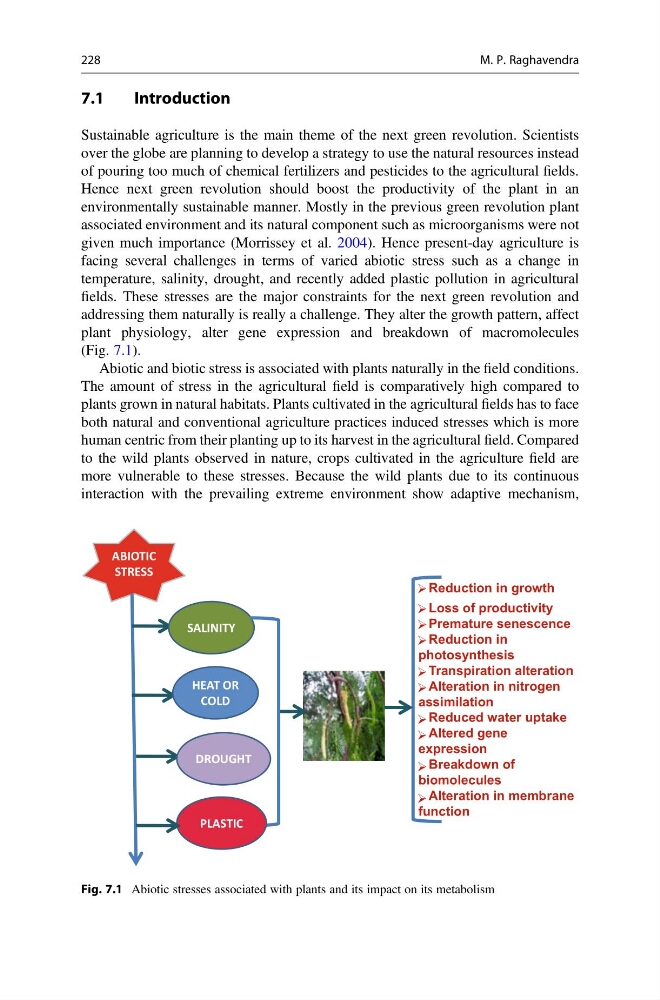
facing several challenges in terms of varied abiotic stress such as a change in
temperature, salinity, drought, and recently added plastic pollution in agricultural
fields. These stresses are the major constraints for the next green revolution and
addressing them naturally is really a challenge. They alter the growth pattern, affect
plant physiology, alter gene expression and breakdown of macromolecules
(Fig. 7.1).
Abiotic and biotic stress is associated with plants naturally in the field conditions.
The amount of stress in the agricultural field is comparatively high compared to
plants grown in natural habitats. Plants cultivated in the agricultural fields has to face
both natural and conventional agriculture practices induced stresses which is more
human centric from their planting up to its harvest in the agricultural field. Compared
to the wild plants observed in nature, crops cultivated in the agriculture field are
more vulnerable to these stresses. Because the wild plants due to its continuous
interaction with the prevailing extreme environment show adaptive mechanism,
ABIOTIC
STRESS
HEAT OR
COLD
SALINITY
DROUGHT
Reduction in growth
Loss of productivity
Premature senescence
Reduction in
photosynthesis
Transpiration alteration
Alteration in nitrogen
assimilation
Reduced water uptake
Altered gene
expression
Breakdown of
biomolecules
Alteration in membrane
function
PLASTIC
Fig. 7.1 Abiotic stresses associated with plants and its impact on its metabolism
228
M. P. Raghavendra
Introduction
Sustainable agriculture is the main theme of the next green revolution. Scientists
over the globe are planning to develop a strategy to use the natural resources instead
of pouring too much of chemical fertilizers and pesticides to the agricultural fields.
Hence next green revolution should boost the productivity of the plant in an
environmentally sustainable manner. Mostly in the previous green revolution plant
associated environment and its natural component such as microorganisms were not
given much importance (Morrissey et al. 2004). Hence present-day agriculture is
facing several challenges in terms of varied abiotic stress such as a change in
temperature, salinity, drought, and recently added plastic pollution in agricultural
fields. These stresses are the major constraints for the next green revolution and
addressing them naturally is really a challenge. They alter the growth pattern, affect
plant physiology, alter gene expression and breakdown of macromolecules
(Fig. 7.1).
Abiotic and biotic stress is associated with plants naturally in the field conditions.
The amount of stress in the agricultural field is comparatively high compared to
plants grown in natural habitats. Plants cultivated in the agricultural fields has to face
both natural and conventional agriculture practices induced stresses which is more
human centric from their planting up to its harvest in the agricultural field. Compared
to the wild plants observed in nature, crops cultivated in the agriculture field are
more vulnerable to these stresses. Because the wild plants due to its continuous
interaction with the prevailing extreme environment show adaptive mechanism,
ABIOTIC
STRESS
HEAT OR
COLD
SALINITY
DROUGHT
Reduction in growth
Loss of productivity
Premature senescence
Reduction in
photosynthesis
Transpiration alteration
Alteration in nitrogen
assimilation
Reduced water uptake
Altered gene
expression
Breakdown of
biomolecules
Alteration in membrane
function
PLASTIC
Fig. 7.1 Abiotic stresses associated with plants and its impact on its metabolism
228
M. P. Raghavendra