

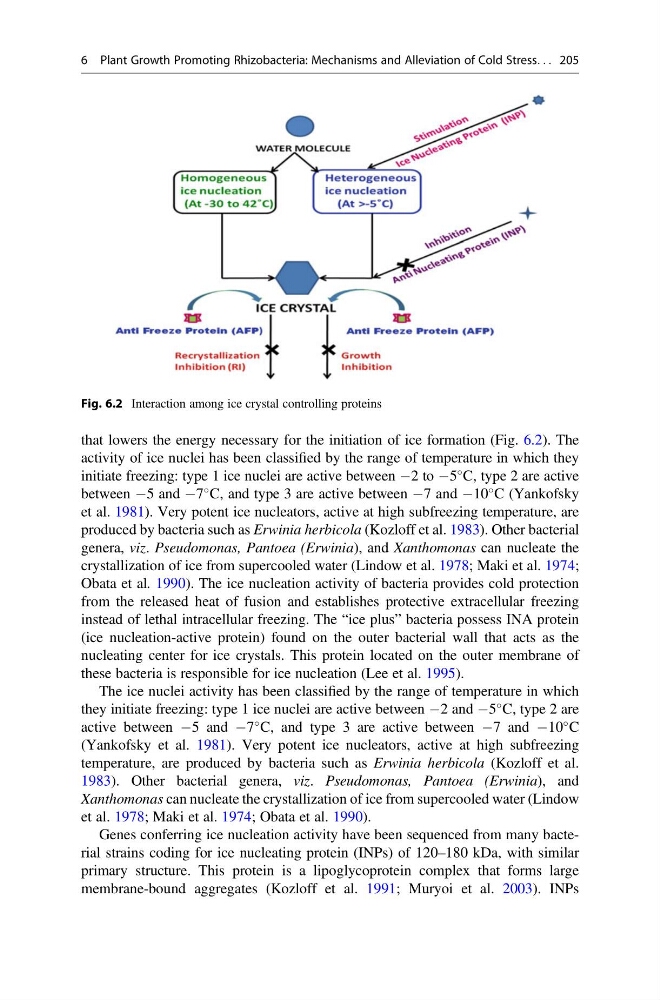
that lowers the energy necessary for the initiation of ice formation (Fig. 6.2). The
activity of ice nuclei has been classified by the range of temperature in which they
initiate freezing: type 1 ice nuclei are active between À2 to À5
C, type 2 are active
between À5 and À7
C, and type 3 are active between À7 and À10
C (Yankofsky
et al. 1981). Very potent ice nucleators, active at high subfreezing temperature, are
produced by bacteria such as Erwinia herbicola (Kozloff et al. 1983). Other bacterial
genera, viz. Pseudomonas, Pantoea (Erwinia), and Xanthomonas can nucleate the
crystallization of ice from supercooled water (Lindow et al. 1978; Maki et al. 1974;
Obata et al. 1990). The ice nucleation activity of bacteria provides cold protection
from the released heat of fusion and establishes protective extracellular freezing
instead of lethal intracellular freezing. The “ice plus” bacteria possess INA protein
(ice nucleation-active protein) found on the outer bacterial wall that acts as the
nucleating center for ice crystals. This protein located on the outer membrane of
these bacteria is responsible for ice nucleation (Lee et al. 1995).
The ice nuclei activity has been classified by the range of temperature in which
they initiate freezing: type 1 ice nuclei are active between À2 and À5
C, type 2 are
active between À5 and À7
C, and type 3 are active between À7 and À10
C
(Yankofsky et al. 1981). Very potent ice nucleators, active at high subfreezing
temperature, are produced by bacteria such as Erwinia herbicola (Kozloff et al.
1983). Other bacterial genera, viz. Pseudomonas, Pantoea (Erwinia), and
Xanthomonas can nucleate the crystallization of ice from supercooled water (Lindow
et al. 1978; Maki et al. 1974; Obata et al. 1990).
Genes conferring ice nucleation activity have been sequenced from many bacterial strains coding for ice nucleating protein (INPs) of 120–180 kDa, with similar
primary structure. This protein is a lipoglycoprotein complex that forms large
membrane-bound aggregates (Kozloff et al. 1991; Muryoi et al. 2003). INPs
Fig. 6.2 Interaction among ice crystal controlling proteins
6 Plant Growth Promoting Rhizobacteria: Mechanisms and Alleviation of Cold Stress. . . 205
activity of ice nuclei has been classified by the range of temperature in which they
initiate freezing: type 1 ice nuclei are active between À2 to À5
C, type 2 are active
between À5 and À7
C, and type 3 are active between À7 and À10
C (Yankofsky
et al. 1981). Very potent ice nucleators, active at high subfreezing temperature, are
produced by bacteria such as Erwinia herbicola (Kozloff et al. 1983). Other bacterial
genera, viz. Pseudomonas, Pantoea (Erwinia), and Xanthomonas can nucleate the
crystallization of ice from supercooled water (Lindow et al. 1978; Maki et al. 1974;
Obata et al. 1990). The ice nucleation activity of bacteria provides cold protection
from the released heat of fusion and establishes protective extracellular freezing
instead of lethal intracellular freezing. The “ice plus” bacteria possess INA protein
(ice nucleation-active protein) found on the outer bacterial wall that acts as the
nucleating center for ice crystals. This protein located on the outer membrane of
these bacteria is responsible for ice nucleation (Lee et al. 1995).
The ice nuclei activity has been classified by the range of temperature in which
they initiate freezing: type 1 ice nuclei are active between À2 and À5
C, type 2 are
active between À5 and À7
C, and type 3 are active between À7 and À10
C
(Yankofsky et al. 1981). Very potent ice nucleators, active at high subfreezing
temperature, are produced by bacteria such as Erwinia herbicola (Kozloff et al.
1983). Other bacterial genera, viz. Pseudomonas, Pantoea (Erwinia), and
Xanthomonas can nucleate the crystallization of ice from supercooled water (Lindow
et al. 1978; Maki et al. 1974; Obata et al. 1990).
Genes conferring ice nucleation activity have been sequenced from many bacterial strains coding for ice nucleating protein (INPs) of 120–180 kDa, with similar
primary structure. This protein is a lipoglycoprotein complex that forms large
membrane-bound aggregates (Kozloff et al. 1991; Muryoi et al. 2003). INPs
Fig. 6.2 Interaction among ice crystal controlling proteins
6 Plant Growth Promoting Rhizobacteria: Mechanisms and Alleviation of Cold Stress. . . 205