

Functionally, the low molecular-mass Csp group of proteins bind ssDNA and
RNA and have a closed β-barrel structure comprising five antiparallel β-strands
(Jiang et al. 1997). Bacterial cold shock proteins consist of a single nucleic acidbinding domain, called the cold shock domain (CSD). The CSD is considered to be
an ancient molecule present even prior to the advent of single cell life and is the most
evolutionarily conserved nucleic acid-binding domain within prokaryotes and
eukaryotes (Graumann and Marahiel 1998). The conserved aromatic amino acid
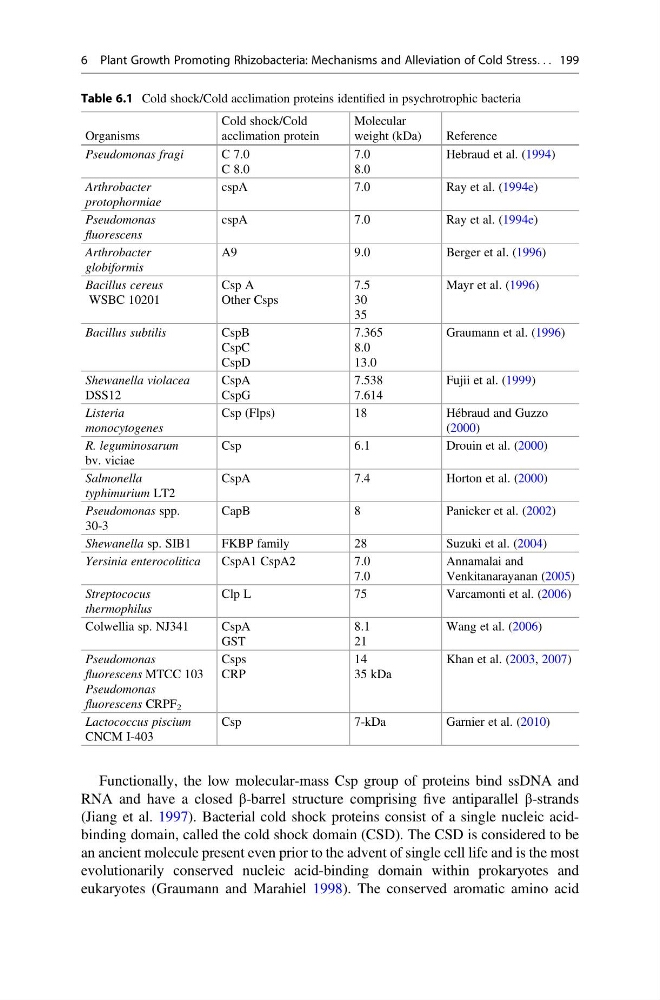
Table 6.1 Cold shock/Cold acclimation proteins identified in psychrotrophic bacteria
Organisms
Cold shock/Cold
acclimation protein
Molecular
weight (kDa)
Reference
Pseudomonas fragi
C 7.0
C 8.0
7.0
8.0
Hebraud et al. (1994)
Arthrobacter
protophormiae
cspA
7.0
Ray et al. (1994e)
Pseudomonas
fluorescens
cspA
7.0
Ray et al. (1994e)
Arthrobacter
globiformis
A9
9.0
Berger et al. (1996)
Bacillus cereus
WSBC 10201
Csp A
Other Csps
7.5
30
35
Mayr et al. (1996)
Bacillus subtilis
CspB
CspC
CspD
7.365
8.0
13.0
Graumann et al. (1996)
Shewanella violacea
DSS12
CspA
CspG
7.538
7.614
Fujii et al. (1999)
Listeria
monocytogenes
Csp (Flps)
18
Hébraud and Guzzo
(2000)
R. leguminosarum
bv. viciae
Csp
6.1
Drouin et al. (2000)
Salmonella
typhimurium LT2
CspA
7.4
Horton et al. (2000)
Pseudomonas spp.
30-3
CapB
8
Panicker et al. (2002)
Shewanella sp. SIB1
FKBP family
28
Suzuki et al. (2004)
Yersinia enterocolitica
CspA1 CspA2
7.0
7.0
Annamalai and
Venkitanarayanan (2005)
Streptococus
thermophilus
Clp L
75
Varcamonti et al. (2006)
Colwellia sp. NJ341
CspA
GST
8.1
21
Wang et al. (2006)
Pseudomonas
fluorescens MTCC 103
Pseudomonas
fluorescens CRPF 2
Csps
CRP
14
35 kDa
Khan et al. (2003, 2007)
Lactococcus piscium
CNCM I-403
Csp
7-kDa
Garnier et al. (2010)
6 Plant Growth Promoting Rhizobacteria: Mechanisms and Alleviation of Cold Stress. . . 199
RNA and have a closed β-barrel structure comprising five antiparallel β-strands
(Jiang et al. 1997). Bacterial cold shock proteins consist of a single nucleic acidbinding domain, called the cold shock domain (CSD). The CSD is considered to be
an ancient molecule present even prior to the advent of single cell life and is the most
evolutionarily conserved nucleic acid-binding domain within prokaryotes and
eukaryotes (Graumann and Marahiel 1998). The conserved aromatic amino acid
Table 6.1 Cold shock/Cold acclimation proteins identified in psychrotrophic bacteria
Organisms
Cold shock/Cold
acclimation protein
Molecular
weight (kDa)
Reference
Pseudomonas fragi
C 7.0
C 8.0
7.0
8.0
Hebraud et al. (1994)
Arthrobacter
protophormiae
cspA
7.0
Ray et al. (1994e)
Pseudomonas
fluorescens
cspA
7.0
Ray et al. (1994e)
Arthrobacter
globiformis
A9
9.0
Berger et al. (1996)
Bacillus cereus
WSBC 10201
Csp A
Other Csps
7.5
30
35
Mayr et al. (1996)
Bacillus subtilis
CspB
CspC
CspD
7.365
8.0
13.0
Graumann et al. (1996)
Shewanella violacea
DSS12
CspA
CspG
7.538
7.614
Fujii et al. (1999)
Listeria
monocytogenes
Csp (Flps)
18
Hébraud and Guzzo
(2000)
R. leguminosarum
bv. viciae
Csp
6.1
Drouin et al. (2000)
Salmonella
typhimurium LT2
CspA
7.4
Horton et al. (2000)
Pseudomonas spp.
30-3
CapB
8
Panicker et al. (2002)
Shewanella sp. SIB1
FKBP family
28
Suzuki et al. (2004)
Yersinia enterocolitica
CspA1 CspA2
7.0
7.0
Annamalai and
Venkitanarayanan (2005)
Streptococus
thermophilus
Clp L
75
Varcamonti et al. (2006)
Colwellia sp. NJ341
CspA
GST
8.1
21
Wang et al. (2006)
Pseudomonas
fluorescens MTCC 103
Pseudomonas
fluorescens CRPF 2
Csps
CRP
14
35 kDa
Khan et al. (2003, 2007)
Lactococcus piscium
CNCM I-403
Csp
7-kDa
Garnier et al. (2010)
6 Plant Growth Promoting Rhizobacteria: Mechanisms and Alleviation of Cold Stress. . . 199