

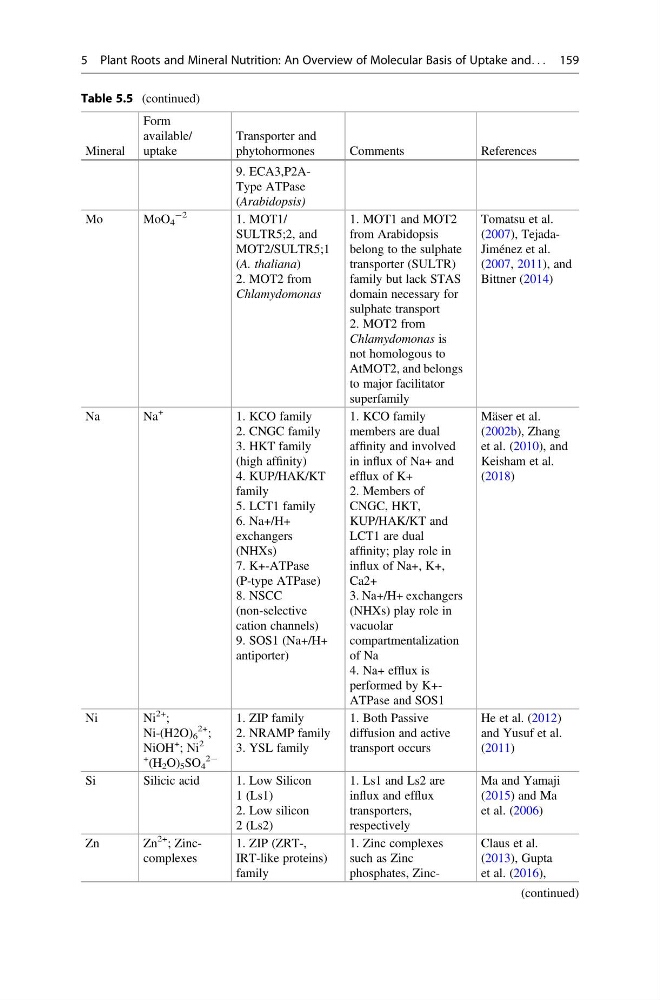
Table 5.5 (continued)
Mineral
Form
available/
uptake
Transporter and
phytohormones
Comments
References
9. ECA3,P2AType ATPase
(Arabidopsis)
Mo
MoO 4
À2
1. MOT1/
SULTR5;2, and
MOT2/SULTR5;1
(A. thaliana)
2. MOT2 from
Chlamydomonas
1. MOT1 and MOT2
from Arabidopsis
belong to the sulphate
transporter (SULTR)
family but lack STAS
domain necessary for
sulphate transport
2. MOT2 from
Chlamydomonas is
not homologous to
AtMOT2, and belongs
to major facilitator
superfamily
Tomatsu et al.
(2007), TejadaJiménez et al.
(2007, 2011), and
Bittner (2014)
Na
Na
+
1. KCO family
2. CNGC family
3. HKT family
(high affinity)
4. KUP/HAK/KT
family
5. LCT1 family
6. Na+/H+
exchangers
(NHXs)
7. K+-ATPase
(P-type ATPase)
8. NSCC
(non-selective
cation channels)
9. SOS1 (Na+/H+
antiporter)
1. KCO family
members are dual
affinity and involved
in influx of Na+ and
efflux of K+
2. Members of
CNGC, HKT,
KUP/HAK/KT and
LCT1 are dual
affinity; play role in
influx of Na+, K+,
Ca2+
3. Na+/H+ exchangers
(NHXs) play role in
vacuolar
compartmentalization
of Na
4. Na+ efflux is
performed by K+ATPase and SOS1
Mäser et al.
(2002b), Zhang
et al. (2010), and
Keisham et al.
(2018)
Ni
Ni
2+ ;
Ni-(H2O) 6
2+ ;
NiOH
+ ; Ni
2
+ (H 2 O) 5 SO 4
2À
1. ZIP family
2. NRAMP family
3. YSL family
1. Both Passive
diffusion and active
transport occurs
He et al. (2012)
and Yusuf et al.
(2011)
Si
Silicic acid
1. Low Silicon
1 (Ls1)
2. Low silicon
2 (Ls2)
1. Ls1 and Ls2 are
influx and efflux
transporters,
respectively
Ma and Yamaji
(2015) and Ma
et al. (2006)
Zn
Zn
2+ ; Zinccomplexes
1. ZIP (ZRT-,
IRT-like proteins)
family
1. Zinc complexes
such as Zinc
phosphates, ZincClaus et al.
(2013), Gupta
et al. (2016),
(continued)
5 Plant Roots and Mineral Nutrition: An Overview of Molecular Basis of Uptake and. . . 159
Mineral
Form
available/
uptake
Transporter and
phytohormones
Comments
References
9. ECA3,P2AType ATPase
(Arabidopsis)
Mo
MoO 4
À2
1. MOT1/
SULTR5;2, and
MOT2/SULTR5;1
(A. thaliana)
2. MOT2 from
Chlamydomonas
1. MOT1 and MOT2
from Arabidopsis
belong to the sulphate
transporter (SULTR)
family but lack STAS
domain necessary for
sulphate transport
2. MOT2 from
Chlamydomonas is
not homologous to
AtMOT2, and belongs
to major facilitator
superfamily
Tomatsu et al.
(2007), TejadaJiménez et al.
(2007, 2011), and
Bittner (2014)
Na
Na
+
1. KCO family
2. CNGC family
3. HKT family
(high affinity)
4. KUP/HAK/KT
family
5. LCT1 family
6. Na+/H+
exchangers
(NHXs)
7. K+-ATPase
(P-type ATPase)
8. NSCC
(non-selective
cation channels)
9. SOS1 (Na+/H+
antiporter)
1. KCO family
members are dual
affinity and involved
in influx of Na+ and
efflux of K+
2. Members of
CNGC, HKT,
KUP/HAK/KT and
LCT1 are dual
affinity; play role in
influx of Na+, K+,
Ca2+
3. Na+/H+ exchangers
(NHXs) play role in
vacuolar
compartmentalization
of Na
4. Na+ efflux is
performed by K+ATPase and SOS1
Mäser et al.
(2002b), Zhang
et al. (2010), and
Keisham et al.
(2018)
Ni
Ni
2+ ;
Ni-(H2O) 6
2+ ;
NiOH
+ ; Ni
2
+ (H 2 O) 5 SO 4
2À
1. ZIP family
2. NRAMP family
3. YSL family
1. Both Passive
diffusion and active
transport occurs
He et al. (2012)
and Yusuf et al.
(2011)
Si
Silicic acid
1. Low Silicon
1 (Ls1)
2. Low silicon
2 (Ls2)
1. Ls1 and Ls2 are
influx and efflux
transporters,
respectively
Ma and Yamaji
(2015) and Ma
et al. (2006)
Zn
Zn
2+ ; Zinccomplexes
1. ZIP (ZRT-,
IRT-like proteins)
family
1. Zinc complexes
such as Zinc
phosphates, ZincClaus et al.
(2013), Gupta
et al. (2016),
(continued)
5 Plant Roots and Mineral Nutrition: An Overview of Molecular Basis of Uptake and. . . 159