

49
and Indonesia) by sharing the JANIS software to maintain national antimicrobial
resistance surveillance (JANIS 2000; Morikane 2012; Tanihara and Suzuki 2016).
2.10 Genomics in Global Antimicrobial
Resistance Surveillance
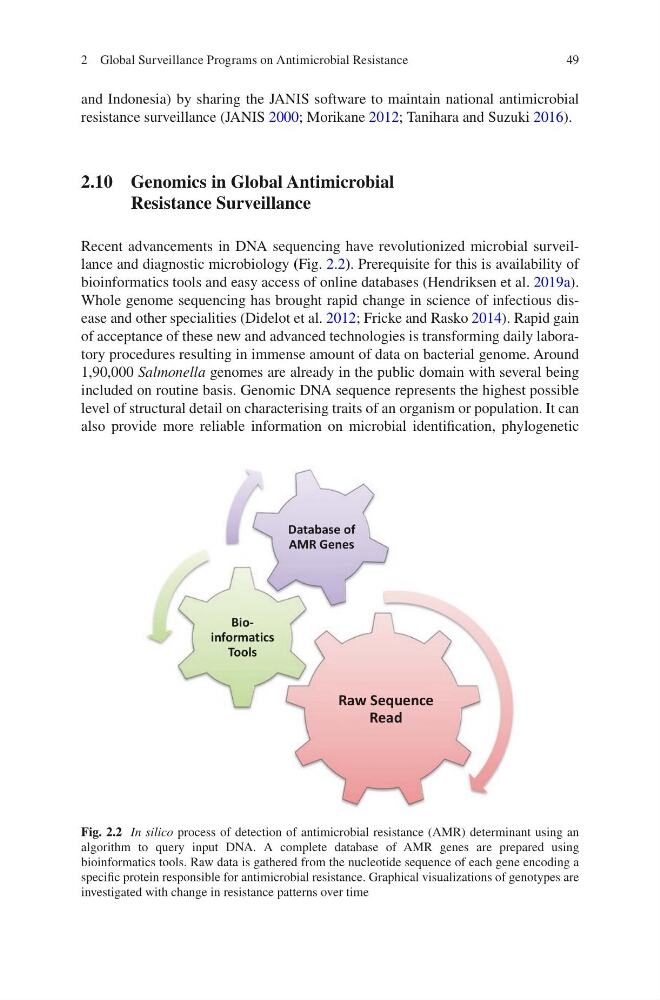
Recent advancements in DNA sequencing have revolutionized microbial surveillance and diagnostic microbiology (Fig. 2.2). Prerequisite for this is availability of
bioinformatics tools and easy access of online databases (Hendriksen et al. 2019a).
Whole genome sequencing has brought rapid change in science of infectious disease and other specialities (Didelot et al. 2012; Fricke and Rasko 2014). Rapid gain
of acceptance of these new and advanced technologies is transforming daily laboratory procedures resulting in immense amount of data on bacterial genome. Around
1,90,000 Salmonella genomes are already in the public domain with several being
included on routine basis. Genomic DNA sequence represents the highest possible
level of structural detail on characterising traits of an organism or population. It can
also provide more reliable information on microbial identification, phylogenetic
Raw Sequence
Read
Bioinformatics
Tools
Database of
AMR Genes
Fig. 2.2 In silico process of detection of antimicrobial resistance (AMR) determinant using an
algorithm to query input DNA. A complete database of AMR genes are prepared using
bioinformatics tools. Raw data is gathered from the nucleotide sequence of each gene encoding a
specific protein responsible for antimicrobial resistance. Graphical visualizations of genotypes are
investigated with change in resistance patterns over time
2 Global Surveillance Programs on Antimicrobial Resistance
and Indonesia) by sharing the JANIS software to maintain national antimicrobial
resistance surveillance (JANIS 2000; Morikane 2012; Tanihara and Suzuki 2016).
2.10 Genomics in Global Antimicrobial
Resistance Surveillance
Recent advancements in DNA sequencing have revolutionized microbial surveillance and diagnostic microbiology (Fig. 2.2). Prerequisite for this is availability of
bioinformatics tools and easy access of online databases (Hendriksen et al. 2019a).
Whole genome sequencing has brought rapid change in science of infectious disease and other specialities (Didelot et al. 2012; Fricke and Rasko 2014). Rapid gain
of acceptance of these new and advanced technologies is transforming daily laboratory procedures resulting in immense amount of data on bacterial genome. Around
1,90,000 Salmonella genomes are already in the public domain with several being
included on routine basis. Genomic DNA sequence represents the highest possible
level of structural detail on characterising traits of an organism or population. It can
also provide more reliable information on microbial identification, phylogenetic
Raw Sequence
Read
Bioinformatics
Tools
Database of
AMR Genes
Fig. 2.2 In silico process of detection of antimicrobial resistance (AMR) determinant using an
algorithm to query input DNA. A complete database of AMR genes are prepared using
bioinformatics tools. Raw data is gathered from the nucleotide sequence of each gene encoding a
specific protein responsible for antimicrobial resistance. Graphical visualizations of genotypes are
investigated with change in resistance patterns over time
2 Global Surveillance Programs on Antimicrobial Resistance