

11
disease state of the animals. Thus to qualify these maximum residue limit levels,
proper training should be provided to the farmers to facilitate careful use of antibiotics and monitoring of animal recovery. They also need to be sensitized about the
withdrawal period of antibiotic to ensure its excretion and clearance from tissues
within safe levels for human consumption, before its sale to the customer. This varies widely depending upon the drug type, animals and dosage form, and thus should
be properly explained and monitored to the farmers by veterinary practitioners. In
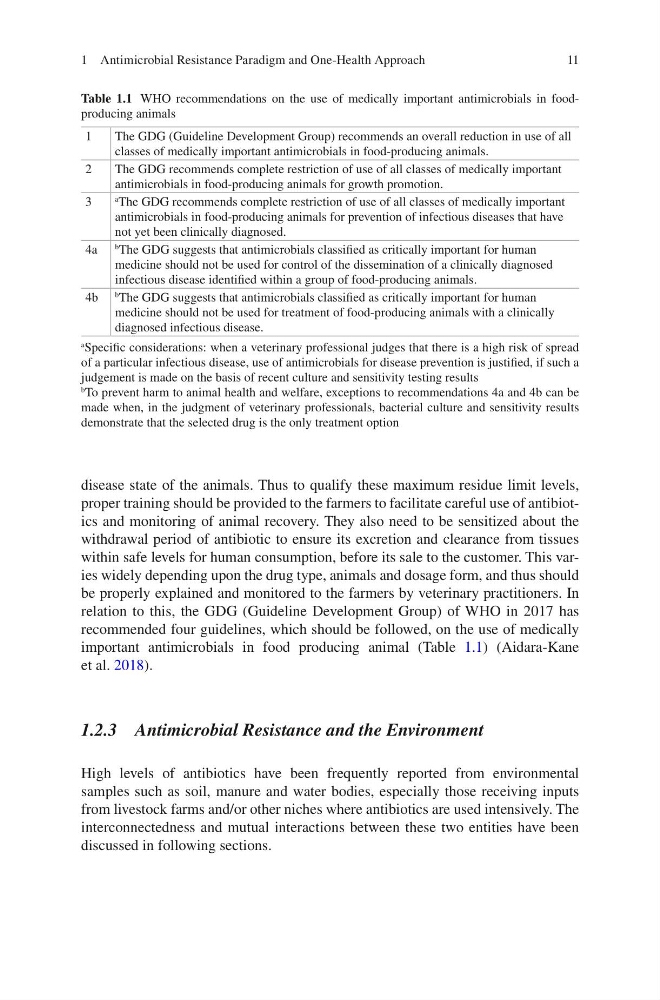
relation to this, the GDG (Guideline Development Group) of WHO in 2017 has
recommended four guidelines, which should be followed, on the use of medically
important antimicrobials in food producing animal (Table 1.1) (Aidara-Kane
et al. 2018).
1.2.3 Antimicrobial Resistance and the Environment
High levels of antibiotics have been frequently reported from environmental
samples such as soil, manure and water bodies, especially those receiving inputs
from livestock farms and/or other niches where antibiotics are used intensively. The
interconnectedness and mutual interactions between these two entities have been
discussed in following sections.
Table 1.1 WHO recommendations on the use of medically important antimicrobials in foodproducing animals
1
The GDG (Guideline Development Group) recommends an overall reduction in use of all
classes of medically important antimicrobials in food-producing animals.
2
The GDG recommends complete restriction of use of all classes of medically important
antimicrobials in food-producing animals for growth promotion.
3
a
The GDG recommends complete restriction of use of all classes of medically important
antimicrobials in food-producing animals for prevention of infectious diseases that have
not yet been clinically diagnosed.
4a
b
The GDG suggests that antimicrobials classified as critically important for human
medicine should not be used for control of the dissemination of a clinically diagnosed
infectious disease identified within a group of food-producing animals.
4b
b
The GDG suggests that antimicrobials classified as critically important for human
medicine should not be used for treatment of food-producing animals with a clinically
diagnosed infectious disease.
a
Specific considerations: when a veterinary professional judges that there is a high risk of spread
of a particular infectious disease, use of antimicrobials for disease prevention is justified, if such a
judgement is made on the basis of recent culture and sensitivity testing results
b
To prevent harm to animal health and welfare, exceptions to recommendations 4a and 4b can be
made when, in the judgment of veterinary professionals, bacterial culture and sensitivity results
demonstrate that the selected drug is the only treatment option
1 Antimicrobial Resistance Paradigm and One-Health Approach
disease state of the animals. Thus to qualify these maximum residue limit levels,
proper training should be provided to the farmers to facilitate careful use of antibiotics and monitoring of animal recovery. They also need to be sensitized about the
withdrawal period of antibiotic to ensure its excretion and clearance from tissues
within safe levels for human consumption, before its sale to the customer. This varies widely depending upon the drug type, animals and dosage form, and thus should
be properly explained and monitored to the farmers by veterinary practitioners. In
relation to this, the GDG (Guideline Development Group) of WHO in 2017 has
recommended four guidelines, which should be followed, on the use of medically
important antimicrobials in food producing animal (Table 1.1) (Aidara-Kane
et al. 2018).
1.2.3 Antimicrobial Resistance and the Environment
High levels of antibiotics have been frequently reported from environmental
samples such as soil, manure and water bodies, especially those receiving inputs
from livestock farms and/or other niches where antibiotics are used intensively. The
interconnectedness and mutual interactions between these two entities have been
discussed in following sections.
Table 1.1 WHO recommendations on the use of medically important antimicrobials in foodproducing animals
1
The GDG (Guideline Development Group) recommends an overall reduction in use of all
classes of medically important antimicrobials in food-producing animals.
2
The GDG recommends complete restriction of use of all classes of medically important
antimicrobials in food-producing animals for growth promotion.
3
a
The GDG recommends complete restriction of use of all classes of medically important
antimicrobials in food-producing animals for prevention of infectious diseases that have
not yet been clinically diagnosed.
4a
b
The GDG suggests that antimicrobials classified as critically important for human
medicine should not be used for control of the dissemination of a clinically diagnosed
infectious disease identified within a group of food-producing animals.
4b
b
The GDG suggests that antimicrobials classified as critically important for human
medicine should not be used for treatment of food-producing animals with a clinically
diagnosed infectious disease.
a
Specific considerations: when a veterinary professional judges that there is a high risk of spread
of a particular infectious disease, use of antimicrobials for disease prevention is justified, if such a
judgement is made on the basis of recent culture and sensitivity testing results
b
To prevent harm to animal health and welfare, exceptions to recommendations 4a and 4b can be
made when, in the judgment of veterinary professionals, bacterial culture and sensitivity results
demonstrate that the selected drug is the only treatment option
1 Antimicrobial Resistance Paradigm and One-Health Approach