

186
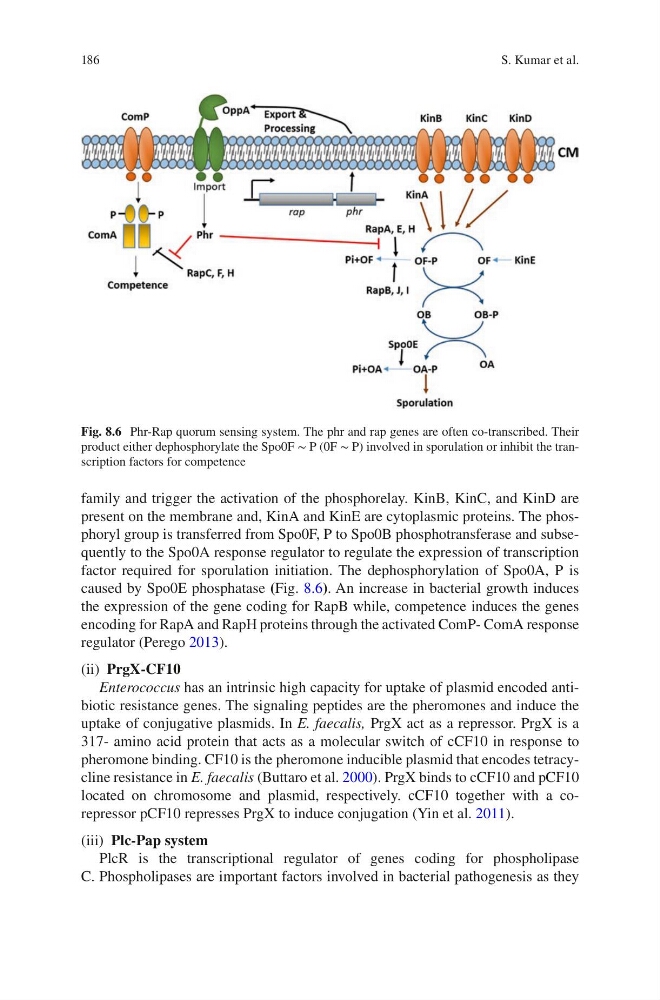
family and trigger the activation of the phosphorelay. KinB, KinC, and KinD are
present on the membrane and, KinA and KinE are cytoplasmic proteins. The phosphoryl group is transferred from Spo0F, P to Spo0B phosphotransferase and subsequently to the Spo0A response regulator to regulate the expression of transcription
factor required for sporulation initiation. The dephosphorylation of Spo0A, P is
caused by Spo0E phosphatase (Fig. 8.6). An increase in bacterial growth induces
the expression of the gene coding for RapB while, competence induces the genes
encoding for RapA and RapH proteins through the activated ComP- ComA response
regulator (Perego 2013).
(ii) PrgX-CF10
Enterococcus has an intrinsic high capacity for uptake of plasmid encoded antibiotic resistance genes. The signaling peptides are the pheromones and induce the
uptake of conjugative plasmids. In E. faecalis, PrgX act as a repressor. PrgX is a
317- amino acid protein that acts as a molecular switch of cCF10 in response to
pheromone binding. CF10 is the pheromone inducible plasmid that encodes tetracycline resistance in E. faecalis (Buttaro et al. 2000). PrgX binds to cCF10 and pCF10
located on chromosome and plasmid, respectively. cCF10 together with a corepressor pCF10 represses PrgX to induce conjugation (Yin et al. 2011).
(iii) Plc-Pap system
PlcR is the transcriptional regulator of genes coding for phospholipase
C. Phospholipases are important factors involved in bacterial pathogenesis as they
Fig. 8.6 Phr-Rap quorum sensing system. The phr and rap genes are often co-transcribed. Their
product either dephosphorylate the Spo0F ∼ P (0F ∼ P) involved in sporulation or inhibit the transcription factors for competence
S. Kumar et al.
family and trigger the activation of the phosphorelay. KinB, KinC, and KinD are
present on the membrane and, KinA and KinE are cytoplasmic proteins. The phosphoryl group is transferred from Spo0F, P to Spo0B phosphotransferase and subsequently to the Spo0A response regulator to regulate the expression of transcription
factor required for sporulation initiation. The dephosphorylation of Spo0A, P is
caused by Spo0E phosphatase (Fig. 8.6). An increase in bacterial growth induces
the expression of the gene coding for RapB while, competence induces the genes
encoding for RapA and RapH proteins through the activated ComP- ComA response
regulator (Perego 2013).
(ii) PrgX-CF10
Enterococcus has an intrinsic high capacity for uptake of plasmid encoded antibiotic resistance genes. The signaling peptides are the pheromones and induce the
uptake of conjugative plasmids. In E. faecalis, PrgX act as a repressor. PrgX is a
317- amino acid protein that acts as a molecular switch of cCF10 in response to
pheromone binding. CF10 is the pheromone inducible plasmid that encodes tetracycline resistance in E. faecalis (Buttaro et al. 2000). PrgX binds to cCF10 and pCF10
located on chromosome and plasmid, respectively. cCF10 together with a corepressor pCF10 represses PrgX to induce conjugation (Yin et al. 2011).
(iii) Plc-Pap system
PlcR is the transcriptional regulator of genes coding for phospholipase
C. Phospholipases are important factors involved in bacterial pathogenesis as they
Fig. 8.6 Phr-Rap quorum sensing system. The phr and rap genes are often co-transcribed. Their
product either dephosphorylate the Spo0F ∼ P (0F ∼ P) involved in sporulation or inhibit the transcription factors for competence
S. Kumar et al.