

180
members of the LuxI protein family using an appropriate acyl-acyl carrier protein
(acyl-ACP) as an acyl donor and S-adenosylmethionine (SAM) as the amino donor.
The first acyl-HSL signaling was observed in a photobacterium Vibrio fischeri,
which produce light at high cell density, but not at low cell density. The acyl-HSL
QS circuit is composed of an autoinducer (N-3-oxohexanoylhomoserinelactone
[OHHL] in Vibrio fischeri), LuxI and LuxR proteins. Autoinducer is produced by
LuxI protein that can diffuse freely in and out of cells. With the increase in cell
density, the concentration of autoinducers also increases. Autoinducers are produced throughout the growth in a limited amount so high cell density is required to
reach the threshold concentration of autoinducers. The receptor for autoinducers is
LuxR protein. The LuxR protein is unstable in a free state and forms a stable structure when it bounds to AIs. This stable complex (LuxR-AI) acts as a transcriptional
activator of specific genes to regulate bacterial physiology. This complex also
induces the expression of LuxI (Fig. 8.3) (Parsek et al. 1999; Swift et al. 2001).
8.2.2 Non-acyl HSL Mediated Quorum Sensing
Gram negative bacteria Ralstonia solanacearum and Xanthomonas campestris
employ the non-acyl HSL mediated quorum sensing. Some Gram negative bacteria
use the phenotype conversion (Phc) regulatory system and diffusible signal factors
(DSF) to regulate the production of enzymes, polysaccharides, signaling molecules,
motility, biofilm formation, and pathogenicity. Phc based quorum sensing system
H
N
O
O
C4-HSL
p-Coumaroyl-HSL
Isovalery-HSL
AI-2 family
Acyl-HSL family
3OC6-HSL
O
OH
OH
OH
OH
OH
HO
HO
B -
OH
O
O
O
O
HO
HO
O
DPD
R-THMF
S-THMF
O
(S)
(S)
(S)
(S)
(R)
(R)
CH 3
CH 3
CH 3
CH
3
CH 3
CH 3
(R)
H
OH
N
O
O
O
(R)
H
N
O
O
O
O
(R)
H
N
O
O
O
(R)
CH 3
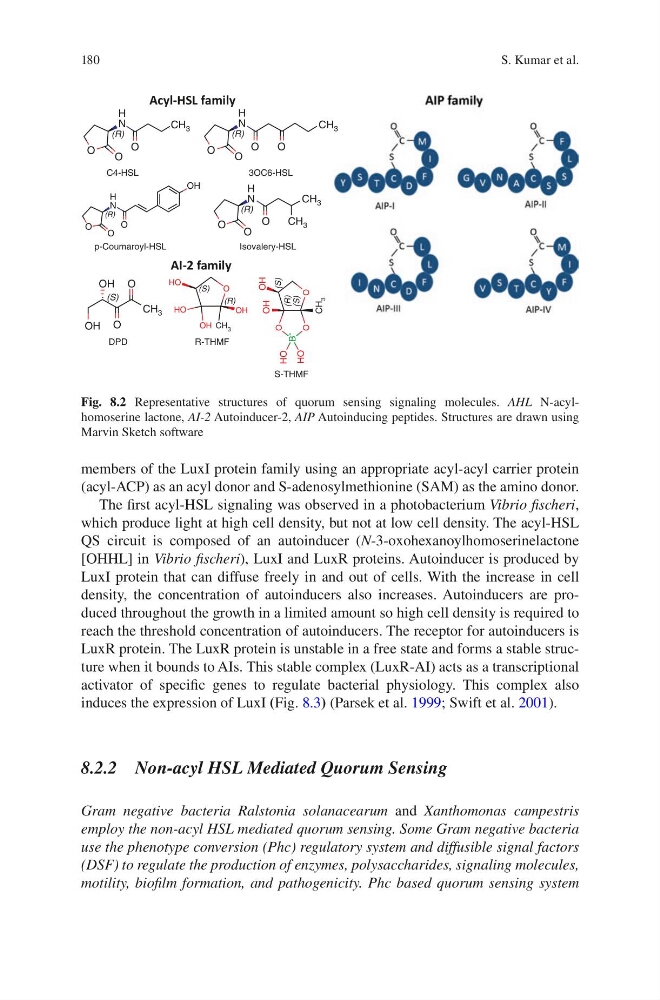
Fig. 8.2 Representative structures of quorum sensing signaling molecules. AHL N-acylhomoserine lactone, AI-2 Autoinducer-2, AIP Autoinducing peptides. Structures are drawn using
Marvin Sketch software
S. Kumar et al.
members of the LuxI protein family using an appropriate acyl-acyl carrier protein
(acyl-ACP) as an acyl donor and S-adenosylmethionine (SAM) as the amino donor.
The first acyl-HSL signaling was observed in a photobacterium Vibrio fischeri,
which produce light at high cell density, but not at low cell density. The acyl-HSL
QS circuit is composed of an autoinducer (N-3-oxohexanoylhomoserinelactone
[OHHL] in Vibrio fischeri), LuxI and LuxR proteins. Autoinducer is produced by
LuxI protein that can diffuse freely in and out of cells. With the increase in cell
density, the concentration of autoinducers also increases. Autoinducers are produced throughout the growth in a limited amount so high cell density is required to
reach the threshold concentration of autoinducers. The receptor for autoinducers is
LuxR protein. The LuxR protein is unstable in a free state and forms a stable structure when it bounds to AIs. This stable complex (LuxR-AI) acts as a transcriptional
activator of specific genes to regulate bacterial physiology. This complex also
induces the expression of LuxI (Fig. 8.3) (Parsek et al. 1999; Swift et al. 2001).
8.2.2 Non-acyl HSL Mediated Quorum Sensing
Gram negative bacteria Ralstonia solanacearum and Xanthomonas campestris
employ the non-acyl HSL mediated quorum sensing. Some Gram negative bacteria
use the phenotype conversion (Phc) regulatory system and diffusible signal factors
(DSF) to regulate the production of enzymes, polysaccharides, signaling molecules,
motility, biofilm formation, and pathogenicity. Phc based quorum sensing system
H
N
O
O
C4-HSL
p-Coumaroyl-HSL
Isovalery-HSL
AI-2 family
Acyl-HSL family
3OC6-HSL
O
OH
OH
OH
OH
OH
HO
HO
B -
OH
O
O
O
O
HO
HO
O
DPD
R-THMF
S-THMF
O
(S)
(S)
(S)
(S)
(R)
(R)
CH 3
CH 3
CH 3
CH
3
CH 3
CH 3
(R)
H
OH
N
O
O
O
(R)
H
N
O
O
O
O
(R)
H
N
O
O
O
(R)
CH 3
Fig. 8.2 Representative structures of quorum sensing signaling molecules. AHL N-acylhomoserine lactone, AI-2 Autoinducer-2, AIP Autoinducing peptides. Structures are drawn using
Marvin Sketch software
S. Kumar et al.