

178
8.1 Introduction
Quorum sensing (QS) is a general term for a bacterial system which helps in communication between bacterial cells. This process involves the production of extracellular signaling molecules called autoinducers (AIs). These molecules are
produced by bacteria in response to changes in their population in a particular niche.
After the accumulation of autoinducers in the local environment, bacteria detect and
respond to AIs to activate the transcription of specific genes to regulate the physiological activities such as symbiosis, reproduction, competence, antibiotic production, antibiotic resistance, biofilm formation, motility, sporulation, bioluminescence,
etc. (Miller and Bassler 2001; Rutherford and Bassler 2012). Despite the different
quorum sensing signaling systems namely acylated homoserine lactones (AHLs),
autoinducer-2 (AI-2), diffusible signal factors (DSFs), diketopiperazines (DKPs),
4-hydroxy-2-alkylquinolines (HAQs) and others, all known QS systems follow the
three basic principles: (1) the community members produce the signaling molecules. When the population is less, the concentration of autoinducer is below the
threshold required for detection. When the population is high, the concentration of
autoinducer is high in the surrounding environment for their detection and responses.
(2) Receptors for autoinducers are either present in the membrane or cytoplasm. (3)
In concert with the activation of specific genes, detection of autoinducer itself
induce the production of autoinducers (Kaplan and Greenberg 1985; Seed
et al. 1995).
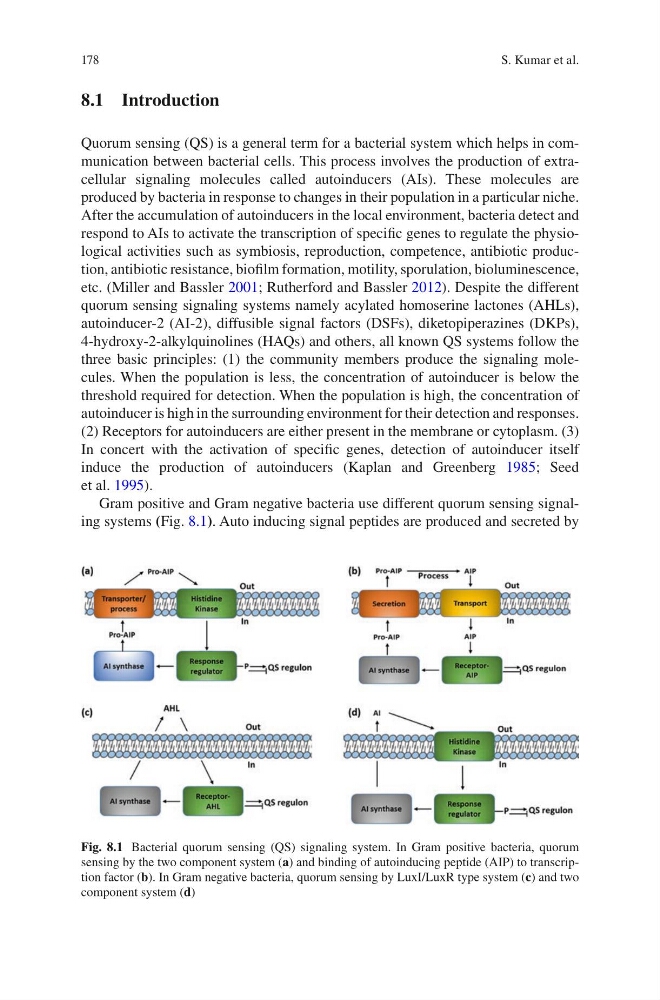
Gram positive and Gram negative bacteria use different quorum sensing signaling systems (Fig. 8.1). Auto inducing signal peptides are produced and secreted by
Fig. 8.1 Bacterial quorum sensing (QS) signaling system. In Gram positive bacteria, quorum
sensing by the two component system (a) and binding of autoinducing peptide (AIP) to transcription factor (b). In Gram negative bacteria, quorum sensing by LuxI/LuxR type system (c) and two
component system (d)
S. Kumar et al.
8.1 Introduction
Quorum sensing (QS) is a general term for a bacterial system which helps in communication between bacterial cells. This process involves the production of extracellular signaling molecules called autoinducers (AIs). These molecules are
produced by bacteria in response to changes in their population in a particular niche.
After the accumulation of autoinducers in the local environment, bacteria detect and
respond to AIs to activate the transcription of specific genes to regulate the physiological activities such as symbiosis, reproduction, competence, antibiotic production, antibiotic resistance, biofilm formation, motility, sporulation, bioluminescence,
etc. (Miller and Bassler 2001; Rutherford and Bassler 2012). Despite the different
quorum sensing signaling systems namely acylated homoserine lactones (AHLs),
autoinducer-2 (AI-2), diffusible signal factors (DSFs), diketopiperazines (DKPs),
4-hydroxy-2-alkylquinolines (HAQs) and others, all known QS systems follow the
three basic principles: (1) the community members produce the signaling molecules. When the population is less, the concentration of autoinducer is below the
threshold required for detection. When the population is high, the concentration of
autoinducer is high in the surrounding environment for their detection and responses.
(2) Receptors for autoinducers are either present in the membrane or cytoplasm. (3)
In concert with the activation of specific genes, detection of autoinducer itself
induce the production of autoinducers (Kaplan and Greenberg 1985; Seed
et al. 1995).
Gram positive and Gram negative bacteria use different quorum sensing signaling systems (Fig. 8.1). Auto inducing signal peptides are produced and secreted by
Fig. 8.1 Bacterial quorum sensing (QS) signaling system. In Gram positive bacteria, quorum
sensing by the two component system (a) and binding of autoinducing peptide (AIP) to transcription factor (b). In Gram negative bacteria, quorum sensing by LuxI/LuxR type system (c) and two
component system (d)
S. Kumar et al.