

160
autoinducer RNAIII-activating protein (RAP), which induces the phosphorylation
of the target of RAP (TRAP). Thus, if TRAP expression or phosphorylation will be
blocked by RNAIII-inhibiting peptide, the bacteria do not produce toxins and do not
cause disease. RNAIII-inhibiting peptide has already been tested and found to have
strong activity in preventing staphylococcal infections, including drug resistant
strains, such as methicillin resistant S. aureus (MRSA), glycopeptides intermediate
S. aureus, and vancomycin intermediate S. aureus strains (Balaban et al. 2007).
Intestinally, a study showed that quorum sensing inhibitors increase the susceptibility of bacterial biofilms to antibiotics. In the presence of quorum sensing inhibitors,
effect of tobramycin on P. aeruginosa, B. cepacia and clindamycin or vancomycin
on S. aureus resulted in increased killing compared to killing by an antibiotic alone
(Brackman et al. 2011). Similarly, penicillic acid and patulin (Penicillium spp.
metabolites), displayed effect on quorum sensing controlled gene expression in
P. aeruginosa. This study also found that P. aeruginosa biofilms treated with patulin
and tobramycin were considerably more susceptible to the antibiotic as compared to
control biofilms exposed to either tobramycin or patulin alone (Rasmussen et al.
2005; Rasamiravaka et al. 2015).
Furthermore, some AHL analogues such as N-(indole-3-butanoyl)-L-HSL and
N-(4-bromo-phenylacetanoyl)-L-HSL has been found to have double inhibitory
activity on LasR based quorum sensing system as well as biofilm formation in
P. aeruginosa. Synthetic AHLs downregulate expression of the Las I AHL synthase,
resulting in reduced expression of the virulence factors pyocyanin and elastase and
in an alteration of biofilm morphology (Rasamiravaka et al. 2015). Similarly, autoinducer- 2 (AI-2) analogs, isobutyl-DPD has been shown to inhibit the maturation of
Escherichia coli biofilms. When isobutyl-DPD was used with gentamicin, the combination rendered almost complete clearance of preexisting E. coli biofilms (Roy
et al. 2013). Vanillin, a benzoic acid derivative, has also been reported to reduce
Aeromonas hydrophila biofilm by 90% on membrane filters at a concentration of
0.18 mg/ml (Ta and Arnason 2016). Meta-bromo-thiolactone has also been found to
prevent virulence factor expression and biofilm formation as well as protects
Caenorhabditis elegans and human A549 lung epithelial cells from quorum sensing
mediated killing by Pseudomonas aeruginosa (O’Loughlin et al. 2013).
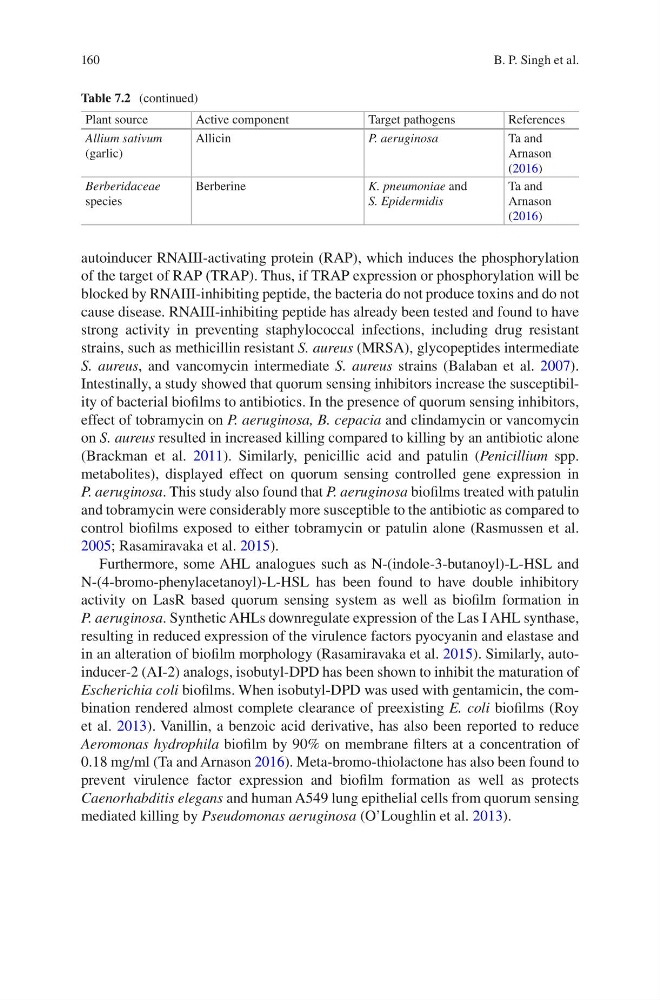
Table 7.2 (continued)
Plant source
Active component
Target pathogens
References
Allium sativum
(garlic)
Allicin
P. aeruginosa
Ta and
Arnason
(2016)
Berberidaceae
species
Berberine
K. pneumoniae and
S. Epidermidis
Ta and
Arnason
(2016)
B. P. Singh et al.
autoinducer RNAIII-activating protein (RAP), which induces the phosphorylation
of the target of RAP (TRAP). Thus, if TRAP expression or phosphorylation will be
blocked by RNAIII-inhibiting peptide, the bacteria do not produce toxins and do not
cause disease. RNAIII-inhibiting peptide has already been tested and found to have
strong activity in preventing staphylococcal infections, including drug resistant
strains, such as methicillin resistant S. aureus (MRSA), glycopeptides intermediate
S. aureus, and vancomycin intermediate S. aureus strains (Balaban et al. 2007).
Intestinally, a study showed that quorum sensing inhibitors increase the susceptibility of bacterial biofilms to antibiotics. In the presence of quorum sensing inhibitors,
effect of tobramycin on P. aeruginosa, B. cepacia and clindamycin or vancomycin
on S. aureus resulted in increased killing compared to killing by an antibiotic alone
(Brackman et al. 2011). Similarly, penicillic acid and patulin (Penicillium spp.
metabolites), displayed effect on quorum sensing controlled gene expression in
P. aeruginosa. This study also found that P. aeruginosa biofilms treated with patulin
and tobramycin were considerably more susceptible to the antibiotic as compared to
control biofilms exposed to either tobramycin or patulin alone (Rasmussen et al.
2005; Rasamiravaka et al. 2015).
Furthermore, some AHL analogues such as N-(indole-3-butanoyl)-L-HSL and
N-(4-bromo-phenylacetanoyl)-L-HSL has been found to have double inhibitory
activity on LasR based quorum sensing system as well as biofilm formation in
P. aeruginosa. Synthetic AHLs downregulate expression of the Las I AHL synthase,
resulting in reduced expression of the virulence factors pyocyanin and elastase and
in an alteration of biofilm morphology (Rasamiravaka et al. 2015). Similarly, autoinducer- 2 (AI-2) analogs, isobutyl-DPD has been shown to inhibit the maturation of
Escherichia coli biofilms. When isobutyl-DPD was used with gentamicin, the combination rendered almost complete clearance of preexisting E. coli biofilms (Roy
et al. 2013). Vanillin, a benzoic acid derivative, has also been reported to reduce
Aeromonas hydrophila biofilm by 90% on membrane filters at a concentration of
0.18 mg/ml (Ta and Arnason 2016). Meta-bromo-thiolactone has also been found to
prevent virulence factor expression and biofilm formation as well as protects
Caenorhabditis elegans and human A549 lung epithelial cells from quorum sensing
mediated killing by Pseudomonas aeruginosa (O’Loughlin et al. 2013).
Table 7.2 (continued)
Plant source
Active component
Target pathogens
References
Allium sativum
(garlic)
Allicin
P. aeruginosa
Ta and
Arnason
(2016)
Berberidaceae
species
Berberine
K. pneumoniae and
S. Epidermidis
Ta and
Arnason
(2016)
B. P. Singh et al.