

155
at 37 °C colanic acid production is hamperred in rich medium). Nineteen gene
located in same cluster called wca (formerly known as cps) are involved in colanic
acid synthesis. Colanic acid synthesis involves 19 genes located in the same cluster,
named wca (formerly known as cps). Colanic acid synthesis is induced by RcsCDB,
a 3 component system and requires a supplementary positive transcription regulator
RcsA. On one hand, colanic acid impairs the initial surface attachment in bacteria
on the other hand, up regulation of its synthesis in biofilms is reported, which is
important for development of the mature biofilm structures (Prigent-Combaret and
Lejeune 1999; Danese et al. 2000; Stoodley et al. 2002a; Stoodley et al. 2002b;
Hanna et al. 2003).
7.3 Signaling in Biofilm
Communicating using chemical signals is an intriguing feature of microbes growing
in biofilms. These chemicals cross the membranes and are sensed by not only the
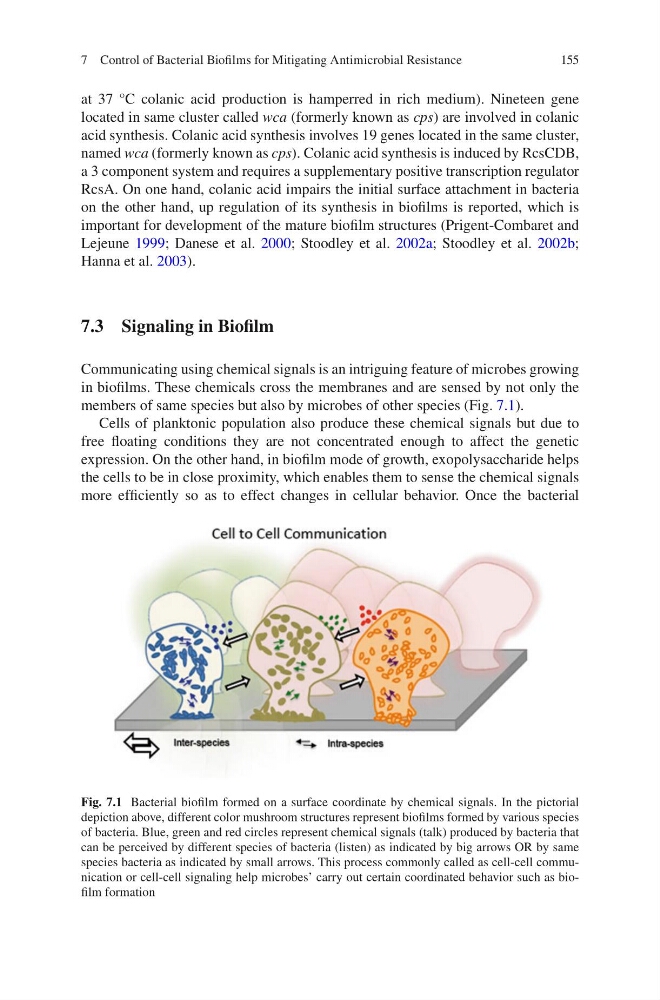
members of same species but also by microbes of other species (Fig. 7.1).
Cells of planktonic population also produce these chemical signals but due to
free floating conditions they are not concentrated enough to affect the genetic
expression. On the other hand, in biofilm mode of growth, exopolysaccharide helps
the cells to be in close proximity, which enables them to sense the chemical signals
more efficiently so as to effect changes in cellular behavior. Once the bacterial
Fig. 7.1 Bacterial biofilm formed on a surface coordinate by chemical signals. In the pictorial
depiction above, different color mushroom structures represent biofilms formed by various species
of bacteria. Blue, green and red circles represent chemical signals (talk) produced by bacteria that
can be perceived by different species of bacteria (listen) as indicated by big arrows OR by same
species bacteria as indicated by small arrows. This process commonly called as cell-cell communication or cell-cell signaling help microbes’ carry out certain coordinated behavior such as biofilm formation
7 Control of Bacterial Biofilms for Mitigating Antimicrobial Resistance
at 37 °C colanic acid production is hamperred in rich medium). Nineteen gene
located in same cluster called wca (formerly known as cps) are involved in colanic
acid synthesis. Colanic acid synthesis involves 19 genes located in the same cluster,
named wca (formerly known as cps). Colanic acid synthesis is induced by RcsCDB,
a 3 component system and requires a supplementary positive transcription regulator
RcsA. On one hand, colanic acid impairs the initial surface attachment in bacteria
on the other hand, up regulation of its synthesis in biofilms is reported, which is
important for development of the mature biofilm structures (Prigent-Combaret and
Lejeune 1999; Danese et al. 2000; Stoodley et al. 2002a; Stoodley et al. 2002b;
Hanna et al. 2003).
7.3 Signaling in Biofilm
Communicating using chemical signals is an intriguing feature of microbes growing
in biofilms. These chemicals cross the membranes and are sensed by not only the
members of same species but also by microbes of other species (Fig. 7.1).
Cells of planktonic population also produce these chemical signals but due to
free floating conditions they are not concentrated enough to affect the genetic
expression. On the other hand, in biofilm mode of growth, exopolysaccharide helps
the cells to be in close proximity, which enables them to sense the chemical signals
more efficiently so as to effect changes in cellular behavior. Once the bacterial
Fig. 7.1 Bacterial biofilm formed on a surface coordinate by chemical signals. In the pictorial
depiction above, different color mushroom structures represent biofilms formed by various species
of bacteria. Blue, green and red circles represent chemical signals (talk) produced by bacteria that
can be perceived by different species of bacteria (listen) as indicated by big arrows OR by same
species bacteria as indicated by small arrows. This process commonly called as cell-cell communication or cell-cell signaling help microbes’ carry out certain coordinated behavior such as biofilm formation
7 Control of Bacterial Biofilms for Mitigating Antimicrobial Resistance