

100
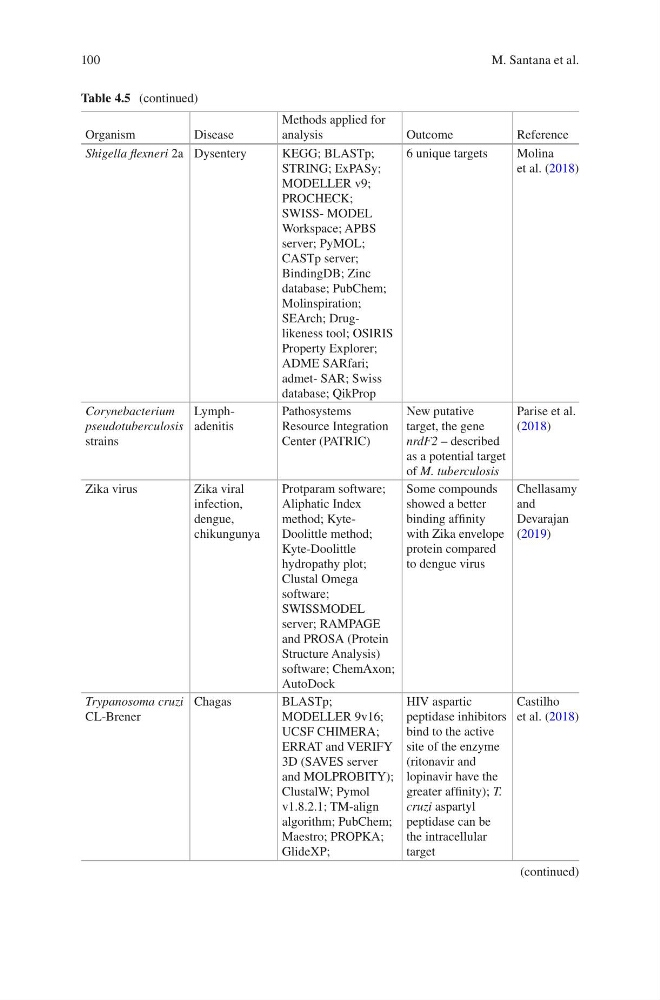
Table 4.5 (continued)
Organism
Disease
Methods applied for
analysis
Outcome
Reference
Shigella flexneri 2a Dysentery
KEGG; BLASTp;
STRING; ExPASy;
MODELLER v9;
PROCHECK;
SWISS- MODEL
Workspace; APBS
server; PyMOL;
CASTp server;
BindingDB; Zinc
database; PubChem;
Molinspiration;
SEArch; Druglikeness tool; OSIRIS
Property Explorer;
ADME SARfari;
admet- SAR; Swiss
database; QikProp
6 unique targets
Molina
et al. (2018)
Corynebacterium
pseudotuberculosis
strains
Lymphadenitis
Pathosystems
Resource Integration
Center (PATRIC)
New putative
target, the gene
nrdF2 – described
as a potential target
of M. tuberculosis
Parise et al.
(2018)
Zika virus
Zika viral
infection,
dengue,
chikungunya
Protparam software;
Aliphatic Index
method; KyteDoolittle method;
Kyte-Doolittle
hydropathy plot;
Clustal Omega
software;
SWISSMODEL
server; RAMPAGE
and PROSA (Protein
Structure Analysis)
software; ChemAxon;
AutoDock
Some compounds
showed a better
binding affinity
with Zika envelope
protein compared
to dengue virus
Chellasamy
and
Devarajan
(2019)
Trypanosoma cruzi
CL-Brener
Chagas
BLASTp;
MODELLER 9v16;
UCSF CHIMERA;
ERRAT and VERIFY
3D (SAVES server
and MOLPROBITY);
ClustalW; Pymol
v1.8.2.1; TM-align
algorithm; PubChem;
Maestro; PROPKA;
GlideXP;
HIV aspartic
peptidase inhibitors
bind to the active
site of the enzyme
(ritonavir and
lopinavir have the
greater affinity); T.
cruzi aspartyl
peptidase can be
the intracellular
target
Castilho
et al. (2018)
(continued)
M. Santana et al.
Table 4.5 (continued)
Organism
Disease
Methods applied for
analysis
Outcome
Reference
Shigella flexneri 2a Dysentery
KEGG; BLASTp;
STRING; ExPASy;
MODELLER v9;
PROCHECK;
SWISS- MODEL
Workspace; APBS
server; PyMOL;
CASTp server;
BindingDB; Zinc
database; PubChem;
Molinspiration;
SEArch; Druglikeness tool; OSIRIS
Property Explorer;
ADME SARfari;
admet- SAR; Swiss
database; QikProp
6 unique targets
Molina
et al. (2018)
Corynebacterium
pseudotuberculosis
strains
Lymphadenitis
Pathosystems
Resource Integration
Center (PATRIC)
New putative
target, the gene
nrdF2 – described
as a potential target
of M. tuberculosis
Parise et al.
(2018)
Zika virus
Zika viral
infection,
dengue,
chikungunya
Protparam software;
Aliphatic Index
method; KyteDoolittle method;
Kyte-Doolittle
hydropathy plot;
Clustal Omega
software;
SWISSMODEL
server; RAMPAGE
and PROSA (Protein
Structure Analysis)
software; ChemAxon;
AutoDock
Some compounds
showed a better
binding affinity
with Zika envelope
protein compared
to dengue virus
Chellasamy
and
Devarajan
(2019)
Trypanosoma cruzi
CL-Brener
Chagas
BLASTp;
MODELLER 9v16;
UCSF CHIMERA;
ERRAT and VERIFY
3D (SAVES server
and MOLPROBITY);
ClustalW; Pymol
v1.8.2.1; TM-align
algorithm; PubChem;
Maestro; PROPKA;
GlideXP;
HIV aspartic
peptidase inhibitors
bind to the active
site of the enzyme
(ritonavir and
lopinavir have the
greater affinity); T.
cruzi aspartyl
peptidase can be
the intracellular
target
Castilho
et al. (2018)
(continued)
M. Santana et al.