

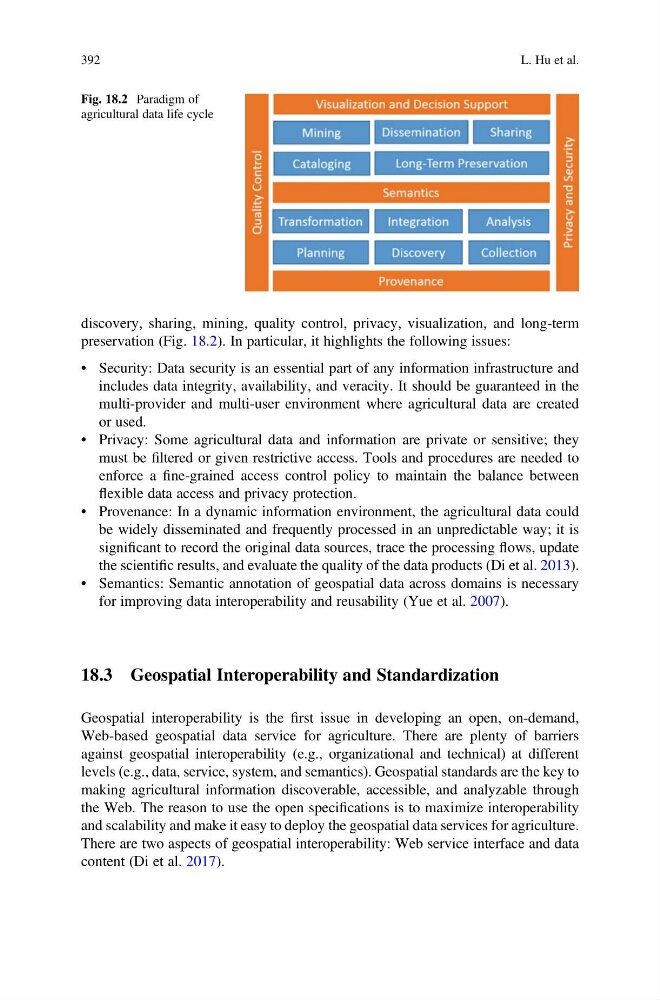
discovery, sharing, mining, quality control, privacy, visualization, and long-term
preservation (Fig. 18.2). In particular, it highlights the following issues:
• Security: Data security is an essential part of any information infrastructure and
includes data integrity, availability, and veracity. It should be guaranteed in the
multi-provider and multi-user environment where agricultural data are created
or used.
• Privacy: Some agricultural data and information are private or sensitive; they
must be filtered or given restrictive access. Tools and procedures are needed to
enforce a fine-grained access control policy to maintain the balance between
flexible data access and privacy protection.
• Provenance: In a dynamic information environment, the agricultural data could
be widely disseminated and frequently processed in an unpredictable way; it is
significant to record the original data sources, trace the processing flows, update
the scientific results, and evaluate the quality of the data products (Di et al. 2013).
• Semantics: Semantic annotation of geospatial data across domains is necessary
for improving data interoperability and reusability (Yue et al. 2007).
18.3 Geospatial Interoperability and Standardization
Geospatial interoperability is the first issue in developing an open, on-demand,
Web-based geospatial data service for agriculture. There are plenty of barriers
against geospatial interoperability (e.g., organizational and technical) at different
levels (e.g., data, service, system, and semantics). Geospatial standards are the key to
making agricultural information discoverable, accessible, and analyzable through
the Web. The reason to use the open specifications is to maximize interoperability
and scalability and make it easy to deploy the geospatial data services for agriculture.
There are two aspects of geospatial interoperability: Web service interface and data
content (Di et al. 2017).
Fig. 18.2 Paradigm of
agricultural data life cycle
392
L. Hu et al.
preservation (Fig. 18.2). In particular, it highlights the following issues:
• Security: Data security is an essential part of any information infrastructure and
includes data integrity, availability, and veracity. It should be guaranteed in the
multi-provider and multi-user environment where agricultural data are created
or used.
• Privacy: Some agricultural data and information are private or sensitive; they
must be filtered or given restrictive access. Tools and procedures are needed to
enforce a fine-grained access control policy to maintain the balance between
flexible data access and privacy protection.
• Provenance: In a dynamic information environment, the agricultural data could
be widely disseminated and frequently processed in an unpredictable way; it is
significant to record the original data sources, trace the processing flows, update
the scientific results, and evaluate the quality of the data products (Di et al. 2013).
• Semantics: Semantic annotation of geospatial data across domains is necessary
for improving data interoperability and reusability (Yue et al. 2007).
18.3 Geospatial Interoperability and Standardization
Geospatial interoperability is the first issue in developing an open, on-demand,
Web-based geospatial data service for agriculture. There are plenty of barriers
against geospatial interoperability (e.g., organizational and technical) at different
levels (e.g., data, service, system, and semantics). Geospatial standards are the key to
making agricultural information discoverable, accessible, and analyzable through
the Web. The reason to use the open specifications is to maximize interoperability
and scalability and make it easy to deploy the geospatial data services for agriculture.
There are two aspects of geospatial interoperability: Web service interface and data
content (Di et al. 2017).
Fig. 18.2 Paradigm of
agricultural data life cycle
392
L. Hu et al.