

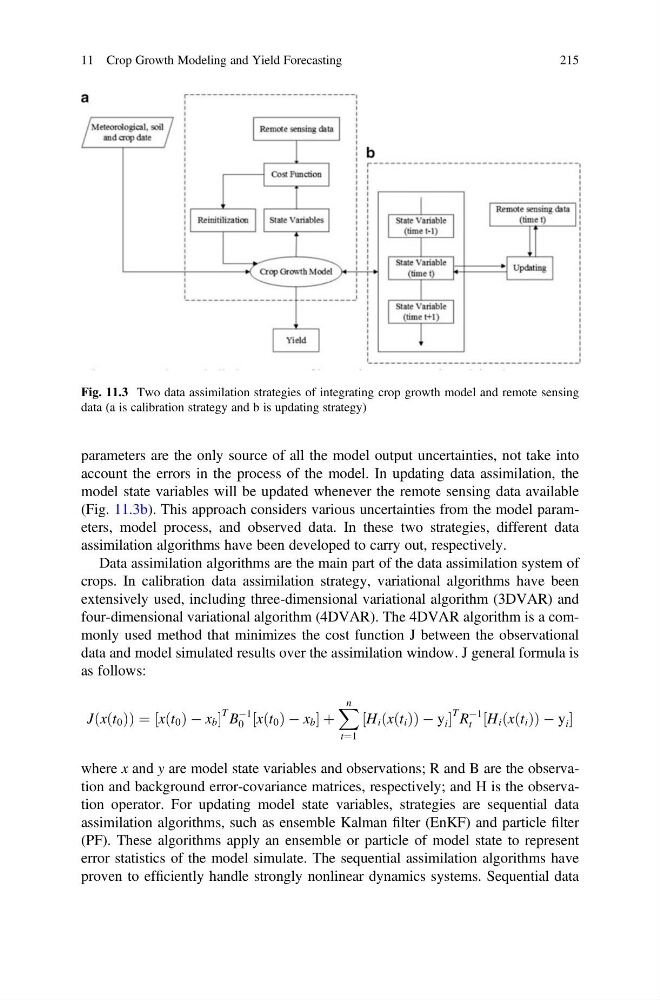
parameters are the only source of all the model output uncertainties, not take into
account the errors in the process of the model. In updating data assimilation, the
model state variables will be updated whenever the remote sensing data available
(Fig. 11.3b). This approach considers various uncertainties from the model parameters, model process, and observed data. In these two strategies, different data
assimilation algorithms have been developed to carry out, respectively.
Data assimilation algorithms are the main part of the data assimilation system of
crops. In calibration data assimilation strategy, variational algorithms have been
extensively used, including three-dimensional variational algorithm (3DVAR) and
four-dimensional variational algorithm (4DVAR). The 4DVAR algorithm is a commonly used method that minimizes the cost function J between the observational
data and model simulated results over the assimilation window. J general formula is
as follows:
J x t 0
ð Þ
ð
Þ¼ x t 0
ð Þ À x b
½
T B
À1
0 x t 0
ð Þ À x b
½
þ
X n
t¼1
H i x t i
ð Þ
ð
ÞÀy i
½
T R
À1
t H i x t i
ð Þ
ð
ÞÀy i
½
where x and y are model state variables and observations; R and B are the observation and background error-covariance matrices, respectively; and H is the observation operator. For updating model state variables, strategies are sequential data
assimilation algorithms, such as ensemble Kalman filter (EnKF) and particle filter
(PF). These algorithms apply an ensemble or particle of model state to represent
error statistics of the model simulate. The sequential assimilation algorithms have
proven to efficiently handle strongly nonlinear dynamics systems. Sequential data
Fig. 11.3 Two data assimilation strategies of integrating crop growth model and remote sensing
data (a is calibration strategy and b is updating strategy)
11 Crop Growth Modeling and Yield Forecasting
215
account the errors in the process of the model. In updating data assimilation, the
model state variables will be updated whenever the remote sensing data available
(Fig. 11.3b). This approach considers various uncertainties from the model parameters, model process, and observed data. In these two strategies, different data
assimilation algorithms have been developed to carry out, respectively.
Data assimilation algorithms are the main part of the data assimilation system of
crops. In calibration data assimilation strategy, variational algorithms have been
extensively used, including three-dimensional variational algorithm (3DVAR) and
four-dimensional variational algorithm (4DVAR). The 4DVAR algorithm is a commonly used method that minimizes the cost function J between the observational
data and model simulated results over the assimilation window. J general formula is
as follows:
J x t 0
ð Þ
ð
Þ¼ x t 0
ð Þ À x b
½
T B
À1
0 x t 0
ð Þ À x b
½
þ
X n
t¼1
H i x t i
ð Þ
ð
ÞÀy i
½
T R
À1
t H i x t i
ð Þ
ð
ÞÀy i
½
where x and y are model state variables and observations; R and B are the observation and background error-covariance matrices, respectively; and H is the observation operator. For updating model state variables, strategies are sequential data
assimilation algorithms, such as ensemble Kalman filter (EnKF) and particle filter
(PF). These algorithms apply an ensemble or particle of model state to represent
error statistics of the model simulate. The sequential assimilation algorithms have
proven to efficiently handle strongly nonlinear dynamics systems. Sequential data
Fig. 11.3 Two data assimilation strategies of integrating crop growth model and remote sensing
data (a is calibration strategy and b is updating strategy)
11 Crop Growth Modeling and Yield Forecasting
215