

(c) Quality management
(d) Market management
(e) Sustainability management
These components are cascaded in seasonal periods. Each of them requires
monitoring, planning, and decisions for controlling the system (Manos et al.
2010). Data fusion is considered especially in monitoring and decision support
layers.
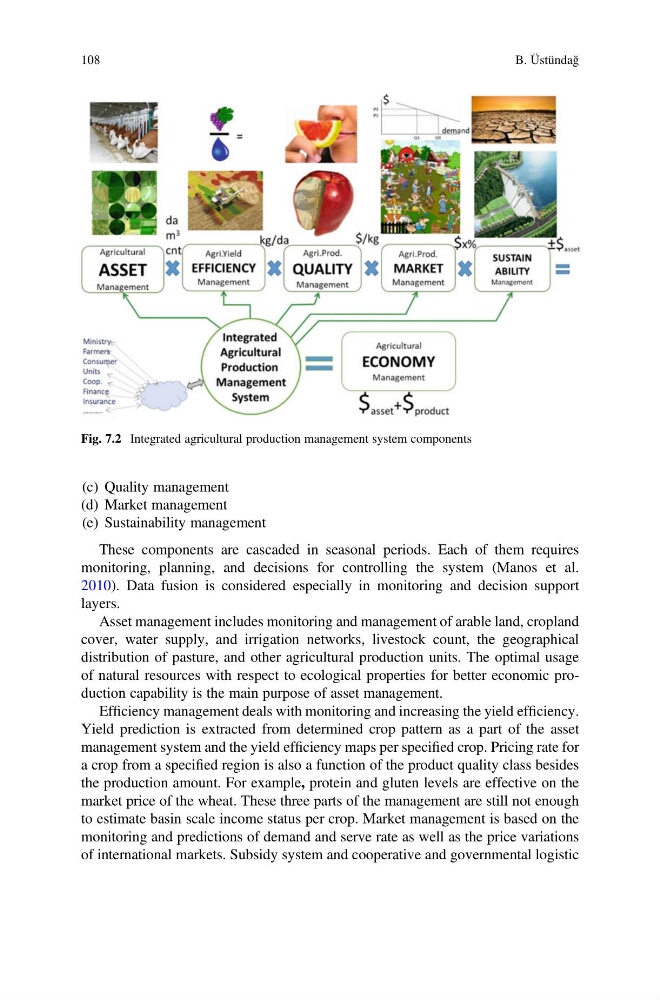
Asset management includes monitoring and management of arable land, cropland
cover, water supply, and irrigation networks, livestock count, the geographical
distribution of pasture, and other agricultural production units. The optimal usage
of natural resources with respect to ecological properties for better economic production capability is the main purpose of asset management.
Efficiency management deals with monitoring and increasing the yield efficiency.
Yield prediction is extracted from determined crop pattern as a part of the asset
management system and the yield efficiency maps per specified crop. Pricing rate for
a crop from a specified region is also a function of the product quality class besides
the production amount. For example, protein and gluten levels are effective on the
market price of the wheat. These three parts of the management are still not enough
to estimate basin scale income status per crop. Market management is based on the
monitoring and predictions of demand and serve rate as well as the price variations
of international markets. Subsidy system and cooperative and governmental logistic
Fig. 7.2 Integrated agricultural production management system components
108
B. Üstündağ
(d) Market management
(e) Sustainability management
These components are cascaded in seasonal periods. Each of them requires
monitoring, planning, and decisions for controlling the system (Manos et al.
2010). Data fusion is considered especially in monitoring and decision support
layers.
Asset management includes monitoring and management of arable land, cropland
cover, water supply, and irrigation networks, livestock count, the geographical
distribution of pasture, and other agricultural production units. The optimal usage
of natural resources with respect to ecological properties for better economic production capability is the main purpose of asset management.
Efficiency management deals with monitoring and increasing the yield efficiency.
Yield prediction is extracted from determined crop pattern as a part of the asset
management system and the yield efficiency maps per specified crop. Pricing rate for
a crop from a specified region is also a function of the product quality class besides
the production amount. For example, protein and gluten levels are effective on the
market price of the wheat. These three parts of the management are still not enough
to estimate basin scale income status per crop. Market management is based on the
monitoring and predictions of demand and serve rate as well as the price variations
of international markets. Subsidy system and cooperative and governmental logistic
Fig. 7.2 Integrated agricultural production management system components
108
B. Üstündağ