

84
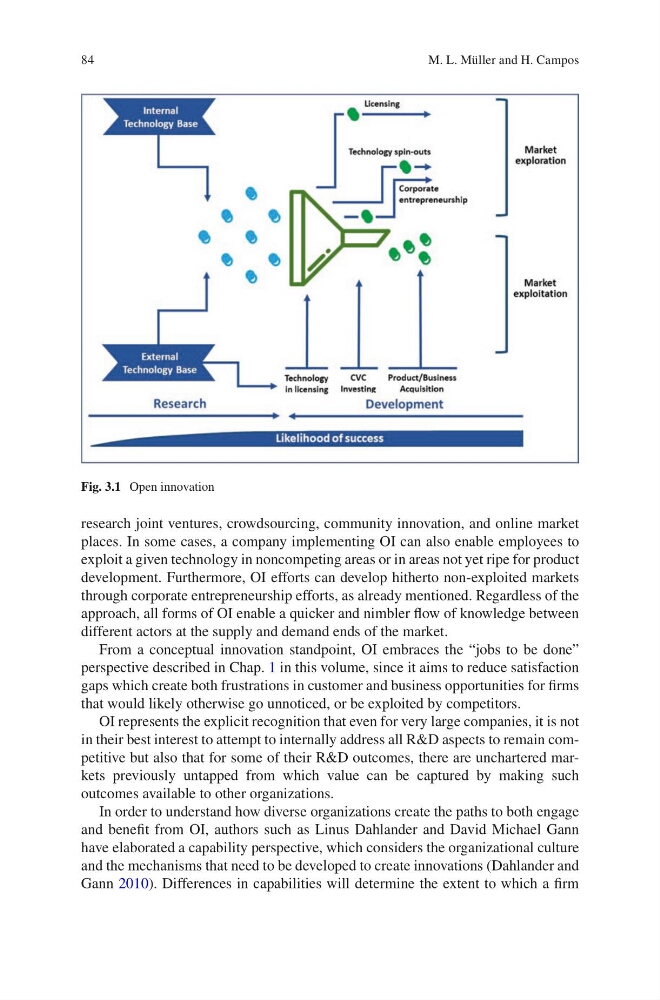
research joint ventures, crowdsourcing, community innovation, and online market
places. In some cases, a company implementing OI can also enable employees to
exploit a given technology in noncompeting areas or in areas not yet ripe for product
development. Furthermore, OI efforts can develop hitherto non-exploited markets
through corporate entrepreneurship efforts, as already mentioned. Regardless of the
approach, all forms of OI enable a quicker and nimbler flow of knowledge between
different actors at the supply and demand ends of the market.
From a conceptual innovation standpoint, OI embraces the “jobs to be done”
perspective described in Chap. 1 in this volume, since it aims to reduce satisfaction
gaps which create both frustrations in customer and business opportunities for firms
that would likely otherwise go unnoticed, or be exploited by competitors.
OI represents the explicit recognition that even for very large companies, it is not
in their best interest to attempt to internally address all R&D aspects to remain competitive but also that for some of their R&D outcomes, there are unchartered markets previously untapped from which value can be captured by making such
outcomes available to other organizations.
In order to understand how diverse organizations create the paths to both engage
and benefit from OI, authors such as Linus Dahlander and David Michael Gann
have elaborated a capability perspective, which considers the organizational culture
and the mechanisms that need to be developed to create innovations (Dahlander and
Gann 2010). Differences in capabilities will determine the extent to which a firm
Fig. 3.1 Open innovation
M. L. Müller and H. Campos
research joint ventures, crowdsourcing, community innovation, and online market
places. In some cases, a company implementing OI can also enable employees to
exploit a given technology in noncompeting areas or in areas not yet ripe for product
development. Furthermore, OI efforts can develop hitherto non-exploited markets
through corporate entrepreneurship efforts, as already mentioned. Regardless of the
approach, all forms of OI enable a quicker and nimbler flow of knowledge between
different actors at the supply and demand ends of the market.
From a conceptual innovation standpoint, OI embraces the “jobs to be done”
perspective described in Chap. 1 in this volume, since it aims to reduce satisfaction
gaps which create both frustrations in customer and business opportunities for firms
that would likely otherwise go unnoticed, or be exploited by competitors.
OI represents the explicit recognition that even for very large companies, it is not
in their best interest to attempt to internally address all R&D aspects to remain competitive but also that for some of their R&D outcomes, there are unchartered markets previously untapped from which value can be captured by making such
outcomes available to other organizations.
In order to understand how diverse organizations create the paths to both engage
and benefit from OI, authors such as Linus Dahlander and David Michael Gann
have elaborated a capability perspective, which considers the organizational culture
and the mechanisms that need to be developed to create innovations (Dahlander and
Gann 2010). Differences in capabilities will determine the extent to which a firm
Fig. 3.1 Open innovation
M. L. Müller and H. Campos