

76
3.3.2 Public-Private Partnerships
The public sector has played an enormous role in agricultural innovations, particularly in the United States within the system of land-grant colleges and universities,
whose mission, as set forth in the Morrill Acts of 1862 and 1890, was to focus on
teaching practical agriculture, science, military science, and engineering. Landgrant universities developed strong breeding programs which became the source of
germplasm for American farmers and local seed companies. Academic research was
pivotal in the development of hybrid seed programs which, in the case of maize,
resulted in the discovery of heterosis, the tendency of a crossbred individual (a
“hybrid”) to show qualities superior to those of either parent (“inbreds” in the case
of maize). The advent of hybrids, with their homogeneous growth across large
expanses of Midwestern lands, allowed for the mechanization of agriculture. The
deployment of hybrids led to major changes in the American farming system: farm
horses were replaced by tractors, and mechanical harvesting replaced labor- intensive
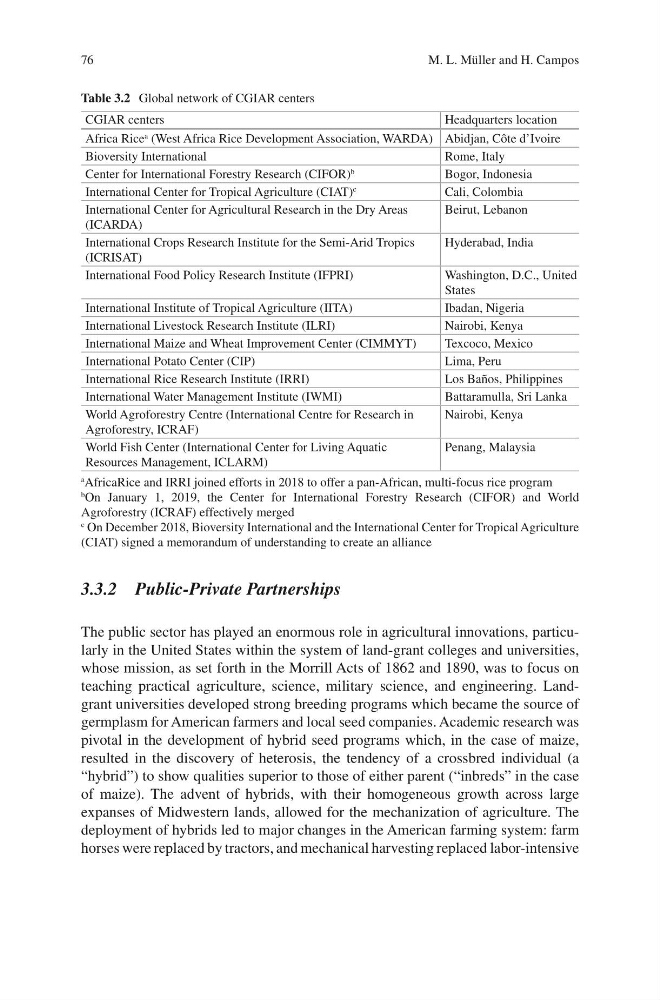
Table 3.2 Global network of CGIAR centers
CGIAR centers
Headquarters location
Africa Rice
a (West Africa Rice Development Association, WARDA) Abidjan, Côte d’Ivoire
Bioversity International
Rome, Italy
Center for International Forestry Research (CIFOR)
b
Bogor, Indonesia
International Center for Tropical Agriculture (CIAT)
c
Cali, Colombia
International Center for Agricultural Research in the Dry Areas
(ICARDA)
Beirut, Lebanon
International Crops Research Institute for the Semi-Arid Tropics
(ICRISAT)
Hyderabad, India
International Food Policy Research Institute (IFPRI)
Washington, D.C., United
States
International Institute of Tropical Agriculture (IITA)
Ibadan, Nigeria
International Livestock Research Institute (ILRI)
Nairobi, Kenya
International Maize and Wheat Improvement Center (CIMMYT)
Texcoco, Mexico
International Potato Center (CIP)
Lima, Peru
International Rice Research Institute (IRRI)
Los Baños, Philippines
International Water Management Institute (IWMI)
Battaramulla, Sri Lanka
World Agroforestry Centre (International Centre for Research in
Agroforestry, ICRAF)
Nairobi, Kenya
World Fish Center (International Center for Living Aquatic
Resources Management, ICLARM)
Penang, Malaysia
a
AfricaRice and IRRI joined efforts in 2018 to offer a pan-African, multi-focus rice program
b
On January 1, 2019, the Center for International Forestry Research (CIFOR) and World
Agroforestry (ICRAF) effectively merged
c On December 2018, Bioversity International and the International Center for Tropical Agriculture
(CIAT) signed a memorandum of understanding to create an alliance
M. L. Müller and H. Campos
3.3.2 Public-Private Partnerships
The public sector has played an enormous role in agricultural innovations, particularly in the United States within the system of land-grant colleges and universities,
whose mission, as set forth in the Morrill Acts of 1862 and 1890, was to focus on
teaching practical agriculture, science, military science, and engineering. Landgrant universities developed strong breeding programs which became the source of
germplasm for American farmers and local seed companies. Academic research was
pivotal in the development of hybrid seed programs which, in the case of maize,
resulted in the discovery of heterosis, the tendency of a crossbred individual (a
“hybrid”) to show qualities superior to those of either parent (“inbreds” in the case
of maize). The advent of hybrids, with their homogeneous growth across large
expanses of Midwestern lands, allowed for the mechanization of agriculture. The
deployment of hybrids led to major changes in the American farming system: farm
horses were replaced by tractors, and mechanical harvesting replaced labor- intensive
Table 3.2 Global network of CGIAR centers
CGIAR centers
Headquarters location
Africa Rice
a (West Africa Rice Development Association, WARDA) Abidjan, Côte d’Ivoire
Bioversity International
Rome, Italy
Center for International Forestry Research (CIFOR)
b
Bogor, Indonesia
International Center for Tropical Agriculture (CIAT)
c
Cali, Colombia
International Center for Agricultural Research in the Dry Areas
(ICARDA)
Beirut, Lebanon
International Crops Research Institute for the Semi-Arid Tropics
(ICRISAT)
Hyderabad, India
International Food Policy Research Institute (IFPRI)
Washington, D.C., United
States
International Institute of Tropical Agriculture (IITA)
Ibadan, Nigeria
International Livestock Research Institute (ILRI)
Nairobi, Kenya
International Maize and Wheat Improvement Center (CIMMYT)
Texcoco, Mexico
International Potato Center (CIP)
Lima, Peru
International Rice Research Institute (IRRI)
Los Baños, Philippines
International Water Management Institute (IWMI)
Battaramulla, Sri Lanka
World Agroforestry Centre (International Centre for Research in
Agroforestry, ICRAF)
Nairobi, Kenya
World Fish Center (International Center for Living Aquatic
Resources Management, ICLARM)
Penang, Malaysia
a
AfricaRice and IRRI joined efforts in 2018 to offer a pan-African, multi-focus rice program
b
On January 1, 2019, the Center for International Forestry Research (CIFOR) and World
Agroforestry (ICRAF) effectively merged
c On December 2018, Bioversity International and the International Center for Tropical Agriculture
(CIAT) signed a memorandum of understanding to create an alliance
M. L. Müller and H. Campos