

74
supply of fertilizer for optimal production, its harvested yield was almost ten times
that of traditional rice.
After the Green Revolution, a large number of innovations dramatically enhanced
the ability of plant breeders to accelerate breeding processes. Scientists used information encoded in DNA to capitalize on the genetic diversity contained within cultivars and to enhance the efficiency and effectiveness of plant breeding endeavors.
These innovations helped reduce the number of breeding cycles required to bring to
market a new variety and accelerated the development of novel elite parents and
improved cultivars, fulfilling the needs of humankind. The combined set of modern
breeding innovations enabled tremendous increases in genetic gain and resulted in
the development of maize hybrids which exhibit commercially relevant levels of
drought tolerance and contain stacked transgenic events conferring resistance to
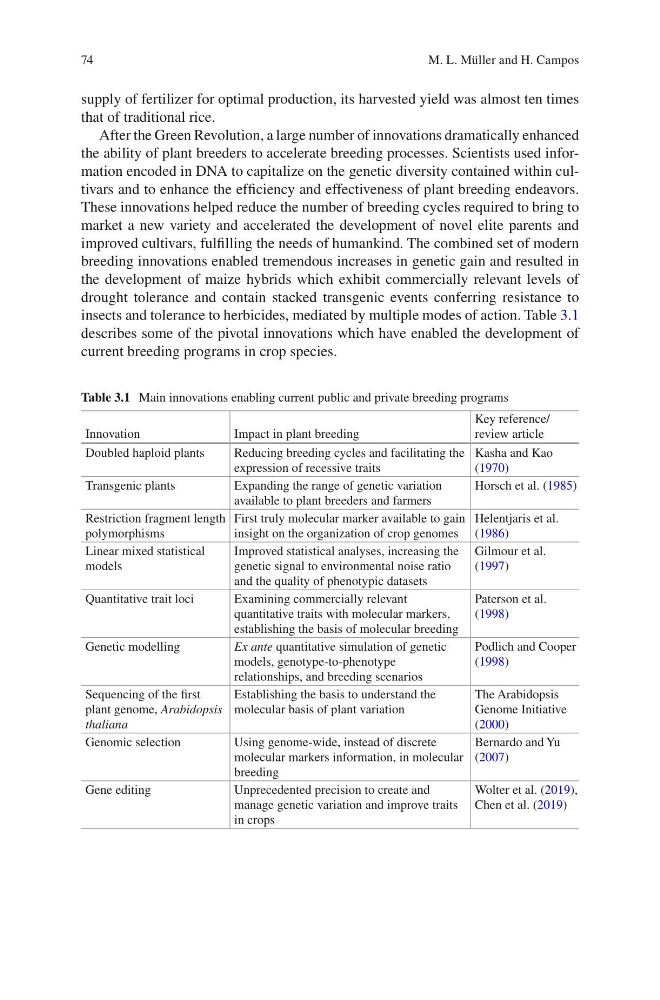
insects and tolerance to herbicides, mediated by multiple modes of action. Table 3.1
describes some of the pivotal innovations which have enabled the development of
current breeding programs in crop species.
Table 3.1 Main innovations enabling current public and private breeding programs
Innovation
Impact in plant breeding
Key reference/
review article
Doubled haploid plants
Reducing breeding cycles and facilitating the
expression of recessive traits
Kasha and Kao
(1970)
Transgenic plants
Expanding the range of genetic variation
available to plant breeders and farmers
Horsch et al. (1985)
Restriction fragment length
polymorphisms
First truly molecular marker available to gain
insight on the organization of crop genomes
Helentjaris et al.
(1986)
Linear mixed statistical
models
Improved statistical analyses, increasing the
genetic signal to environmental noise ratio
and the quality of phenotypic datasets
Gilmour et al.
(1997)
Quantitative trait loci
Examining commercially relevant
quantitative traits with molecular markers,
establishing the basis of molecular breeding
Paterson et al.
(1998)
Genetic modelling
Ex ante quantitative simulation of genetic
models, genotype-to-phenotype
relationships, and breeding scenarios
Podlich and Cooper
(1998)
Sequencing of the first
plant genome, Arabidopsis
thaliana
Establishing the basis to understand the
molecular basis of plant variation
The Arabidopsis
Genome Initiative
(2000)
Genomic selection
Using genome-wide, instead of discrete
molecular markers information, in molecular
breeding
Bernardo and Yu
(2007)
Gene editing
Unprecedented precision to create and
manage genetic variation and improve traits
in crops
Wolter et al. (2019),
Chen et al. (2019)
M. L. Müller and H. Campos
supply of fertilizer for optimal production, its harvested yield was almost ten times
that of traditional rice.
After the Green Revolution, a large number of innovations dramatically enhanced
the ability of plant breeders to accelerate breeding processes. Scientists used information encoded in DNA to capitalize on the genetic diversity contained within cultivars and to enhance the efficiency and effectiveness of plant breeding endeavors.
These innovations helped reduce the number of breeding cycles required to bring to
market a new variety and accelerated the development of novel elite parents and
improved cultivars, fulfilling the needs of humankind. The combined set of modern
breeding innovations enabled tremendous increases in genetic gain and resulted in
the development of maize hybrids which exhibit commercially relevant levels of
drought tolerance and contain stacked transgenic events conferring resistance to
insects and tolerance to herbicides, mediated by multiple modes of action. Table 3.1
describes some of the pivotal innovations which have enabled the development of
current breeding programs in crop species.
Table 3.1 Main innovations enabling current public and private breeding programs
Innovation
Impact in plant breeding
Key reference/
review article
Doubled haploid plants
Reducing breeding cycles and facilitating the
expression of recessive traits
Kasha and Kao
(1970)
Transgenic plants
Expanding the range of genetic variation
available to plant breeders and farmers
Horsch et al. (1985)
Restriction fragment length
polymorphisms
First truly molecular marker available to gain
insight on the organization of crop genomes
Helentjaris et al.
(1986)
Linear mixed statistical
models
Improved statistical analyses, increasing the
genetic signal to environmental noise ratio
and the quality of phenotypic datasets
Gilmour et al.
(1997)
Quantitative trait loci
Examining commercially relevant
quantitative traits with molecular markers,
establishing the basis of molecular breeding
Paterson et al.
(1998)
Genetic modelling
Ex ante quantitative simulation of genetic
models, genotype-to-phenotype
relationships, and breeding scenarios
Podlich and Cooper
(1998)
Sequencing of the first
plant genome, Arabidopsis
thaliana
Establishing the basis to understand the
molecular basis of plant variation
The Arabidopsis
Genome Initiative
(2000)
Genomic selection
Using genome-wide, instead of discrete
molecular markers information, in molecular
breeding
Bernardo and Yu
(2007)
Gene editing
Unprecedented precision to create and
manage genetic variation and improve traits
in crops
Wolter et al. (2019),
Chen et al. (2019)
M. L. Müller and H. Campos