

66
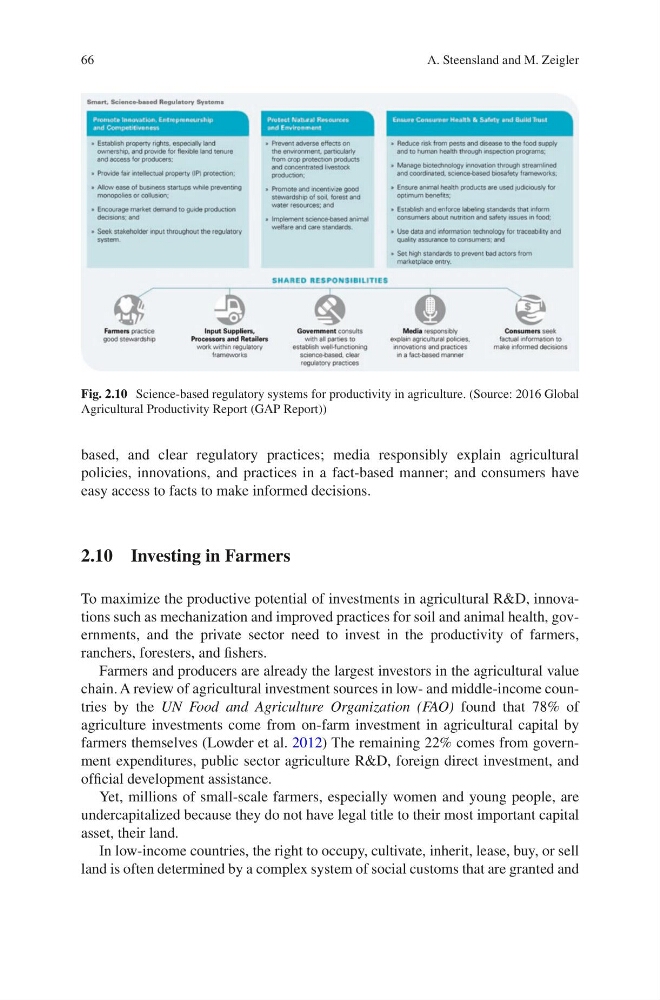
based, and clear regulatory practices; media responsibly explain agricultural
policies, innovations, and practices in a fact-based manner; and consumers have
easy access to facts to make informed decisions.
2.10 Investing in Farmers
To maximize the productive potential of investments in agricultural R&D, innovations such as mechanization and improved practices for soil and animal health, governments, and the private sector need to invest in the productivity of farmers,
ranchers, foresters, and fishers.
Farmers and producers are already the largest investors in the agricultural value
chain. A review of agricultural investment sources in low- and middle-income countries by the UN Food and Agriculture Organization (FAO) found that 78% of
agriculture investments come from on-farm investment in agricultural capital by
farmers themselves (Lowder et al. 2012) The remaining 22% comes from government expenditures, public sector agriculture R&D, foreign direct investment, and
official development assistance.
Yet, millions of small-scale farmers, especially women and young people, are
undercapitalized because they do not have legal title to their most important capital
asset, their land.
In low-income countries, the right to occupy, cultivate, inherit, lease, buy, or sell
land is often determined by a complex system of social customs that are granted and
(continued)
Fig. 2.10 Science-based regulatory systems for productivity in agriculture. (Source: 2016 Global
Agricultural Productivity Report (GAP Report))
A. Steensland and M. Zeigler
based, and clear regulatory practices; media responsibly explain agricultural
policies, innovations, and practices in a fact-based manner; and consumers have
easy access to facts to make informed decisions.
2.10 Investing in Farmers
To maximize the productive potential of investments in agricultural R&D, innovations such as mechanization and improved practices for soil and animal health, governments, and the private sector need to invest in the productivity of farmers,
ranchers, foresters, and fishers.
Farmers and producers are already the largest investors in the agricultural value
chain. A review of agricultural investment sources in low- and middle-income countries by the UN Food and Agriculture Organization (FAO) found that 78% of
agriculture investments come from on-farm investment in agricultural capital by
farmers themselves (Lowder et al. 2012) The remaining 22% comes from government expenditures, public sector agriculture R&D, foreign direct investment, and
official development assistance.
Yet, millions of small-scale farmers, especially women and young people, are
undercapitalized because they do not have legal title to their most important capital
asset, their land.
In low-income countries, the right to occupy, cultivate, inherit, lease, buy, or sell
land is often determined by a complex system of social customs that are granted and
(continued)
Fig. 2.10 Science-based regulatory systems for productivity in agriculture. (Source: 2016 Global
Agricultural Productivity Report (GAP Report))
A. Steensland and M. Zeigler