

60
Box 2.10 Better Breeds and Better Feed Are Key for Climate Resilience
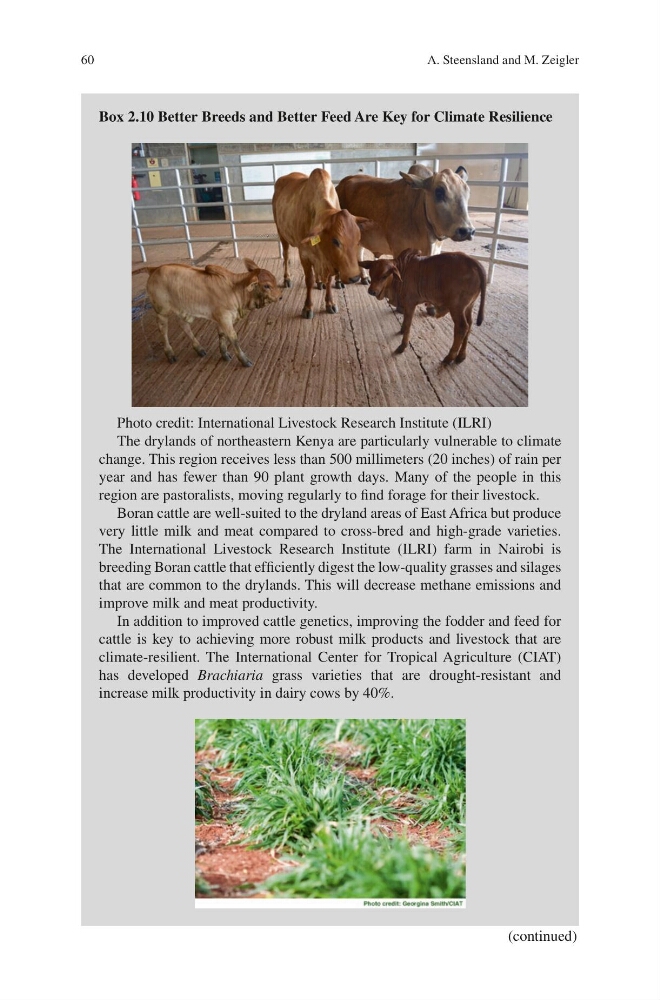
Photo credit: International Livestock Research Institute (ILRI)
The drylands of northeastern Kenya are particularly vulnerable to climate
change. This region receives less than 500 millimeters (20 inches) of rain per
year and has fewer than 90 plant growth days. Many of the people in this
region are pastoralists, moving regularly to find forage for their livestock.
Boran cattle are well-suited to the dryland areas of East Africa but produce
very little milk and meat compared to cross-bred and high-grade varieties.
The International Livestock Research Institute (ILRI) farm in Nairobi is
breeding Boran cattle that efficiently digest the low-quality grasses and silages
that are common to the drylands. This will decrease methane emissions and
improve milk and meat productivity.
In addition to improved cattle genetics, improving the fodder and feed for
cattle is key to achieving more robust milk products and livestock that are
climate-resilient. The International Center for Tropical Agriculture (CIAT)
has developed Brachiaria grass varieties that are drought-resistant and
increase milk productivity in dairy cows by 40%.
(continued)
A. Steensland and M. Zeigler
Box 2.10 Better Breeds and Better Feed Are Key for Climate Resilience
Photo credit: International Livestock Research Institute (ILRI)
The drylands of northeastern Kenya are particularly vulnerable to climate
change. This region receives less than 500 millimeters (20 inches) of rain per
year and has fewer than 90 plant growth days. Many of the people in this
region are pastoralists, moving regularly to find forage for their livestock.
Boran cattle are well-suited to the dryland areas of East Africa but produce
very little milk and meat compared to cross-bred and high-grade varieties.
The International Livestock Research Institute (ILRI) farm in Nairobi is
breeding Boran cattle that efficiently digest the low-quality grasses and silages
that are common to the drylands. This will decrease methane emissions and
improve milk and meat productivity.
In addition to improved cattle genetics, improving the fodder and feed for
cattle is key to achieving more robust milk products and livestock that are
climate-resilient. The International Center for Tropical Agriculture (CIAT)
has developed Brachiaria grass varieties that are drought-resistant and
increase milk productivity in dairy cows by 40%.
(continued)
A. Steensland and M. Zeigler