

56
Trees provide shade for the cattle, protecting them from heat. And with more
vegetation in the pastures, the soil retains nutrients, water, and carbon, making
ranches more resilient to cyclical drought.
The Government of Colombia has proposed reducing the total land used for livestock by 21% by 2030, and the national cattle ranching association, FEDEGÁN,
proposes similar pastureland reduction goals along with productivity increases. But
making the transition from extensive cattle ranching systems to the newer silvopastoral systems is not easy, as it requires both technical support and a change in mindset. Many ranchers perceive forestry and cattle ranching as incompatible practices
and often clear forested areas so cattle can graze on grasslands. Ranchers also fear
that by using less pasture and conserving more forests, they risk losing some of their
farmland to the government or other ranchers.
ants, butterflies, and other wildlife increased. Monitoring studies have confirmed reduced pollution of water sources.
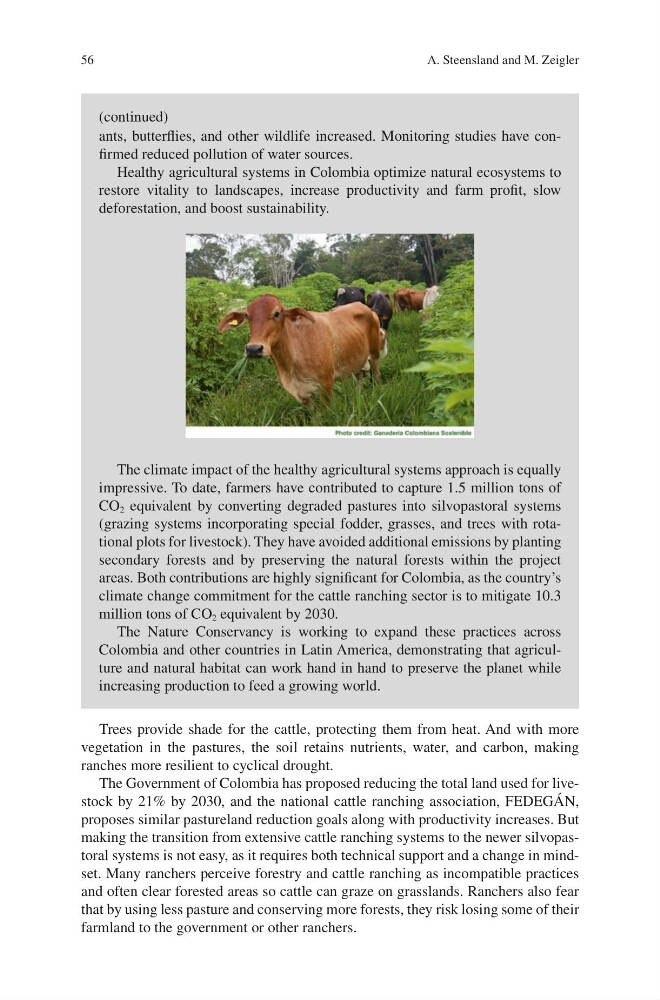
Healthy agricultural systems in Colombia optimize natural ecosystems to
restore vitality to landscapes, increase productivity and farm profit, slow
deforestation, and boost sustainability.
The climate impact of the healthy agricultural systems approach is equally
impressive. To date, farmers have contributed to capture 1.5 million tons of
CO 2 equivalent by converting degraded pastures into silvopastoral systems
(grazing systems incorporating special fodder, grasses, and trees with rotational plots for livestock). They have avoided additional emissions by planting
secondary forests and by preserving the natural forests within the project
areas. Both contributions are highly significant for Colombia, as the country’s
climate change commitment for the cattle ranching sector is to mitigate 10.3
million tons of CO 2 equivalent by 2030.
The Nature Conservancy is working to expand these practices across
Colombia and other countries in Latin America, demonstrating that agriculture and natural habitat can work hand in hand to preserve the planet while
increasing production to feed a growing world.
(continued)
A. Steensland and M. Zeigler
Trees provide shade for the cattle, protecting them from heat. And with more
vegetation in the pastures, the soil retains nutrients, water, and carbon, making
ranches more resilient to cyclical drought.
The Government of Colombia has proposed reducing the total land used for livestock by 21% by 2030, and the national cattle ranching association, FEDEGÁN,
proposes similar pastureland reduction goals along with productivity increases. But
making the transition from extensive cattle ranching systems to the newer silvopastoral systems is not easy, as it requires both technical support and a change in mindset. Many ranchers perceive forestry and cattle ranching as incompatible practices
and often clear forested areas so cattle can graze on grasslands. Ranchers also fear
that by using less pasture and conserving more forests, they risk losing some of their
farmland to the government or other ranchers.
ants, butterflies, and other wildlife increased. Monitoring studies have confirmed reduced pollution of water sources.
Healthy agricultural systems in Colombia optimize natural ecosystems to
restore vitality to landscapes, increase productivity and farm profit, slow
deforestation, and boost sustainability.
The climate impact of the healthy agricultural systems approach is equally
impressive. To date, farmers have contributed to capture 1.5 million tons of
CO 2 equivalent by converting degraded pastures into silvopastoral systems
(grazing systems incorporating special fodder, grasses, and trees with rotational plots for livestock). They have avoided additional emissions by planting
secondary forests and by preserving the natural forests within the project
areas. Both contributions are highly significant for Colombia, as the country’s
climate change commitment for the cattle ranching sector is to mitigate 10.3
million tons of CO 2 equivalent by 2030.
The Nature Conservancy is working to expand these practices across
Colombia and other countries in Latin America, demonstrating that agriculture and natural habitat can work hand in hand to preserve the planet while
increasing production to feed a growing world.
(continued)
A. Steensland and M. Zeigler