

39
land to seize the market opportunity to supply livestock feed. Better production practices and better seeds are needed.
As part of Monsanto (now Bayer AG) Vietnam’s sustainable development
efforts, more than 200,000 farmers have received training since 2015 on good
agronomic practices and hybrid corn seed selection. Seeds with beneficial
traits improved through conventional breeding and advanced biotechnology
are now becoming available for many farmers in Vietnam.
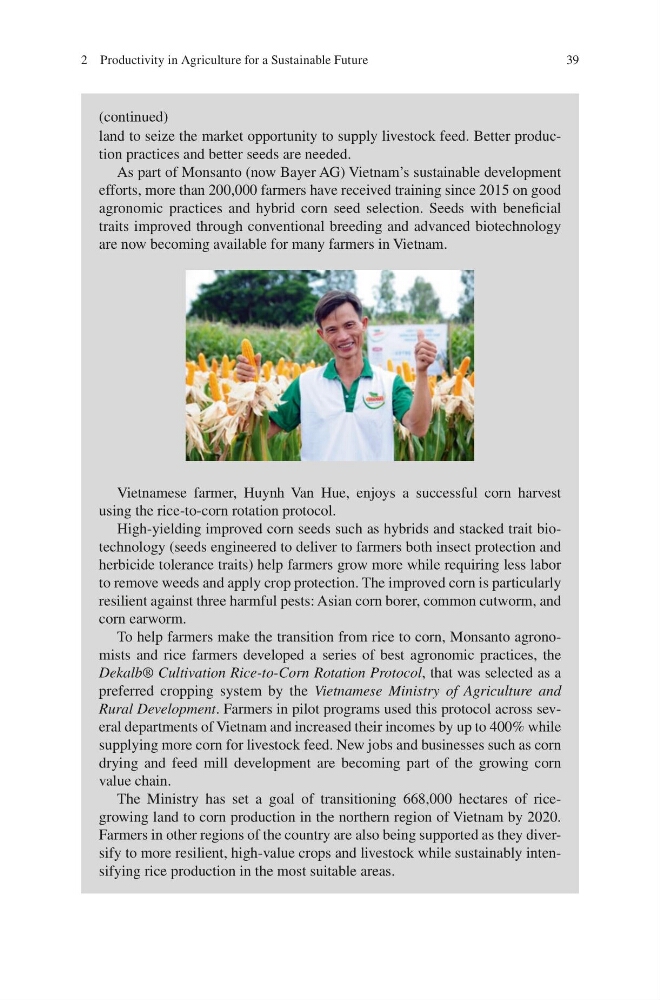
Vietnamese farmer, Huynh Van Hue, enjoys a successful corn harvest
using the rice-to-corn rotation protocol.
High-yielding improved corn seeds such as hybrids and stacked trait biotechnology (seeds engineered to deliver to farmers both insect protection and
herbicide tolerance traits) help farmers grow more while requiring less labor
to remove weeds and apply crop protection. The improved corn is particularly
resilient against three harmful pests: Asian corn borer, common cutworm, and
corn earworm.
To help farmers make the transition from rice to corn, Monsanto agronomists and rice farmers developed a series of best agronomic practices, the
Dekalb® Cultivation Rice-to-Corn Rotation Protocol, that was selected as a
preferred cropping system by the Vietnamese Ministry of Agriculture and
Rural Development. Farmers in pilot programs used this protocol across several departments of Vietnam and increased their incomes by up to 400% while
supplying more corn for livestock feed. New jobs and businesses such as corn
drying and feed mill development are becoming part of the growing corn
value chain.
The Ministry has set a goal of transitioning 668,000 hectares of ricegrowing land to corn production in the northern region of Vietnam by 2020.
Farmers in other regions of the country are also being supported as they diversify to more resilient, high-value crops and livestock while sustainably intensifying rice production in the most suitable areas.
(continued)
2 Productivity in Agriculture for a Sustainable Future
land to seize the market opportunity to supply livestock feed. Better production practices and better seeds are needed.
As part of Monsanto (now Bayer AG) Vietnam’s sustainable development
efforts, more than 200,000 farmers have received training since 2015 on good
agronomic practices and hybrid corn seed selection. Seeds with beneficial
traits improved through conventional breeding and advanced biotechnology
are now becoming available for many farmers in Vietnam.
Vietnamese farmer, Huynh Van Hue, enjoys a successful corn harvest
using the rice-to-corn rotation protocol.
High-yielding improved corn seeds such as hybrids and stacked trait biotechnology (seeds engineered to deliver to farmers both insect protection and
herbicide tolerance traits) help farmers grow more while requiring less labor
to remove weeds and apply crop protection. The improved corn is particularly
resilient against three harmful pests: Asian corn borer, common cutworm, and
corn earworm.
To help farmers make the transition from rice to corn, Monsanto agronomists and rice farmers developed a series of best agronomic practices, the
Dekalb® Cultivation Rice-to-Corn Rotation Protocol, that was selected as a
preferred cropping system by the Vietnamese Ministry of Agriculture and
Rural Development. Farmers in pilot programs used this protocol across several departments of Vietnam and increased their incomes by up to 400% while
supplying more corn for livestock feed. New jobs and businesses such as corn
drying and feed mill development are becoming part of the growing corn
value chain.
The Ministry has set a goal of transitioning 668,000 hectares of ricegrowing land to corn production in the northern region of Vietnam by 2020.
Farmers in other regions of the country are also being supported as they diversify to more resilient, high-value crops and livestock while sustainably intensifying rice production in the most suitable areas.
(continued)
2 Productivity in Agriculture for a Sustainable Future