

210
individual bird performance could have been accomplished. However, the economics of egg production and the technologies available at that time did not justify the
costs of such a system.
There are two important points illustrated by this story. One is that the desire to
link measurement of outcomes and management actions in farming is not new.
However, the economics of measurement (the cost of measurement versus the benefits of doing so), given the available technology, inhibited my father and other
farmers from capturing and exploiting more data. The second point, then, is that
measurement is both an economic and a technical issue for agricultural managers.
8.2.2 What Is or Can Be Data in Agriculture?
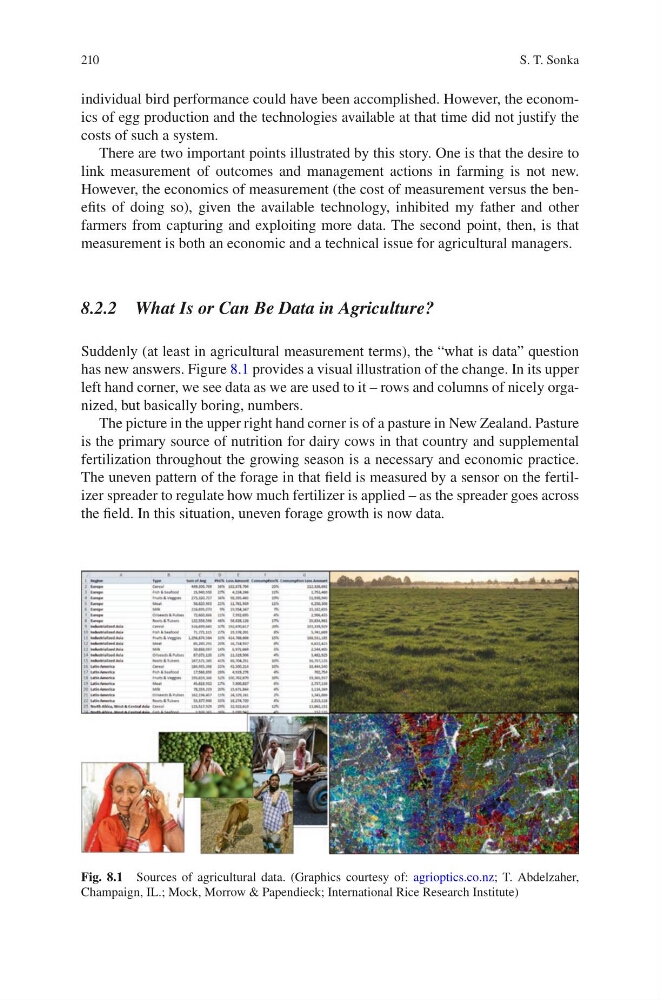
Suddenly (at least in agricultural measurement terms), the “what is data” question
has new answers. Figure 8.1 provides a visual illustration of the change. In its upper
left hand corner, we see data as we are used to it – rows and columns of nicely organized, but basically boring, numbers.
The picture in the upper right hand corner is of a pasture in New Zealand. Pasture
is the primary source of nutrition for dairy cows in that country and supplemental
fertilization throughout the growing season is a necessary and economic practice.
The uneven pattern of the forage in that field is measured by a sensor on the fertilizer spreader to regulate how much fertilizer is applied – as the spreader goes across
the field. In this situation, uneven forage growth is now data.
Fig. 8.1 Sources of agricultural data. (Graphics courtesy of: agrioptics.co.nz; T. Abdelzaher,
Champaign, IL.; Mock, Morrow & Papendieck; International Rice Research Institute)
S. T. Sonka
individual bird performance could have been accomplished. However, the economics of egg production and the technologies available at that time did not justify the
costs of such a system.
There are two important points illustrated by this story. One is that the desire to
link measurement of outcomes and management actions in farming is not new.
However, the economics of measurement (the cost of measurement versus the benefits of doing so), given the available technology, inhibited my father and other
farmers from capturing and exploiting more data. The second point, then, is that
measurement is both an economic and a technical issue for agricultural managers.
8.2.2 What Is or Can Be Data in Agriculture?
Suddenly (at least in agricultural measurement terms), the “what is data” question
has new answers. Figure 8.1 provides a visual illustration of the change. In its upper
left hand corner, we see data as we are used to it – rows and columns of nicely organized, but basically boring, numbers.
The picture in the upper right hand corner is of a pasture in New Zealand. Pasture
is the primary source of nutrition for dairy cows in that country and supplemental
fertilization throughout the growing season is a necessary and economic practice.
The uneven pattern of the forage in that field is measured by a sensor on the fertilizer spreader to regulate how much fertilizer is applied – as the spreader goes across
the field. In this situation, uneven forage growth is now data.
Fig. 8.1 Sources of agricultural data. (Graphics courtesy of: agrioptics.co.nz; T. Abdelzaher,
Champaign, IL.; Mock, Morrow & Papendieck; International Rice Research Institute)
S. T. Sonka