

184
and making agriculture, forestry, and fisheries more productive. The second, the
World Food Programme (WFP), established in 1961 as a joint FAO/UN joint venture, provides emergency food aid and humanitarian services. The third agency, the
International Fund for Agricultural Development (IFAD), formed during the food
crisis of the early 1970s, is tasked with providing improved technologies and production methods to the poorest nations of the world (Shaw 2007).
Most hungry and malnourished peoples live in rural areas and earn their livings
by working on small-scale farming, fishing, or forestry. Almost 75% of these farms,
around 375 million, are smaller than one hectare in size and provide barely enough
food for the family to live. Programs that helped rural families in times of crisis
were often extended to become permanent relief operations. While assisting in
immediate hunger and nutrition efforts, these programs did little to improve the
long-term viability and sustainability of the rural poor.
After decades of hunger relief programs, a shift in policy emerged in the 1980s.
Leading food donor nations became weary of providing excess foodstuffs to other
food deficit nations. It was becoming evident that the wholesale export of charitable
grains and foods to developing nations was hurting their ability to develop their own
sustainable agriculture economy.
6
A new “market-based” approach started to emerge
that emphasized self-sufficiency and building infrastructure to support local farmers
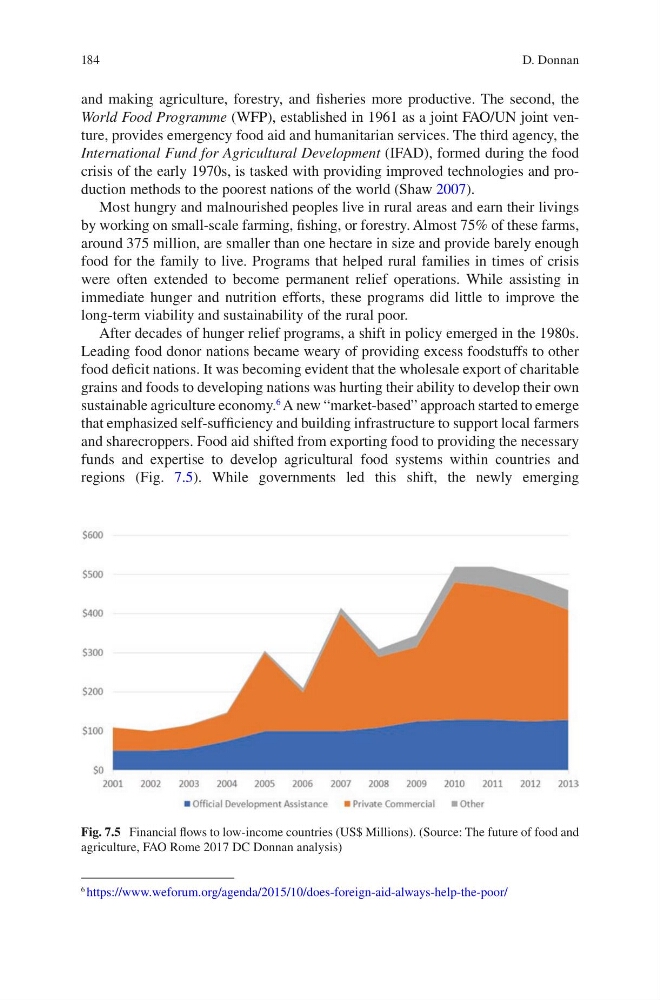
and sharecroppers. Food aid shifted from exporting food to providing the necessary
funds and expertise to develop agricultural food systems within countries and
regions (Fig. 7.5). While governments led this shift, the newly emerging
6 https://www.weforum.org/agenda/2015/10/does-foreign-aid-always-help-the-poor/
Fig. 7.5 Financial flows to low-income countries (US$ Millions). (Source: The future of food and
agriculture, FAO Rome 2017 DC Donnan analysis)
D. Donnan
and making agriculture, forestry, and fisheries more productive. The second, the
World Food Programme (WFP), established in 1961 as a joint FAO/UN joint venture, provides emergency food aid and humanitarian services. The third agency, the
International Fund for Agricultural Development (IFAD), formed during the food
crisis of the early 1970s, is tasked with providing improved technologies and production methods to the poorest nations of the world (Shaw 2007).
Most hungry and malnourished peoples live in rural areas and earn their livings
by working on small-scale farming, fishing, or forestry. Almost 75% of these farms,
around 375 million, are smaller than one hectare in size and provide barely enough
food for the family to live. Programs that helped rural families in times of crisis
were often extended to become permanent relief operations. While assisting in
immediate hunger and nutrition efforts, these programs did little to improve the
long-term viability and sustainability of the rural poor.
After decades of hunger relief programs, a shift in policy emerged in the 1980s.
Leading food donor nations became weary of providing excess foodstuffs to other
food deficit nations. It was becoming evident that the wholesale export of charitable
grains and foods to developing nations was hurting their ability to develop their own
sustainable agriculture economy.
6
A new “market-based” approach started to emerge
that emphasized self-sufficiency and building infrastructure to support local farmers
and sharecroppers. Food aid shifted from exporting food to providing the necessary
funds and expertise to develop agricultural food systems within countries and
regions (Fig. 7.5). While governments led this shift, the newly emerging
6 https://www.weforum.org/agenda/2015/10/does-foreign-aid-always-help-the-poor/
Fig. 7.5 Financial flows to low-income countries (US$ Millions). (Source: The future of food and
agriculture, FAO Rome 2017 DC Donnan analysis)
D. Donnan