

170
Box 6.6 Business Champions – Snapshot: Promo Fruits, Benin
Back in 2000, a group of pineapple producers, led by Dieudonné Alladjodjo,
unsuccessfully tried to develop different trading relations with larger offtakers in Benin, Nigeria, and the European Union. The group decided that
processing pineapple juice for the local market was more commercially viable
and created the Pineapple Recovery Initiative (IRA) cooperative, with starting
capital of US $5,000 and a processing capacity of 200 kg of pineapple per day.
The IRA cooperative gradually increased its processing capacity to 5,000 kg
per day in 2009.
Then in 2011, the IRA cooperative was transformed into a company with
limited liability (SARL) and 100% of its shares distributed among IRA member producers. The company’s processing capacity increased from 5 to 45
tons per day.
The business model of Promo Fruits is based on four pillars:
1. The company sources from small-scale pineapple producers in Benin,
including 2,580 producers grouped into nine professional organizations.
2. Promo Fruits produces 100% natural juice, for which the company has
been able to develop a national and sub-regional market.
3. The company offers producers a competitive and incentivizing price,
which motivates and retains producers and allows the factory to guarantee
its supply.
4. Promo Fruits intervenes upstream in the value chain by facilitating the
access of producers, who are members of the sourcing network, to an input
credit system.
Over the course of collaboration between Promo Fruits and 2SCALE, the
company’s management indicated the intent to focus more specifically on
BoP markets. Without changing the nature of the product (natural fruit juice),
new packaging was developed. Smaller SKUs were produced to increase
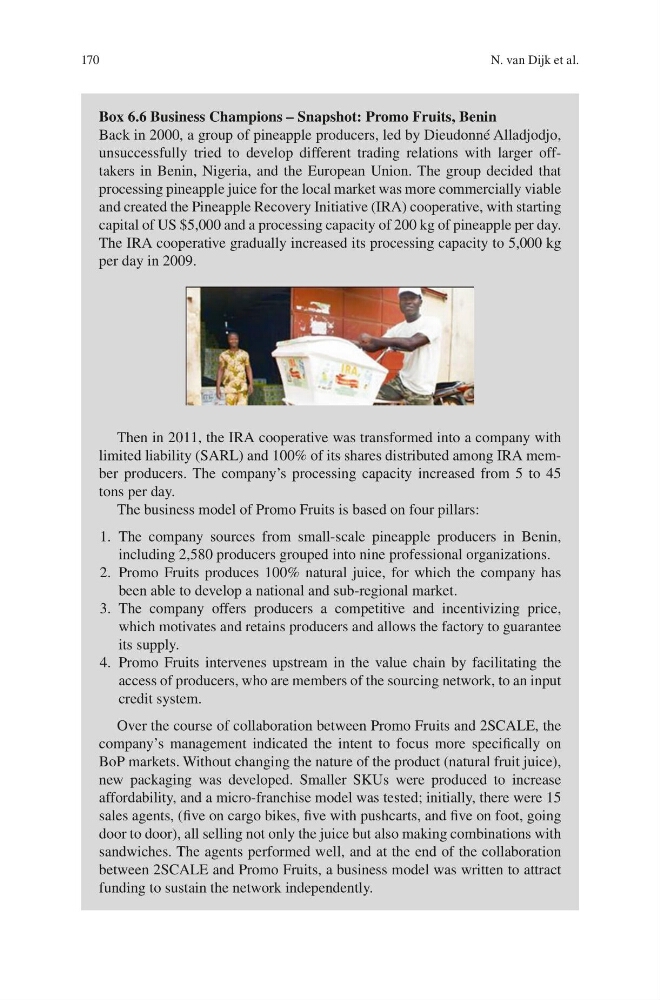
affordability, and a micro-franchise model was tested; initially, there were 15
sales agents, (five on cargo bikes, five with pushcarts, and five on foot, going
door to door), all selling not only the juice but also making combinations with
sandwiches. The agents performed well, and at the end of the collaboration
between 2SCALE and Promo Fruits, a business model was written to attract
funding to sustain the network independently.
N. van Dijk et al.
Box 6.6 Business Champions – Snapshot: Promo Fruits, Benin
Back in 2000, a group of pineapple producers, led by Dieudonné Alladjodjo,
unsuccessfully tried to develop different trading relations with larger offtakers in Benin, Nigeria, and the European Union. The group decided that
processing pineapple juice for the local market was more commercially viable
and created the Pineapple Recovery Initiative (IRA) cooperative, with starting
capital of US $5,000 and a processing capacity of 200 kg of pineapple per day.
The IRA cooperative gradually increased its processing capacity to 5,000 kg
per day in 2009.
Then in 2011, the IRA cooperative was transformed into a company with
limited liability (SARL) and 100% of its shares distributed among IRA member producers. The company’s processing capacity increased from 5 to 45
tons per day.
The business model of Promo Fruits is based on four pillars:
1. The company sources from small-scale pineapple producers in Benin,
including 2,580 producers grouped into nine professional organizations.
2. Promo Fruits produces 100% natural juice, for which the company has
been able to develop a national and sub-regional market.
3. The company offers producers a competitive and incentivizing price,
which motivates and retains producers and allows the factory to guarantee
its supply.
4. Promo Fruits intervenes upstream in the value chain by facilitating the
access of producers, who are members of the sourcing network, to an input
credit system.
Over the course of collaboration between Promo Fruits and 2SCALE, the
company’s management indicated the intent to focus more specifically on
BoP markets. Without changing the nature of the product (natural fruit juice),
new packaging was developed. Smaller SKUs were produced to increase
affordability, and a micro-franchise model was tested; initially, there were 15
sales agents, (five on cargo bikes, five with pushcarts, and five on foot, going
door to door), all selling not only the juice but also making combinations with
sandwiches. The agents performed well, and at the end of the collaboration
between 2SCALE and Promo Fruits, a business model was written to attract
funding to sustain the network independently.
N. van Dijk et al.