

2
accounts for over 50% of all employment in most countries and 35–54% of fulltime equivalent-based employment (Jayne et al. 2017). These farmers require to
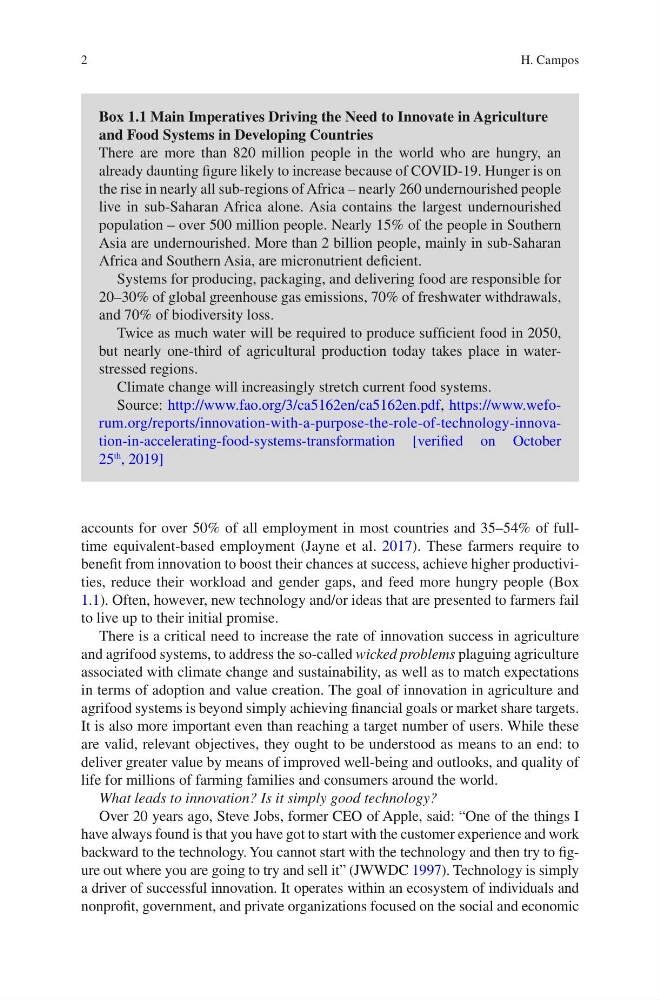
benefit from innovation to boost their chances at success, achieve higher productivities, reduce their workload and gender gaps, and feed more hungry people (Box
1.1). Often, however, new technology and/or ideas that are presented to farmers fail
to live up to their initial promise.
There is a critical need to increase the rate of innovation success in agriculture
and agrifood systems, to address the so-called wicked problems plaguing agriculture
associated with climate change and sustainability, as well as to match expectations
in terms of adoption and value creation. The goal of innovation in agriculture and
agrifood systems is beyond simply achieving financial goals or market share targets.
It is also more important even than reaching a target number of users. While these
are valid, relevant objectives, they ought to be understood as means to an end: to
deliver greater value by means of improved well-being and outlooks, and quality of
life for millions of farming families and consumers around the world.
What leads to innovation? Is it simply good technology?
Over 20 years ago, Steve Jobs, former CEO of Apple, said: “One of the things I
have always found is that you have got to start with the customer experience and work
backward to the technology. You cannot start with the technology and then try to figure out where you are going to try and sell it” (JWWDC 1997). Technology is simply
a driver of successful innovation. It operates within an ecosystem of individuals and
nonprofit, government, and private organizations focused on the social and economic
Box 1.1 Main Imperatives Driving the Need to Innovate in Agriculture
and Food Systems in Developing Countries
There are more than 820 million people in the world who are hungry, an
already daunting figure likely to increase because of COVID-19. Hunger is on
the rise in nearly all sub-regions of Africa – nearly 260 undernourished people
live in sub-Saharan Africa alone. Asia contains the largest undernourished
population – over 500 million people. Nearly 15% of the people in Southern
Asia are undernourished. More than 2 billion people, mainly in sub-Saharan
Africa and Southern Asia, are micronutrient deficient.
Systems for producing, packaging, and delivering food are responsible for
20–30% of global greenhouse gas emissions, 70% of freshwater withdrawals,
and 70% of biodiversity loss.
Twice as much water will be required to produce sufficient food in 2050,
but nearly one-third of agricultural production today takes place in waterstressed regions.
Climate change will increasingly stretch current food systems.
rum.org/reports/innovation-with-a-purpose-the-role-of-technology-innovation-in-accelerating-food-systems-transformation [verified on October
25
th
, 2019]
H. Campos
accounts for over 50% of all employment in most countries and 35–54% of fulltime equivalent-based employment (Jayne et al. 2017). These farmers require to
benefit from innovation to boost their chances at success, achieve higher productivities, reduce their workload and gender gaps, and feed more hungry people (Box
1.1). Often, however, new technology and/or ideas that are presented to farmers fail
to live up to their initial promise.
There is a critical need to increase the rate of innovation success in agriculture
and agrifood systems, to address the so-called wicked problems plaguing agriculture
associated with climate change and sustainability, as well as to match expectations
in terms of adoption and value creation. The goal of innovation in agriculture and
agrifood systems is beyond simply achieving financial goals or market share targets.
It is also more important even than reaching a target number of users. While these
are valid, relevant objectives, they ought to be understood as means to an end: to
deliver greater value by means of improved well-being and outlooks, and quality of
life for millions of farming families and consumers around the world.
What leads to innovation? Is it simply good technology?
Over 20 years ago, Steve Jobs, former CEO of Apple, said: “One of the things I
have always found is that you have got to start with the customer experience and work
backward to the technology. You cannot start with the technology and then try to figure out where you are going to try and sell it” (JWWDC 1997). Technology is simply
a driver of successful innovation. It operates within an ecosystem of individuals and
nonprofit, government, and private organizations focused on the social and economic
Box 1.1 Main Imperatives Driving the Need to Innovate in Agriculture
and Food Systems in Developing Countries
There are more than 820 million people in the world who are hungry, an
already daunting figure likely to increase because of COVID-19. Hunger is on
the rise in nearly all sub-regions of Africa – nearly 260 undernourished people
live in sub-Saharan Africa alone. Asia contains the largest undernourished
population – over 500 million people. Nearly 15% of the people in Southern
Asia are undernourished. More than 2 billion people, mainly in sub-Saharan
Africa and Southern Asia, are micronutrient deficient.
Systems for producing, packaging, and delivering food are responsible for
20–30% of global greenhouse gas emissions, 70% of freshwater withdrawals,
and 70% of biodiversity loss.
Twice as much water will be required to produce sufficient food in 2050,
but nearly one-third of agricultural production today takes place in waterstressed regions.
Climate change will increasingly stretch current food systems.
rum.org/reports/innovation-with-a-purpose-the-role-of-technology-innovation-in-accelerating-food-systems-transformation [verified on October
25
th
, 2019]
H. Campos