

165
• Appeals to the customer
• Is distinct from the competition
• Represents the values of the organization
The relevant tools for this strategy are the persona, value proposition, and branding. As an example, 2SCALE supported Shalem Investments in Kenya in product
and brand strategy, developing a nutritious porridge targeted at the BoP (Box 6.4).
The first step was to develop a product formula that met the nutritional needs and
taste palate of the Kenyan BoP consumer. Once the product formula was finalized,
the key challenge was to develop a brand strategy and packaging design. To ensure
the brand appealed to the customer, Shalem conducted consumer research. The key
conclusion from this work was that customers were highly aspirational and concerned by the quality of the product. To meet these preferences, Shalem developed
a modern and colorful brand in quality, printed pouches – ensuring that the product
had a high sense of perceived quality. This strategy directly allowed Shalem to differentiate itself from its competitors, who were mostly still using printed paper bags
with limited colors. Finally, Shalem had a strong vision for its organization that was
incorporated in the new packaging design: embracing an energetic and empowering
view on providing quality nutrition.
Box 6.4 Business Champions – Snapshot: Shalem, Kenya
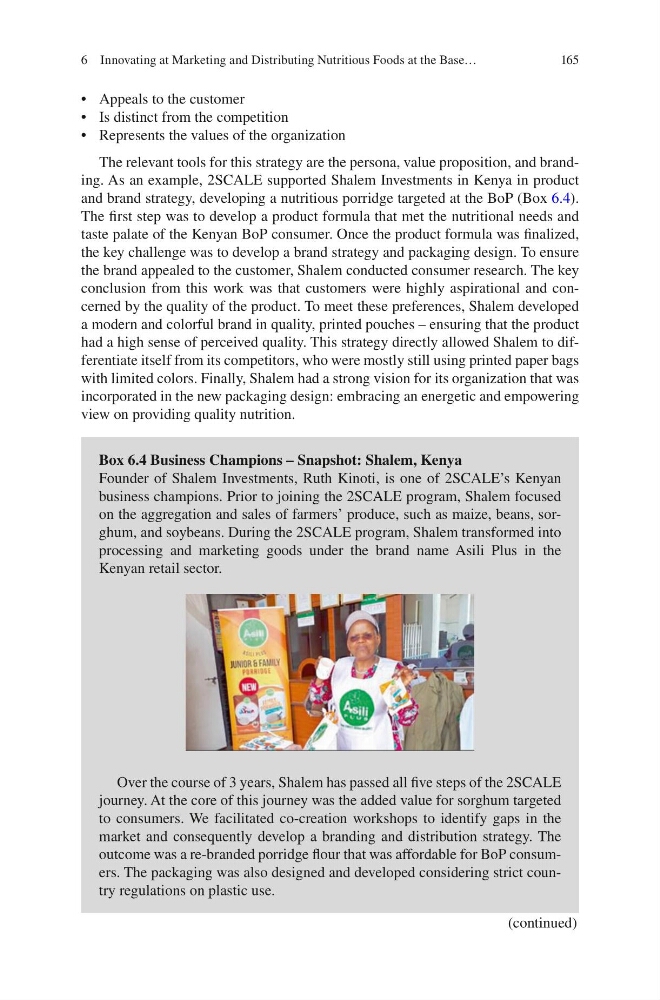
Founder of Shalem Investments, Ruth Kinoti, is one of 2SCALE’s Kenyan
business champions. Prior to joining the 2SCALE program, Shalem focused
on the aggregation and sales of farmers’ produce, such as maize, beans, sorghum, and soybeans. During the 2SCALE program, Shalem transformed into
processing and marketing goods under the brand name Asili Plus in the
Kenyan retail sector.
Over the course of 3 years, Shalem has passed all five steps of the 2SCALE
journey. At the core of this journey was the added value for sorghum targeted
to consumers. We facilitated co-creation workshops to identify gaps in the
market and consequently develop a branding and distribution strategy. The
outcome was a re-branded porridge flour that was affordable for BoP consumers. The packaging was also designed and developed considering strict country regulations on plastic use.
(continued)
6 Innovating at Marketing and Distributing Nutritious Foods at the Base…
• Appeals to the customer
• Is distinct from the competition
• Represents the values of the organization
The relevant tools for this strategy are the persona, value proposition, and branding. As an example, 2SCALE supported Shalem Investments in Kenya in product
and brand strategy, developing a nutritious porridge targeted at the BoP (Box 6.4).
The first step was to develop a product formula that met the nutritional needs and
taste palate of the Kenyan BoP consumer. Once the product formula was finalized,
the key challenge was to develop a brand strategy and packaging design. To ensure
the brand appealed to the customer, Shalem conducted consumer research. The key
conclusion from this work was that customers were highly aspirational and concerned by the quality of the product. To meet these preferences, Shalem developed
a modern and colorful brand in quality, printed pouches – ensuring that the product
had a high sense of perceived quality. This strategy directly allowed Shalem to differentiate itself from its competitors, who were mostly still using printed paper bags
with limited colors. Finally, Shalem had a strong vision for its organization that was
incorporated in the new packaging design: embracing an energetic and empowering
view on providing quality nutrition.
Box 6.4 Business Champions – Snapshot: Shalem, Kenya
Founder of Shalem Investments, Ruth Kinoti, is one of 2SCALE’s Kenyan
business champions. Prior to joining the 2SCALE program, Shalem focused
on the aggregation and sales of farmers’ produce, such as maize, beans, sorghum, and soybeans. During the 2SCALE program, Shalem transformed into
processing and marketing goods under the brand name Asili Plus in the
Kenyan retail sector.
Over the course of 3 years, Shalem has passed all five steps of the 2SCALE
journey. At the core of this journey was the added value for sorghum targeted
to consumers. We facilitated co-creation workshops to identify gaps in the
market and consequently develop a branding and distribution strategy. The
outcome was a re-branded porridge flour that was affordable for BoP consumers. The packaging was also designed and developed considering strict country regulations on plastic use.
(continued)
6 Innovating at Marketing and Distributing Nutritious Foods at the Base…