

109
to existing and/or alternative practices. In other words, what are the reasons that
underpin current practices and interaction patterns and/or what are the reasons that
actors have for rejecting alternative practices and courses of action? The ‘reasons
for (non)adoption’ model (Figs. 4.2 and 4.3) offers several entry points of investigating and diagnosing these.
First, the model offers a more elaborate overview of relevant variables than
social-psychological models, which can be used to describe and analyse people’s
rationale. For example, if one wants to understand why farmers refuse to spray
against a disease, one may consider how this relates to their knowledge (how do
they understand the disease dynamics?), their feelings of responsibility (do they feel
responsible for combating the disease?), their values (how important is the crop for
them?), the social influence or social pressures experienced (what do others expect
and what sanctions or incentives are in place?), their trust in others (are farmers
confident that others will spray as well and/or that the agro-dealer sells the right
chemicals?) and their individual abilities (are farmers confident that they have the
right skills and equipment for spraying and/or can they afford to obtain these?).
Disentangling people’s rationale in relation to several practices in an assemblage
helps to understand what the most important bottlenecks or leverages may be.
Simultaneously, this offers entry points for intervention: if farmers refuse to spray
because they do not understand the dynamics of the disease, then it makes sense to
invest in interventions that foster awareness raising and learning. However, if farmers do not feel responsible or do not trust that their neighbours will also spray, then
other types of strategies will have to be considered.
A second entry point for diagnostic analyses offered by the model is to focus on
the formal and informal institutions that orient people’s considerations and ways of
thinking. When the purpose is to develop a scaling strategy, such analysis of people’s rationales and underlying institutions needs to be combined with an assessment of which critically bottlenecks and leverages may be(come) amenable to
change and what types of interventions (ranging from persuasive campaigns to
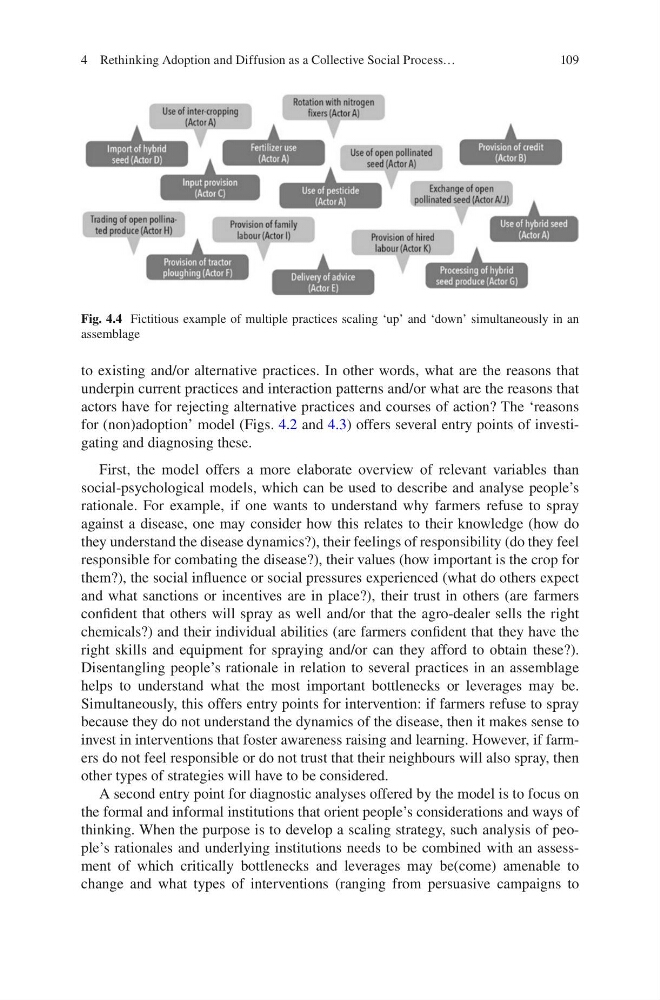
Fig. 4.4 Fictitious example of multiple practices scaling ‘up’ and ‘down’ simultaneously in an
assemblage
4 Rethinking Adoption and Diffusion as a Collective Social Process…
to existing and/or alternative practices. In other words, what are the reasons that
underpin current practices and interaction patterns and/or what are the reasons that
actors have for rejecting alternative practices and courses of action? The ‘reasons
for (non)adoption’ model (Figs. 4.2 and 4.3) offers several entry points of investigating and diagnosing these.
First, the model offers a more elaborate overview of relevant variables than
social-psychological models, which can be used to describe and analyse people’s
rationale. For example, if one wants to understand why farmers refuse to spray
against a disease, one may consider how this relates to their knowledge (how do
they understand the disease dynamics?), their feelings of responsibility (do they feel
responsible for combating the disease?), their values (how important is the crop for
them?), the social influence or social pressures experienced (what do others expect
and what sanctions or incentives are in place?), their trust in others (are farmers
confident that others will spray as well and/or that the agro-dealer sells the right
chemicals?) and their individual abilities (are farmers confident that they have the
right skills and equipment for spraying and/or can they afford to obtain these?).
Disentangling people’s rationale in relation to several practices in an assemblage
helps to understand what the most important bottlenecks or leverages may be.
Simultaneously, this offers entry points for intervention: if farmers refuse to spray
because they do not understand the dynamics of the disease, then it makes sense to
invest in interventions that foster awareness raising and learning. However, if farmers do not feel responsible or do not trust that their neighbours will also spray, then
other types of strategies will have to be considered.
A second entry point for diagnostic analyses offered by the model is to focus on
the formal and informal institutions that orient people’s considerations and ways of
thinking. When the purpose is to develop a scaling strategy, such analysis of people’s rationales and underlying institutions needs to be combined with an assessment of which critically bottlenecks and leverages may be(come) amenable to
change and what types of interventions (ranging from persuasive campaigns to
Fig. 4.4 Fictitious example of multiple practices scaling ‘up’ and ‘down’ simultaneously in an
assemblage
4 Rethinking Adoption and Diffusion as a Collective Social Process…