

97
hand. Some of these perceptions are in fact reconfigured during the adoption process; based on information acquired, a person’s perception of the situation and/or
the perception of the relative advantages of the innovation may change.
Rogers seminal synthesis has been amended and developed further since its
appearance in 1962 (see Rogers 1995). Moreover, the overall perspective and largely
linear paradigm that it reflects have been criticised sharply (see, e.g. Leeuwis 2004).
4.2.2 Social-Psychological Follow-Up
Rogers’ focus on individual decision-making has inspired many scholars to apply
social-psychological theories and models to the issue of adoption (Taherdoost
2018). Such models include the theory of reasoned action (TRA, Fishbein and
Ajzen 1975), the theory of planned behaviour (TPB, Ajzen 1985, 1991), different
versions of the technology acceptance model (Davis et al. 1989; Venkatesh and
Davis 2000), social cognitive theory (SCT, Rana and Dwivedi 2015) and uses and
gratification theory (U&G, West and Turner 2010). Several such models were integrated in the unified theory of acceptance and use of technology (UTAUT) by
Venkatesh et al. (2003).
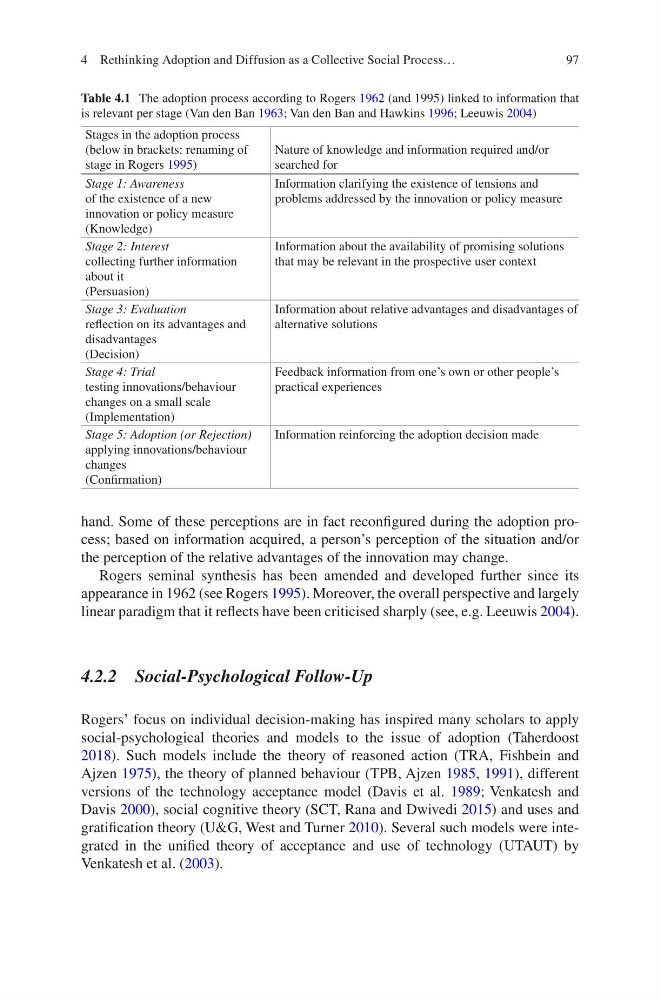
Table 4.1 The adoption process according to Rogers 1962 (and 1995) linked to information that
is relevant per stage (Van den Ban 1963; Van den Ban and Hawkins 1996; Leeuwis 2004)
Stages in the adoption process
(below in brackets: renaming of
stage in Rogers 1995)
Nature of knowledge and information required and/or
searched for
Stage 1: Awareness
of the existence of a new
innovation or policy measure
(Knowledge)
Information clarifying the existence of tensions and
problems addressed by the innovation or policy measure
Stage 2: Interest
collecting further information
about it
(Persuasion)
Information about the availability of promising solutions
that may be relevant in the prospective user context
Stage 3: Evaluation
reflection on its advantages and
disadvantages
(Decision)
Information about relative advantages and disadvantages of
alternative solutions
Stage 4: Trial
testing innovations/behaviour
changes on a small scale
(Implementation)
Feedback information from one’s own or other people’s
practical experiences
Stage 5: Adoption (or Rejection)
applying innovations/behaviour
changes
(Confirmation)
Information reinforcing the adoption decision made
4 Rethinking Adoption and Diffusion as a Collective Social Process…
hand. Some of these perceptions are in fact reconfigured during the adoption process; based on information acquired, a person’s perception of the situation and/or
the perception of the relative advantages of the innovation may change.
Rogers seminal synthesis has been amended and developed further since its
appearance in 1962 (see Rogers 1995). Moreover, the overall perspective and largely
linear paradigm that it reflects have been criticised sharply (see, e.g. Leeuwis 2004).
4.2.2 Social-Psychological Follow-Up
Rogers’ focus on individual decision-making has inspired many scholars to apply
social-psychological theories and models to the issue of adoption (Taherdoost
2018). Such models include the theory of reasoned action (TRA, Fishbein and
Ajzen 1975), the theory of planned behaviour (TPB, Ajzen 1985, 1991), different
versions of the technology acceptance model (Davis et al. 1989; Venkatesh and
Davis 2000), social cognitive theory (SCT, Rana and Dwivedi 2015) and uses and
gratification theory (U&G, West and Turner 2010). Several such models were integrated in the unified theory of acceptance and use of technology (UTAUT) by
Venkatesh et al. (2003).
Table 4.1 The adoption process according to Rogers 1962 (and 1995) linked to information that
is relevant per stage (Van den Ban 1963; Van den Ban and Hawkins 1996; Leeuwis 2004)
Stages in the adoption process
(below in brackets: renaming of
stage in Rogers 1995)
Nature of knowledge and information required and/or
searched for
Stage 1: Awareness
of the existence of a new
innovation or policy measure
(Knowledge)
Information clarifying the existence of tensions and
problems addressed by the innovation or policy measure
Stage 2: Interest
collecting further information
about it
(Persuasion)
Information about the availability of promising solutions
that may be relevant in the prospective user context
Stage 3: Evaluation
reflection on its advantages and
disadvantages
(Decision)
Information about relative advantages and disadvantages of
alternative solutions
Stage 4: Trial
testing innovations/behaviour
changes on a small scale
(Implementation)
Feedback information from one’s own or other people’s
practical experiences
Stage 5: Adoption (or Rejection)
applying innovations/behaviour
changes
(Confirmation)
Information reinforcing the adoption decision made
4 Rethinking Adoption and Diffusion as a Collective Social Process…