

and can produce some MSDs, such as low back
pain and neck shoulder pain. This study, therefore,
will fill the research gaps by providing an innovative ergonomically desktop–chair design based on
students’ anthropometric measurements. Thus, it will
make a contribution to the existing literature on
the compatibility between classroom desktop–chair
dimensions and students’ anthropometric characteristics, and improve the performance of students in
terms of attentiveness while professors or instructors
are teaching them.
3 RESEARCH METHODOLOGY
The entire methodology of the study can be divided
into the steps that are described in Figure 1.
Figure 1. Main steps of the study methods.
3.1 Sample determination
Four higher institutions in Uasin Gishu County, Kenya,
namely, (i) Moi University (MU), (ii) University of
Eldoret (UoE), (iii) Rift Valley Technical Training
Institute (RVTTI), and (iv) The Eldoret National Polytechnic (TENP), were selected to participate in the
study. The students sample in the study was three
hundred and eighty-two, through the use of equations
given by Madara (2016):
Students per institutions
Total number of students in institutions
∗ Sample size
3.2 Body dimensions
The design of standard furniture needs the direct
involvement of anthropometric measurements. Various researchers (Igbokwe, Osueke, Opara, Ileagu,
& Ezeakaibeya 2019b) have recommended the body
dimensions which are essential in designing furniture,
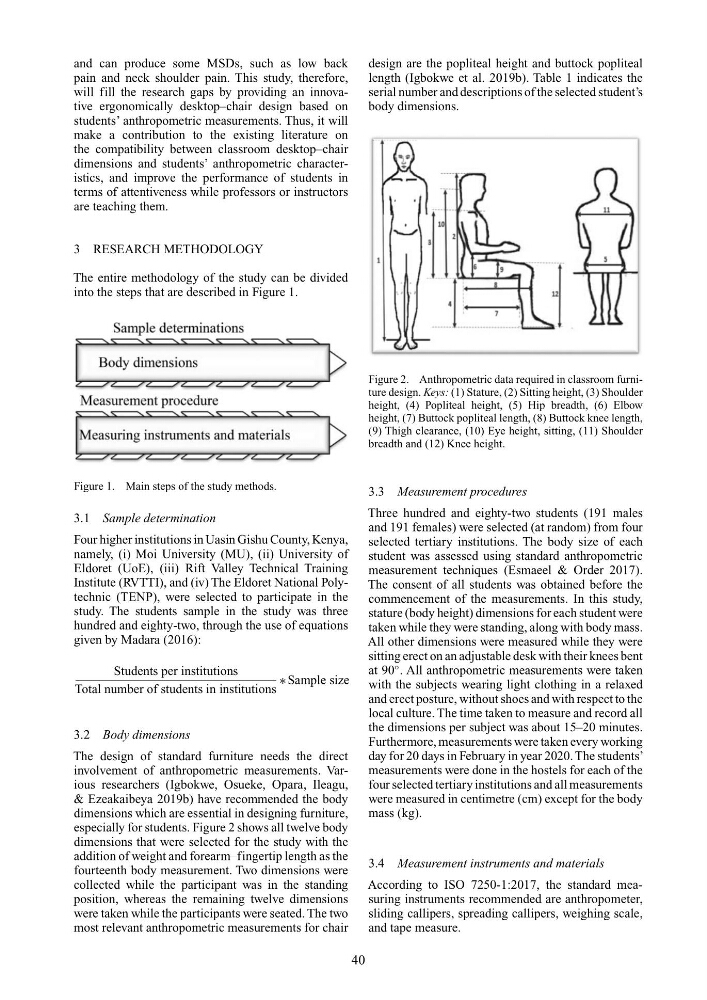
especially for students. Figure 2 shows all twelve body
dimensions that were selected for the study with the
addition of weight and forearm–fingertip length as the
fourteenth body measurement. Two dimensions were
collected while the participant was in the standing
position, whereas the remaining twelve dimensions
were taken while the participants were seated. The two
most relevant anthropometric measurements for chair
design are the popliteal height and buttock popliteal
length (Igbokwe et al. 2019b). Table 1 indicates the
serial number and descriptions of the selected student’s
body dimensions.
Figure 2. Anthropometric data required in classroom furniture design. Keys: (1) Stature, (2) Sitting height, (3) Shoulder
height, (4) Popliteal height, (5) Hip breadth, (6) Elbow
height, (7) Buttock popliteal length, (8) Buttock knee length,
(9) Thigh clearance, (10) Eye height, sitting, (11) Shoulder
breadth and (12) Knee height.
3.3 Measurement procedures
Three hundred and eighty-two students (191 males
and 191 females) were selected (at random) from four
selected tertiary institutions. The body size of each
student was assessed using standard anthropometric
measurement techniques (Esmaeel & Order 2017).
The consent of all students was obtained before the
commencement of the measurements. In this study,
stature (body height) dimensions for each student were
taken while they were standing, along with body mass.
All other dimensions were measured while they were
sitting erect on an adjustable desk with their knees bent
at 90
◦ . All anthropometric measurements were taken
with the subjects wearing light clothing in a relaxed
and erect posture, without shoes and with respect to the
local culture. The time taken to measure and record all
the dimensions per subject was about 15–20 minutes.
Furthermore, measurements were taken every working
day for 20 days in February in year 2020. The students’
measurements were done in the hostels for each of the
four selected tertiary institutions and all measurements
were measured in centimetre (cm) except for the body
mass (kg).
3.4 Measurement instruments and materials
According to ISO 7250-1:2017, the standard measuring instruments recommended are anthropometer,
sliding callipers, spreading callipers, weighing scale,
and tape measure.
40
pain and neck shoulder pain. This study, therefore,
will fill the research gaps by providing an innovative ergonomically desktop–chair design based on
students’ anthropometric measurements. Thus, it will
make a contribution to the existing literature on
the compatibility between classroom desktop–chair
dimensions and students’ anthropometric characteristics, and improve the performance of students in
terms of attentiveness while professors or instructors
are teaching them.
3 RESEARCH METHODOLOGY
The entire methodology of the study can be divided
into the steps that are described in Figure 1.
Figure 1. Main steps of the study methods.
3.1 Sample determination
Four higher institutions in Uasin Gishu County, Kenya,
namely, (i) Moi University (MU), (ii) University of
Eldoret (UoE), (iii) Rift Valley Technical Training
Institute (RVTTI), and (iv) The Eldoret National Polytechnic (TENP), were selected to participate in the
study. The students sample in the study was three
hundred and eighty-two, through the use of equations
given by Madara (2016):
Students per institutions
Total number of students in institutions
∗ Sample size
3.2 Body dimensions
The design of standard furniture needs the direct
involvement of anthropometric measurements. Various researchers (Igbokwe, Osueke, Opara, Ileagu,
& Ezeakaibeya 2019b) have recommended the body
dimensions which are essential in designing furniture,
especially for students. Figure 2 shows all twelve body
dimensions that were selected for the study with the
addition of weight and forearm–fingertip length as the
fourteenth body measurement. Two dimensions were
collected while the participant was in the standing
position, whereas the remaining twelve dimensions
were taken while the participants were seated. The two
most relevant anthropometric measurements for chair
design are the popliteal height and buttock popliteal
length (Igbokwe et al. 2019b). Table 1 indicates the
serial number and descriptions of the selected student’s
body dimensions.
Figure 2. Anthropometric data required in classroom furniture design. Keys: (1) Stature, (2) Sitting height, (3) Shoulder
height, (4) Popliteal height, (5) Hip breadth, (6) Elbow
height, (7) Buttock popliteal length, (8) Buttock knee length,
(9) Thigh clearance, (10) Eye height, sitting, (11) Shoulder
breadth and (12) Knee height.
3.3 Measurement procedures
Three hundred and eighty-two students (191 males
and 191 females) were selected (at random) from four
selected tertiary institutions. The body size of each
student was assessed using standard anthropometric
measurement techniques (Esmaeel & Order 2017).
The consent of all students was obtained before the
commencement of the measurements. In this study,
stature (body height) dimensions for each student were
taken while they were standing, along with body mass.
All other dimensions were measured while they were
sitting erect on an adjustable desk with their knees bent
at 90
◦ . All anthropometric measurements were taken
with the subjects wearing light clothing in a relaxed
and erect posture, without shoes and with respect to the
local culture. The time taken to measure and record all
the dimensions per subject was about 15–20 minutes.
Furthermore, measurements were taken every working
day for 20 days in February in year 2020. The students’
measurements were done in the hostels for each of the
four selected tertiary institutions and all measurements
were measured in centimetre (cm) except for the body
mass (kg).
3.4 Measurement instruments and materials
According to ISO 7250-1:2017, the standard measuring instruments recommended are anthropometer,
sliding callipers, spreading callipers, weighing scale,
and tape measure.
40