

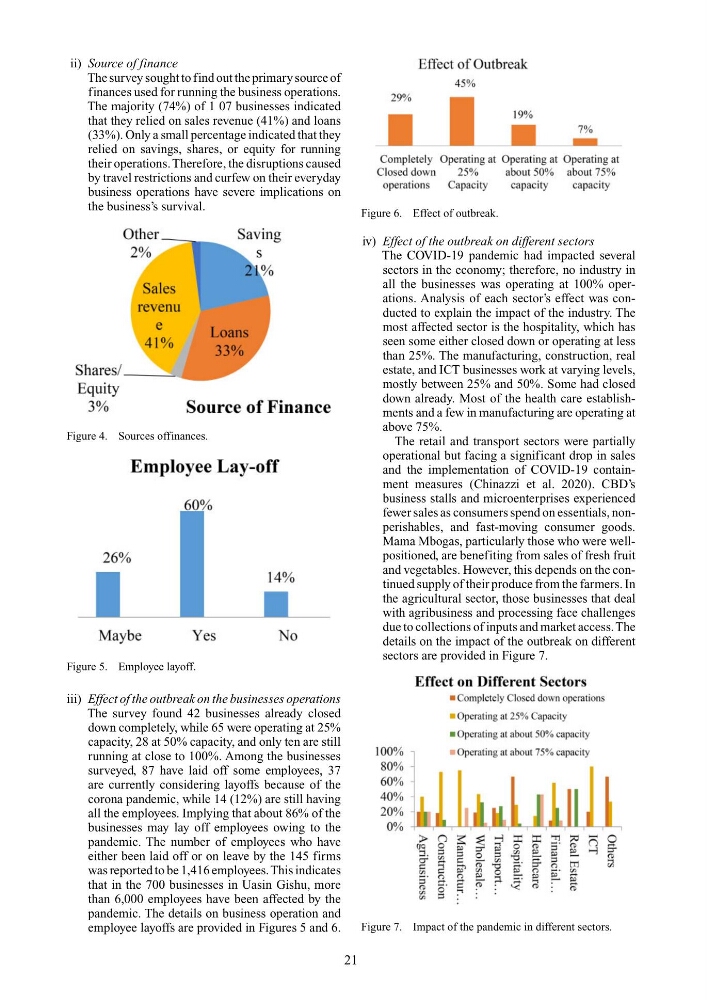
ii) Source of finance
The survey sought to find out the primary source of
finances used for running the business operations.
The majority (74%) of 1 07 businesses indicated
that they relied on sales revenue (41%) and loans
(33%). Only a small percentage indicated that they
relied on savings, shares, or equity for running
their operations. Therefore, the disruptions caused
by travel restrictions and curfew on their everyday
business operations have severe implications on
the business’s survival.
Figure 4. Sources offinances.
Figure 5. Employee layoff.
iii) Effect of the outbreak on the businesses operations
The survey found 42 businesses already closed
down completely, while 65 were operating at 25%
capacity, 28 at 50% capacity, and only ten are still
running at close to 100%. Among the businesses
surveyed, 87 have laid off some employees, 37
are currently considering layoffs because of the
corona pandemic, while 14 (12%) are still having
all the employees. Implying that about 86% of the
businesses may lay off employees owing to the
pandemic. The number of employees who have
either been laid off or on leave by the 145 firms
was reported to be 1,416 employees. This indicates
that in the 700 businesses in Uasin Gishu, more
than 6,000 employees have been affected by the
pandemic. The details on business operation and
employee layoffs are provided in Figures 5 and 6.
Figure 6. Effect of outbreak.
iv) Effect of the outbreak on different sectors
The COVID-19 pandemic had impacted several
sectors in the economy; therefore, no industry in
all the businesses was operating at 100% operations. Analysis of each sector’s effect was conducted to explain the impact of the industry. The
most affected sector is the hospitality, which has
seen some either closed down or operating at less
than 25%. The manufacturing, construction, real
estate, and ICT businesses work at varying levels,
mostly between 25% and 50%. Some had closed
down already. Most of the health care establishments and a few in manufacturing are operating at
above 75%.
The retail and transport sectors were partially
operational but facing a significant drop in sales
and the implementation of COVID-19 containment measures (Chinazzi et al. 2020). CBD’s
business stalls and microenterprises experienced
fewer sales as consumers spend on essentials, nonperishables, and fast-moving consumer goods.
Mama Mbogas, particularly those who were wellpositioned, are benefiting from sales of fresh fruit
and vegetables. However, this depends on the continued supply of their produce from the farmers. In
the agricultural sector, those businesses that deal
with agribusiness and processing face challenges
due to collections of inputs and market access. The
details on the impact of the outbreak on different
sectors are provided in Figure 7.
Figure 7. Impact of the pandemic in different sectors.
21
The survey sought to find out the primary source of
finances used for running the business operations.
The majority (74%) of 1 07 businesses indicated
that they relied on sales revenue (41%) and loans
(33%). Only a small percentage indicated that they
relied on savings, shares, or equity for running
their operations. Therefore, the disruptions caused
by travel restrictions and curfew on their everyday
business operations have severe implications on
the business’s survival.
Figure 4. Sources offinances.
Figure 5. Employee layoff.
iii) Effect of the outbreak on the businesses operations
The survey found 42 businesses already closed
down completely, while 65 were operating at 25%
capacity, 28 at 50% capacity, and only ten are still
running at close to 100%. Among the businesses
surveyed, 87 have laid off some employees, 37
are currently considering layoffs because of the
corona pandemic, while 14 (12%) are still having
all the employees. Implying that about 86% of the
businesses may lay off employees owing to the
pandemic. The number of employees who have
either been laid off or on leave by the 145 firms
was reported to be 1,416 employees. This indicates
that in the 700 businesses in Uasin Gishu, more
than 6,000 employees have been affected by the
pandemic. The details on business operation and
employee layoffs are provided in Figures 5 and 6.
Figure 6. Effect of outbreak.
iv) Effect of the outbreak on different sectors
The COVID-19 pandemic had impacted several
sectors in the economy; therefore, no industry in
all the businesses was operating at 100% operations. Analysis of each sector’s effect was conducted to explain the impact of the industry. The
most affected sector is the hospitality, which has
seen some either closed down or operating at less
than 25%. The manufacturing, construction, real
estate, and ICT businesses work at varying levels,
mostly between 25% and 50%. Some had closed
down already. Most of the health care establishments and a few in manufacturing are operating at
above 75%.
The retail and transport sectors were partially
operational but facing a significant drop in sales
and the implementation of COVID-19 containment measures (Chinazzi et al. 2020). CBD’s
business stalls and microenterprises experienced
fewer sales as consumers spend on essentials, nonperishables, and fast-moving consumer goods.
Mama Mbogas, particularly those who were wellpositioned, are benefiting from sales of fresh fruit
and vegetables. However, this depends on the continued supply of their produce from the farmers. In
the agricultural sector, those businesses that deal
with agribusiness and processing face challenges
due to collections of inputs and market access. The
details on the impact of the outbreak on different
sectors are provided in Figure 7.
Figure 7. Impact of the pandemic in different sectors.
21